
Buy PDF guide

Buy PDF guide — 25.71 USD

PDF — 25.71 USD

GOLDEN RING

GOLDEN RING

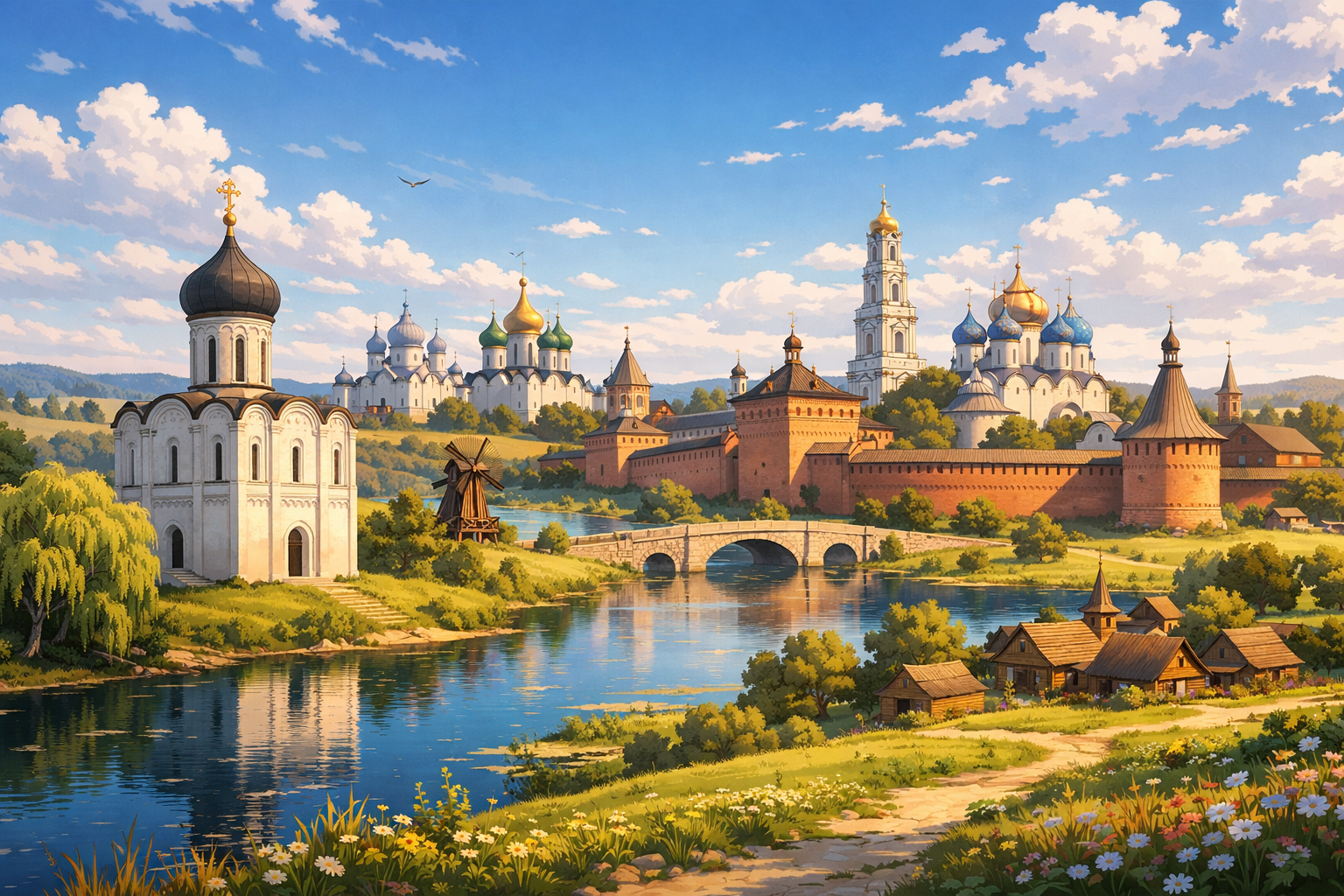
Arrive in Moscow and trace the Golden Ring through Sergiev Posad, Pereslavl-Zalessky, Rostov Veliky, Yaroslavl, Kostroma, Ivanovo, Suzdal, and Vladimir/Bogolyubovo—an arc of kremlins, white-stone cathedrals, and quiet riverside streets. Return to the capital with bell chimes in your ears and sunset gleaming off blue-and-gold cupolas.

🧭 DAY-BY-DAY ROUTE

Ready-made country and city routes with daily plans, sights, transport and accommodation. Buy PDF guides for independent travel.

🧭 DAY-BY-DAY ROUTE


Day 1 — Moscow → Sergiev Posad: the “gateway” to the Golden Ring

  • ✈️/🚄 Arrival in Moscow. Convenient transfer from the airports to the center — express trains to the railway stations; then a suburban train on the Yaroslavl line to Sergiev Posad (plan to leave no later than noon so you can catch the first views of the Lavra during the day).

  • 😶 Evening walk around the Holy Trinity St. Sergius Lavra: massive walls, bell towers, and cathedrals in soft light emphasize the monastery’s “fortress” character and its rich palette of white-and-azure, golden, and tile accents. Viewpoints by the ponds and along the perimeter of the ramparts offer complete panoramas of the ensemble.


Day 2 — Sergiev Posad: the Lavra + a museum “key” to Old Russian art

  • 😶 The Holy Trinity St. Sergius Lavra is the core of the spiritual and artistic tradition of Northeastern Rus'. Look not only at the iconostases and frescoes, but also at the breadth of the spaces: from paved courtyards and the vaults of the monks’ cells to the massing of the cathedrals and bell towers. Trinity Cathedral, Assumption Cathedral, and the gate churches form an “orchestra” of volumes in which each era left its own timbre.

  • 😶 The Sergiev Posad Museum-Reserve (the “Horse Yard” exhibitions) provides excellent context for what you’ve seen: icon painting, wood carving, everyday objects. After the museum, the Lavra’s architectural details “clarify”: you grasp the logic of the workshops and the evolution of forms.

Day 3 — Sergiev Posad → Pereslavl-Zalessky: princely foundations and Lake Pleshcheyevo

  • 🚌 Bus transfer: Sergiev Posad → Pereslavl-Zalessky (approx. 1h 45m–2h; morning departures are more convenient).

  • 😶 A calm day by Lake Pleshcheyevo: low shoreline lines, broad water, and the domes of old monasteries on the horizon create an almost “Byzantine” softness of silhouette. Historically, it’s important to read the town as a “pattern” around the lake — roads, settlements, monastic complexes.

Day 4 — Pereslavl-Zalessky: the museum-reserve and early stone cathedrals

  • 😶 Pereslavl Museum-Reserve: the 12th-century Transfiguration Cathedral is a rare, laconic monument of the pre-Mongol period; the exhibitions in the Goritsky Monastery connect the “bare” stone forms with the town’s real life and crafts. The “Peter I’s Boat” estate-museum adds another layer: “the history of the state through a local place.”

Day 5 — Pereslavl → Rostov Veliky: the kremlin as a “city within a city”

  • 🚌 Transfer: Pereslavl → Rostov Veliky (≈ 1h 15m–1h 30m by bus along the M8 highway).

  • 😶 The Rostov Kremlin is an ensemble with “lace-like” walls, white buildings, and lake views. Here it’s especially important to walk: the transitions between courtyards, galleries, and cathedrals show how ceremonial grandeur and defensiveness combine into a coherent artistic image.

Day 6 — Rostov Veliky → Yaroslavl: from archaic roots to baroque silhouettes on the Volga

  • 🚆 Transfer: Rostov Veliky → Yaroslavl (suburban train/train, 35–60 minutes; direct commuter and passing trains run).

  • 😶 Yaroslavl historic center (a UNESCO site): regular urban layout, the massive monastic walls of the Spaso-Preobrazhensky Monastery, торговые ряды and the “floating” domes of church dominants along the Kotorosl and the Volga. Spend the evening on the embankment and the belfry with views of the rivers’ confluence.

Day 7 — Yaroslavl: the Spaso-Preobrazhensky Monastery and the “sixteen-sided” churches of the 17th century

  • 😶 The Yaroslavl Museum-Reserve on the territory of the Spaso-Preobrazhensky Monastery: a 16th-century cathedral with massive walls and later additions, refectory chambers, belfry. In the city — an “encyclopedia” of 17th-century Yaroslavl ornamental style: from John the Baptist in Tolchkovo to Elijah the Prophet on Sovetskaya Square.

Day 8 — Yaroslavl → Kostroma: the Romanov theme and wooden architecture

  • 🚆/🚌 Transfer: Yaroslavl → Kostroma (≈ 1h 15m–2h depending on train/bus).

  • 😶 The Ipatiev Monastery is the “cradle” of the House of Romanov, with the stern fortress-like massing of its walls and powerful towers at the confluence of the Kostroma River and the Volga. Nearby is the Kostroma Sloboda architectural-ethnographic complex: peasant huts, chapels, barns — the “living” fabric of the northern wooden world.

Day 9 — Kostroma → Ivanovo: from merchant suburbs to textile Art Nouveau

  • 🚆 Transfer: Kostroma → Ivanovo (≈ 1h 30m–2h; direct commuter trains according to schedule).

  • 🚶 Ivanovo — a city of the textile industry and early modernism: factory buildings, workshops, and merchant houses. At the D. G. Buryliin Museum of Local Lore — collections of clocks, glass, and textiles; the city can be “read” as a dialogue between craftsmanship and the industrial growth of the 19th–20th centuries.

Day 10 — Ivanovo → Suzdal: a “museum city” and the kremlin on the Kamenka

  • 🚆/🚌 Transfer: Ivanovo → Vladimir (train) → Suzdal (bus/minibus). Total 2 h 30 min–3 h 30 min with a transfer.

  • 🚶 Suzdal Kremlin with the Nativity Cathedral: brick-and-white-stone sculptural forms and the “quiet” landscape of the Kamenka. Evening — in the lanes of the old posads: low rooflines, front gardens, wooden façades, and the shimmering domes of numerous churches.

Day 11 — Suzdal → Vladimir/Bogolyubovo: Spaso-Evfimiev Monastery and the Church of the Intercession on the Nerl

  • 🚶 Morning: Spaso-Evfimiev Monastery and the Museum of Wooden Architecture. Two poles — the stone power of the fortified monastery and the warm “structure” of a northern village — give a holistic understanding of architecture as part of a way of life.

  • 🚌 Day: Suzdal → Vladimir/Bogolyubovo (about 40–60 minutes by bus to Vladimir and a short hop to the settlement of Bogolyubovo). Walking path across the Bogolyubovo meadow to the Church of the Intercession on the Nerl (≈ 20–25 minutes one way along a level path). The white-stone silhouette on the flood meadows is a feast of proportions and light.

Day 12 — Vladimir: the cathedrals and the “gate” of Rus’ → Moscow

  • 🚶 Morning in Vladimir: the Assumption Cathedral with frescoes by Andrei Rublev, the carved Dmitrievsky Cathedral, the Golden Gate with a museum exhibition — three “pillars” of Vladimir-Suzdal architecture that set the canon for the northeast of Rus’.

  • 🚆 In the afternoon — return to Moscow by express train (plan for 1 h 40 min–2 h 15 min according to the timetable). A final walk in the city center is optional.

Flight tickets

eSIM for travel

Buy PDF guide

Buy PDF guide — 25.71 USD

PDF — 25.71 USD