
Buy PDF guide

Buy PDF guide — 25.71 USD

PDF — 25.71 USD

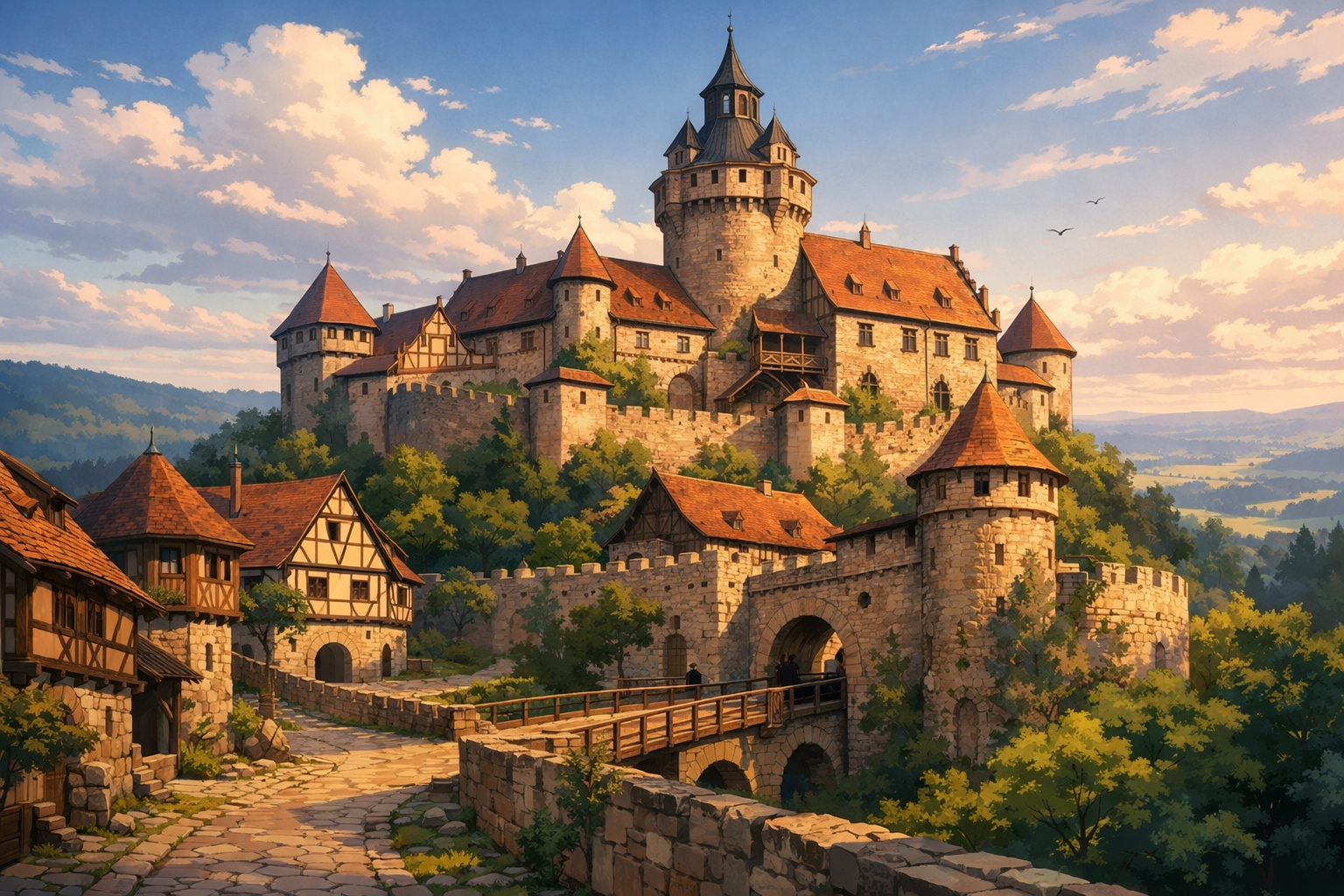
Ronneburg Castle

Ronneburg Castle

Germany blends storybook towns with layers of imperial history, all within easy reach of Frankfurt. Follow this route through castle-topped Ronneburg, the timber-framed charm of Gelnhausen and Büdingen, and the cultural heritage of Hanau before returning to the city’s sleek skyline.

🧭 ROUTE BY DAY

Ready-made country and city routes with daily plans, sights, transport and accommodation. Buy PDF guides for independent travel.

🧭 ROUTE BY DAY


Day 1 — Frankfurt am Main: arrival and a gentle start to the route

  • ✈️ The arrival base is Frankfurt am Main. After landing, it is convenient not to rush straight to the castle, but to spend the first day in the city or near a transport hub east of Frankfurt to ease into the rhythm of the trip. From the airport there are direct regional and S-Bahn connections toward Hanau; for the trip to Hanau it is usually worth allowing about 45–60 minutes including transfer time and getting out of the terminal, while to the Ronneburg area by car it is about 35–45 minutes without heavy traffic.

  • 🚶 Dedicate the evening to a short walk and an early rest. This tour is built around a medieval hilltop fortress, so it is better to begin the main exploration with a fresh mind: Ronneburg Castle reveals itself not as a single façade, but as a complex defensive organism — with towers, courtyards, service spaces, a well, and a distinctive sense of height above the landscape.


Day 2 — Ronneburg Castle: first acquaintance with the fortress and its silhouette

  • 🚗 In the morning, head to Ronneburg Castle. From Hanau or the eastern districts of Frankfurt, the drive usually takes about 30–45 minutes; from Langenselbold railway station you will then need a taxi for about 10 minutes. The approach to the castle already works as a prologue in itself: the fortress stands on a height and appears gradually, like a well-staged historical scene.

  • 🚶 It is best to devote the first day at the castle to “reading” the overall ensemble. Ronneburg is one of the best-preserved hilltop fortresses in Hesse, retaining a striking medieval character and later layers without losing its defensive logic. Here it is important to look not only at the walls, but also at how the gates, inner courtyard, passages, viewpoints, and tower verticals are organized. Stone, height, wind, and the panorama of the surrounding hills create a strong feeling of distance from modernity — as if the space itself compels you to slow down and start noticing the details.

Day 3 — Ronneburg Castle: museum interiors, the well, and the “residential side” of the fortress

  • 🚶 Devote the second day at the castle to the interior rooms and the museum section. It is best to allow at least 3–4 hours for a relaxed visit plus a lunch break in the castle restaurant or nearby. The exhibition and the route through the core of the fortress help you see Ronneburg not only as a fortification, but also as a place of everyday life: kitchens, service rooms, material culture, martial motifs, and the famous deep well create a sense of real rather than decorative history.

  • 🚶 This day is especially good for slow observation of texture. Ronneburg has no “museum sterility”: on the contrary, its strength lies in the fact that the walls, staircases, and passages preserve the harshness of a real fortress. Here it is easy to feel the difference between the ceremonial representation of a castle and its practical function — defense, resource storage, and control of the territory. If a pre-booked guided tour is available, it helps connect the rooms into a unified historical narrative.

Day 4 — Ronneburg Castle: medieval atmosphere, falconry theme, and landscape views

  • 🚶 Leave another day for a deeper stay in Ronneburg. This is not excessive luxury, but the right pace for a historical site of this type: at different hours the fortress reads differently. Morning light emphasizes the sculptural quality of the stone and the massiveness of the towers, daylight reveals the layout of the courtyard and walls, and by evening its role as an observation point over roads and surrounding settlements is felt more strongly.

  • 🦅 If a visit to the falconry program has been arranged in advance, this day is especially fitting for the theme of medieval hunting and status. Even without a show, the combination of “fortress + birds of prey + elevated terrain” strengthens the impression of living history. After the main visit, it is good to leave time for unhurried coffee and photographs: Ronneburg does not demand haste, it is remembered best precisely in the pauses — in the silence of the passages, in the sharp outline of the crenellations, and in the feeling that before you is not a reconstruction, but a fortress that has survived the centuries.

Day 5 — Gelnhausen: the Kaiserpfalz and the imperial context of the region

  • 🚗 Transfer: Ronneburg → Gelnhausen. By car, it is convenient to allow about 20–30 minutes. If traveling via Langenselbold and then by train/taxi, the journey will be longer and require transfers.

  • 🚶 After several days at the castle, it is especially useful to look at another type of medieval architecture in the region — the Kaiserpfalz in Gelnhausen. This is no longer simply a fortress on a hill, but imperial residential architecture associated with the Staufers and the figure of Barbarossa. The ruins here are romantic, but very informative: the island setting, the remains of the walls, and the representative logic of the complex make it possible to feel how power, symbolism, and strategic calculation were combined in the 12th century. After the austere castle environment of Ronneburg, Gelnhausen offers a more “political” and imperial angle on the medieval world.

Day 6 — Gelnhausen: the city museum and the historic fabric of the old center

  • 🚶 This day is best devoted not to long transfers, but to deepening the context. The Gelnhausen Museum and a walk through the old center help bring together impressions of the region: trade routes, urban self-government, everyday history, and late medieval and early modern transformations. Allow 1.5–2 hours for the museum and at least another 2 hours for the streets, squares, and a relaxed lunch.

  • 🚶 Gelnhausen is excellent because here the medieval character is felt not as a separate monument, but as an environment. Half-timbered houses, narrow streets, changes in elevation, and historic façades create a soft transition from the “hard” fortress architecture of Ronneburg to urban life. This is an important stop on the route: it shows for whom and for what castles existed at all — not in emptiness, but in a network of roads, markets, power, and crafts.

Day 7 — Büdingen: castle and fortified urban image

  • 🚗 Transfer: Gelnhausen → Büdingen. By car it is usually about 25–35 minutes; by public transport you need to allow noticeably more time and transfers.

  • 🚶 Büdingen is an ideal continuation of the theme. If Ronneburg impresses as a hilltop fortress in the landscape, then Büdingen adds an almost theatrically coherent fortified urban image as well. Büdingen Castle and the historic center give the feeling of a medieval ensemble in which fortification, courtly representation, and residential environment coexist side by side. Here it is especially pleasant to compare the sculptural quality of the defenses and the more “lived-in” aristocratic architecture with the austere logic of Ronneburg.

Day 8 — Büdingen: Schlossmuseum and a second slow day in the old town

  • 🚶 Give Büdingen a full second day. The Schlossmuseum helps show the evolution of the castle from a defensive core to an aristocratic residence, while a second walk through the streets lets you read the city with greater awareness. It is convenient to allow 2–3 hours for the museum and palace section, then take a lunch break and return to the outer walls and gates.

  • 🚶 In Büdingen, the multilayered nature of time is especially noticeable: Romanesque and Gothic motifs, later reconstructions, the half-timbered environment, city gates, cobbled streets, and palace accents. After Ronneburg, the theme of status and comfort is felt more strongly here, but the defensive memory does not disappear. This contrast makes the route come alive: you are not simply “looking at another castle,” but comparing different scenarios of medieval architecture’s existence.

Day 9 — Hanau: Schloss Philippsruhe and a change of era

  • 🚗 Transfer: Büdingen → Hanau. By car it is usually worth allowing about 35–50 minutes. This is a convenient day to change base and enjoy a more comfortable city evening.

  • 🚶 Schloss Philippsruhe in Hanau is important as a deliberate change of perspective: after medieval fortresses and towns, you move to a later palace culture. The Baroque and later palace language here does not cancel the historical storyline of the route, but completes it: from defense and territorial control — to representation, garden perspective, and a museum reading of the past. The historical museum within the palace walls helps you see how ideas of power, taste, and space changed over time.

Day 10 — Hanau: historical museum and an unhurried day without long transfers

  • 🚶 After intensive days, it is helpful to have a calmer museum day. The Hanau Historical Museum in Schloss Philippsruhe is convenient to explore without haste, leaving time for the park, riverside views, and lunch. Allow 3–4 hours for the museum complex itself and another 1–2 hours for a walk around the surroundings.

  • 🚶 This day works as an intellectual breather. It allows you to turn impressions from “memory in stone” into a historical narrative: to compare how the region developed from medieval defensive forms to later palace and museum scenarios. After this, the image of Ronneburg becomes even more expressive — you see more clearly just how archaic, austere, and honest it is in its fortress nature.

Day 11 — Return to Ronneburg or a free day to revisit your favorite spot

  • 🚗 Today it is sensible to keep the day flexible. The best option for a historical tour is a repeat trip to Ronneburg or to one of the neighboring medieval locations, if you want to see what remained “between the frames.” By car from Hanau to the castle, it is again worth allowing about 30–45 minutes one way; by public transport — more time and transfers.

  • 🚶 Returning to the castle at the final stage almost always gives new impressions. After Gelnhausen, Büdingen, and Hanau, you already perceive Ronneburg differently: not just as a beautiful fortress, but as an important node in the regional architectural history. If a repeat visit is not needed, the day can be used for rest, archival notes, sorting photographs, and a calm dinner — this rhythm makes the 12-day route not tiring, but deep.

Day 12 — Frankfurt am Main: departure and wrapping up

  • 🚆/🚗 Transfer to Frankfurt Airport. From Hanau by train or S-Bahn/regional service to the airport, it is usually worth allowing about 45–60 minutes; by car — about 35–45 minutes without serious congestion. It is better to have at least a 2.5–3 hour buffer before departure, especially if you are returning a car.

  • 🚶 Before leaving, it is useful to mentally gather the route into one line: Ronneburg showed the austere power of a medieval hilltop fortress; Gelnhausen — imperial scale and urban environment; Büdingen — an almost complete historical scenography of a fortified town; Hanau — the transition to later palace representation. Such an ending makes the trip not a collection of points, but a coherent story of how the architecture of power changed from stone defense to museum memory.

Flight tickets

eSIM for travel

Buy PDF guide

Buy PDF guide — 25.71 USD

PDF — 25.71 USD