
Buy PDF guide

Buy PDF guide — 25.71 USD

PDF — 25.71 USD

ROYAL CASTLES OF BAVARIA

ROYAL CASTLES OF BAVARIA

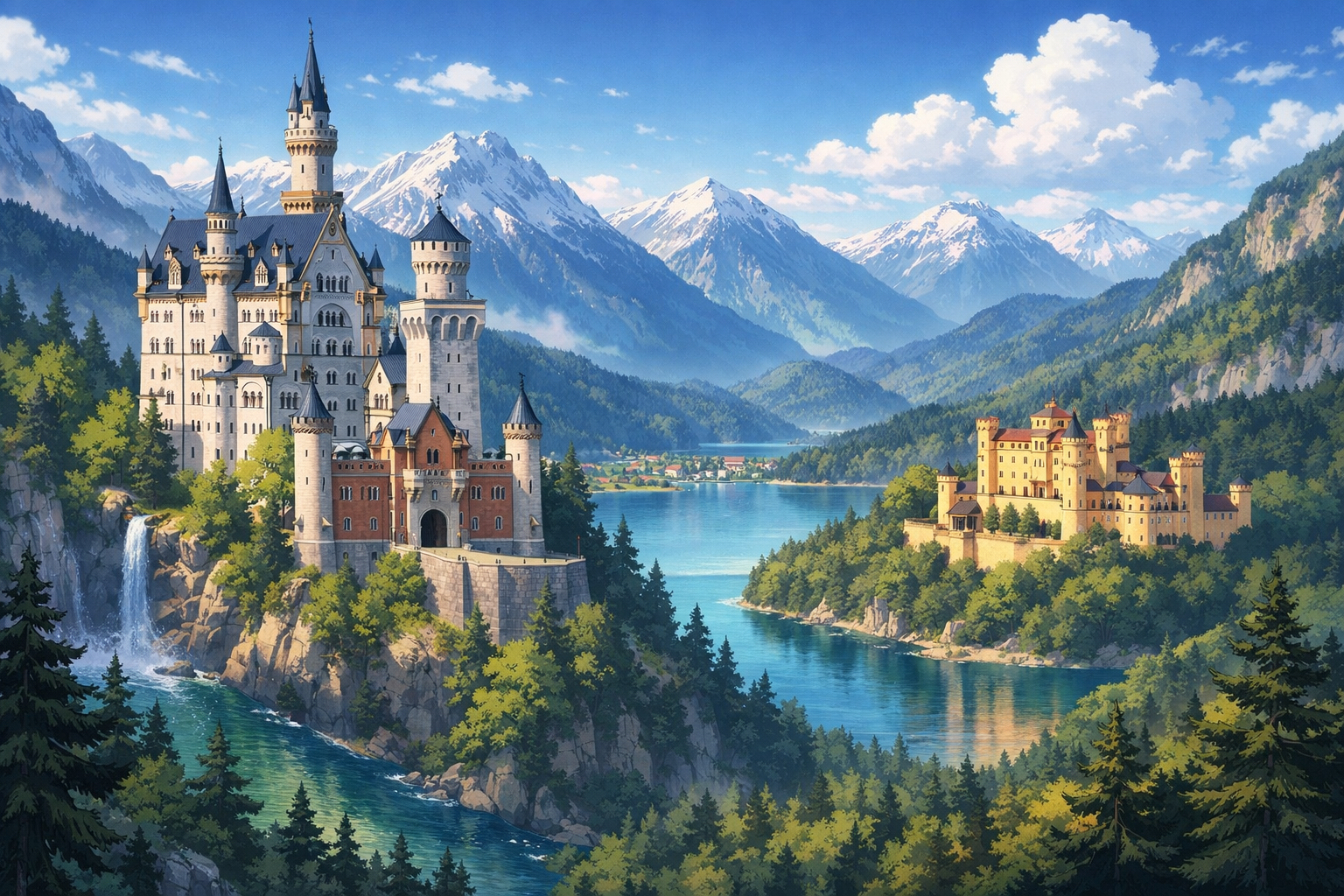
Trace Bavaria’s royal arc from Munich to Füssen, where Hohenschwangau and fairytale Neuschwanstein crown the Alpine foothills. Continue to the rococo glow of the Wieskirche and Linderhof, pass through frescoed Oberammergau, dip into Tyrolean Reutte, and loop back to Munich. Mountain air and castle spires linger long after the road unwinds.

🧭 DAY-BY-DAY ITINERARY

Ready-made country and city routes with daily plans, sights, transport and accommodation. Buy PDF guides for independent travel.

🧭 DAY-BY-DAY ITINERARY


Day 1 — Munich: an introduction to the “Wittelsbach dynasty”

  • 🚶 Walk through the historic center and the Residenz (Residenzstraße 1): this is the tour’s “opening shot” — from late-medieval halls to Neoclassical courtyards. It’s an easy place to pick up the thread of Bavaria’s rulers so you can later recognize their traces in Hohenschwangau, Neuschwanstein, and Linderhof.

  • 🏛️ Visit to the Bayerisches Nationalmuseum (Prinzregentenstraße 3): decorative arts and displays that explain what cultural fabric the interiors of Bavarian residences are “woven” from. In the evening — rest and get ready for the move to the Alps.


Day 2 — Transfer to Füssen/Schwangau + Lake Alpsee

  • 🚆 Munich → Füssen (≈ 2 hours by regional train). Then transfer to the bus to Hohenschwangau (≈ 10–15 min). Check in at a hotel at the foot of the castles.

  • 🌅 Evening walk along Alpsee: a mirror of water, spruce-covered slopes, and two castles in one panorama. This is the best “soft introduction” to the place—without crowds and in ideal light.

Day 3 — Hohenschwangau: the “family residence” and the Museum of the Bavarian Kings

  • 🏰 Schloss Hohenschwangau: the residential home of Maximilian II — where Ludwig II’s taste took shape and where his early dreams of knightly myths were born. Pay attention to the romantic murals and intimate layout: this is a “home,” not a theatrical set.

  • 🏛️ Museum der Bayerischen Könige (on the shore of Alpsee): a multimedia exhibition about the Wittelsbach dynasty links what you see in Hohenschwangau with your later impressions of Neuschwanstein and Linderhof.

  • 🕰️ Timing: morning entry to Hohenschwangau (≈ 45–60 min tour), then the museum (≈ 60–90 min). The afternoon window — rest/viewpoints by the lake.

Day 4 — Neuschwanstein: a romantic neo-medieval poem

  • 🏰 Schloss Neuschwanstein: “a Middle Ages composed in the 19th century.” In the interiors, look for Wagnerian musical allusions, lighting accents, and contrasts of scale (narrow passages → grand halls).

  • 🌉 Route: hike up (30–40 min) or take the shuttle bus to Marienbrücke (bridge over the Pöllat Gorge) and walk down to the castle. The view from the bridge is Bavaria’s classic postcard.

  • 🕰️ Timing: enter the area at opening; castle tour ≈ 30–40 min (at your ticket time). Allow another 1.5–2 hours for photo spots and walking. After — a relaxed lunch and rest.

Day 5 — Füssen: St. Mang Monastery and Hohes Schloss

  • 🏛️ Museum der Stadt Füssen in the former Benedictine abbey of St. Mang: music, lutes, and the spirit of the Via Claudia Augusta. The basilica and cloisters offer a rare chance to see a “living” Baroque complex without the bustle.

  • 🏰 Hohes Schloss Füssen: one of Bavaria’s best Late Gothic fortresses, with illusionistic façade paintings and the Staatsgalerie (Late Gothic painting and sculpture).

Day 6 — Wieskirche (UNESCO) and rural Baroque poetry

  • ⛪ Wieskirche (Steingaden): the benchmark of Bavarian Rococo, where light dissolves the walls. Outside — an alpine meadow; inside — airy vaults and gold “floating” in a milky glow.

  • 🕰️ Timing: travel from Füssen by bus via Steingaden (route via Wieskirche) or by car ≈ 40–55 min one way. For the visit — 45–60 min + a coffee break.

Day 7 — Linderhof and Ettal: “a Versailles in miniature” and a monastic ensemble

  • 🏛️ Schloss Linderhof: Ludwig II’s most “French” palace — gilded interiors, mirrored vistas, park pavilions, and an intimate scale that amplifies the sense of luxury.

  • ⛪ Ettal Abbey: a powerful Baroque dome and a monastery village where architecture lives through crafts (brewery, refectories). The history goes back to the 14th century; renewals range from Baroque to the 20th century.

Day 8 — Oberammergau: woodcarving, the Passion Play theater, and the museum

  • 🏛️ Oberammergau Museum: the Passion of Christ as the cultural code of the local theater, and house woodcarving as “folk architecture in miniature.” A walk along the half-timbered alpine streets — for the painted façades and workshops.

  • 🕰️ An easy day: bus transfers via Ettal/Oberammergau, returning by evening to your base near Füssen.

Day 9 — Reutte (Tyrol, Austria): lofty ruins and the highline179 suspension bridge

  • 🏰 Burgenwelt Ehrenberg + highline179: a complex of medieval fortifications and a spectacular pedestrian crossing between the ruins. A grand landscape shot: valley, fortresses, and the bridge’s hanging line.

  • 🕰️ Travel: Füssen → Reutte by regional bus (≈ 25–35 min), climb from the parking lot/town center up to the bridge — ≈ 20–30 min. Return in the daytime; evening — rest/thermal baths.

Day 10 — Tegelberg panoramas and Füssen’s arc of lakes

  • ⛰️ Tegelberg viewpoints and trails around Hopfensee/Forggensee: the “architecture of the terrain” helps you read why castles and roads are placed exactly where they are. In clear weather, it’s an ideal day for shooting.

Day 11 — Weather backup: revisits and “details”

  • 🔁 Return to your favorite spots: Marienbrücke at sunrise, Hohenschwangau’s courtyard without the crowds, museum interiors with attention to small details. In bad weather—Füssen’s museums and a warm lunch.

Day 12 — Return to Munich: the finale of dynastic history

  • 🚆 Füssen → Munich (≈ 2 h), evening walk at Nymphenburg/Lehel—compare Munich’s “palace language” with the meadow poetry of the Alps.

Flight tickets

eSIM for travel

Buy PDF guide

Buy PDF guide — 25.71 USD

PDF — 25.71 USD