
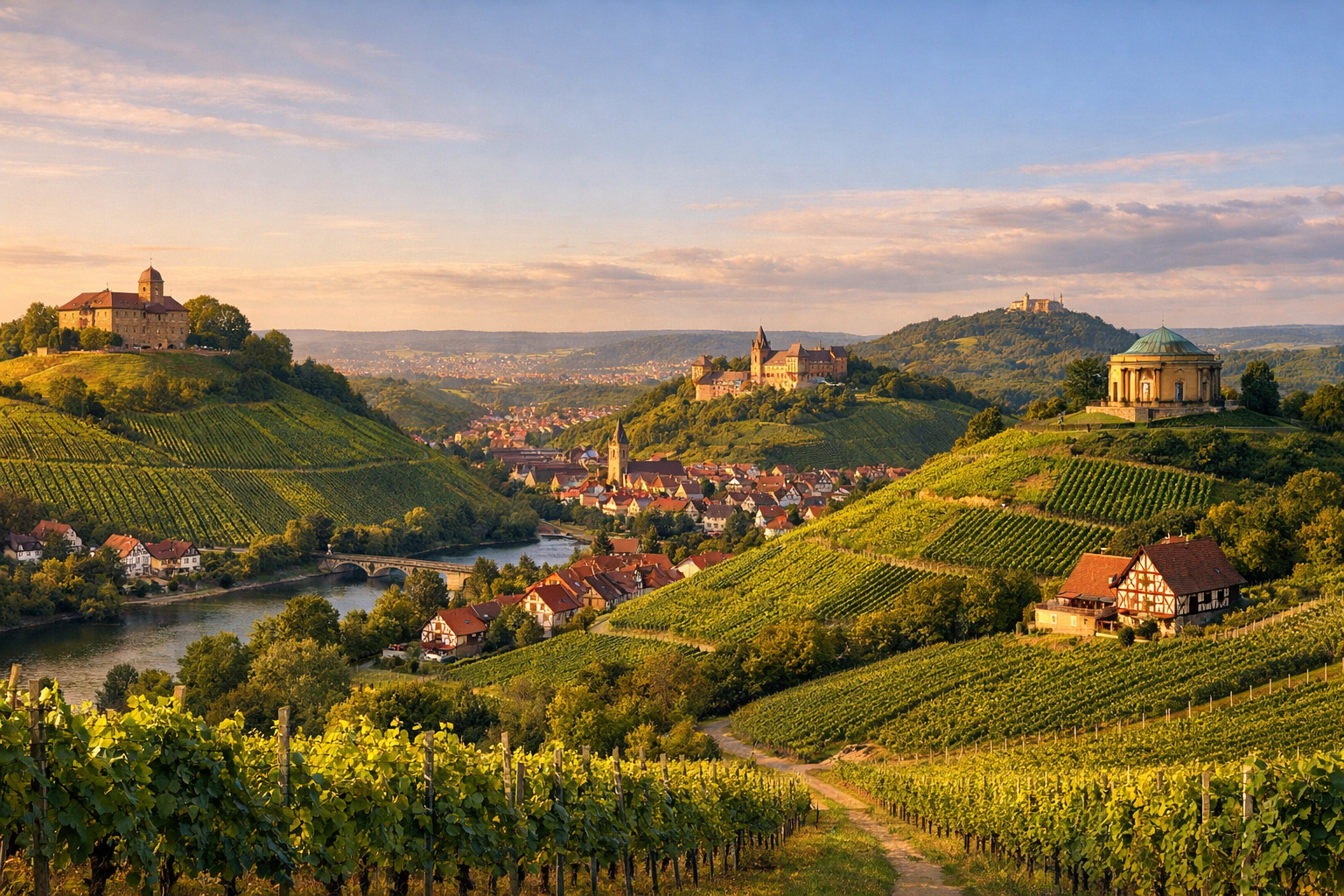
Day 1 — Stuttgart: old town, Schillerplatz, and the city’s wine atmosphere
🚆 It is convenient to plan your arrival in Stuttgart via Stuttgart Airport: getting to the city center on the S-Bahn S2 or S3 from Flughafen/Messe station to Hauptbahnhof usually takes about 27 minutes, trains run regularly, and from the main station to a hotel in the central area it is often just a 5–15 minute walk or a short taxi ride. If your flight arrives early, allow another 20–30 minutes for baggage claim and a relaxed transfer to the hotel without rushing.
💤 After check-in, it is better not to jump straight into a packed program: leave 1–1.5 hours to rest, shower, and take a short break after the journey. A wine route through Württemberg is especially rewarding at an unhurried pace: here, what matters is not only the points on the map, but also the feeling of gentle slopes, terraced vineyards, cozy squares, and a slow city evening with a glass of local Trollinger, Riesling, or Lemberger.
🚶 Stuttgart’s historic center and the area around Schillerplatz are the perfect first introduction to the wine capital of the region. Stuttgart is surprising because it is not just a major business city, but also one of the largest winegrowing communities in Germany: vineyards are literally woven into the urban fabric here, and the theme of wine is felt not as a tourist backdrop, but as part of everyday life. Start your walk at Schlossplatz and gradually make your way to Schillerplatz — a square with a particularly expressive old-Stuttgart atmosphere, where among historic facades, Stiftskirche, and the mass of the Old Castle, the contrast between Württemberg’s courtly past and the living modern city is especially tangible. This is exactly where the city’s famous wine life unfolds: in season, the square becomes the heart of the Stuttgarter Weindorf, and even outside festival dates the area keeps the mood of an elegant, distinctly southern-feeling German city where you want to linger on a terrace, order a tasting set, and watch the evening light settle on tiled roofs and the stone of old squares.
🍷 In the second half of the day, devote time specifically to Stuttgart’s wine side: choose one of the city’s wine bars or traditional Swabian Weinstube in the center and ease into the local styles. Württemberg is especially interesting because wine here feels very grounded and gastronomic: not ceremonially museum-like, but alive, connected to cuisine, landscape, and everyday culture. The local reds, especially Trollinger and Lemberger, usually open up easily and warmly, while the whites are fresh and structured. It is worth leaving at least 1.5–2 hours for dinner: this region is not about a quick “one glass and move on,” but about a slow evening in which the city gradually becomes softer, more intimate, and warmer.