
Buy PDF guide

Buy PDF guide — 25.71 USD

PDF — 25.71 USD

WEST POINT AND THE HUDSON VALLEY

WEST POINT AND THE HUDSON VALLEY

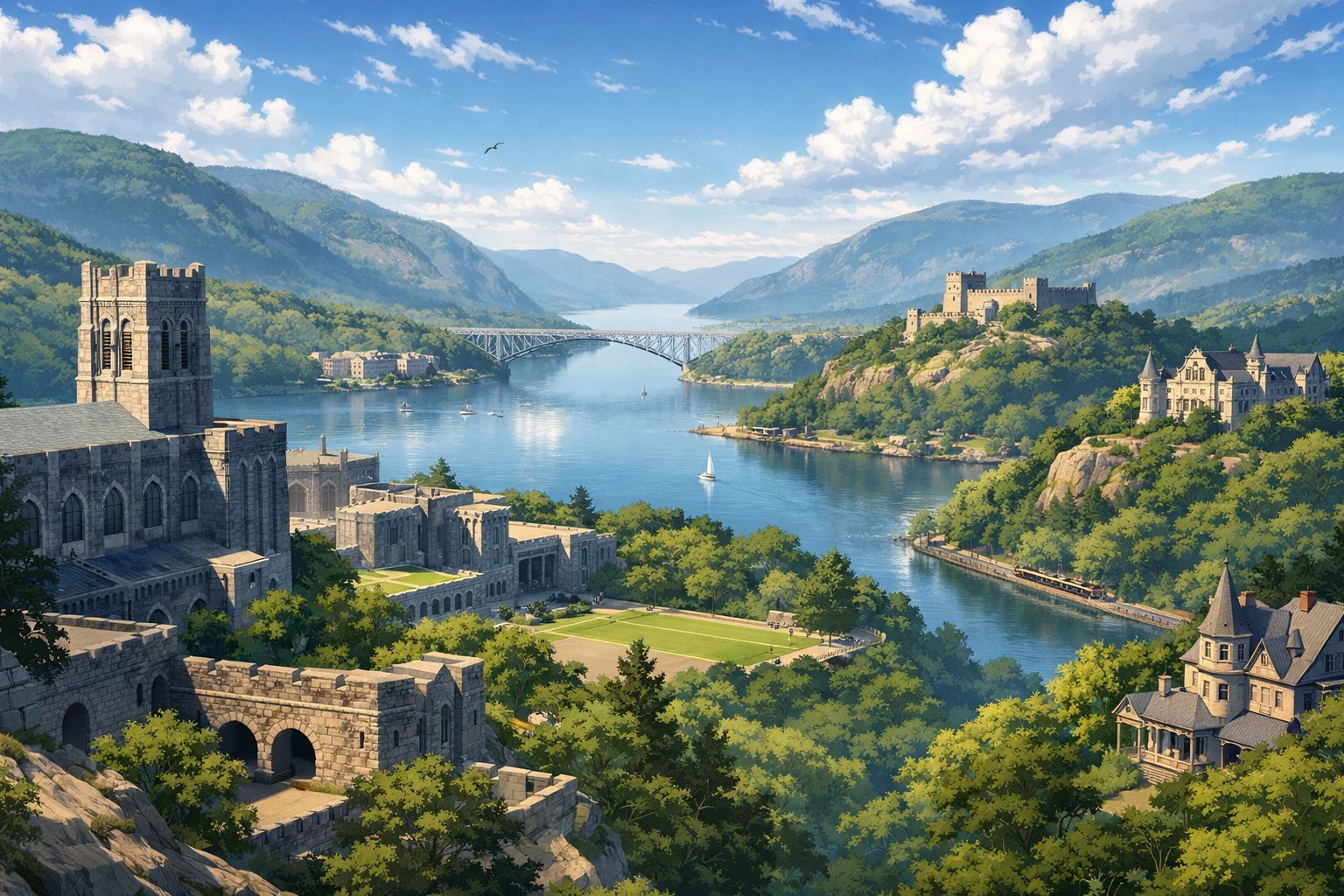
West Point and the Hudson Valley blend riverfront views, historic estates, and small towns full of character. Follow the Hudson from Newburgh and West Point to Beacon, Hyde Park, and Sleepy Hollow for a trip shaped by scenic train rides, art, and Revolutionary-era charm.

🧭 DAY-BY-DAY ROUTE

Ready-made country and city routes with daily plans, sights, transport and accommodation. Buy PDF guides for independent travel.

🧭 DAY-BY-DAY ROUTE


Day 1 — Arrival in the Newburgh / West Point area: a gentle introduction to the Hudson Valley

  • ✈️ Arrive via Stewart International Airport (New Windsor) or by train/bus through Newburgh. After check-in, keep the day relaxed and avoid overloading it: from the airport to West Point it is usually about 25–35 minutes by car, depending on traffic and access conditions.

  • 🚶 In the evening, it is better not to try to “cram in” a museum block, but to tune in to the geography of the trip: here the Hudson Valley feels like a blend of military history, river landscape, and old American architecture. Even a short walk along the Newburgh waterfront or to scenic viewpoints nearby gives an important emotional prologue: a broad river, dark folds of hills, stone and brick buildings, and the memory of the Revolutionary era and the 19th century.


Day 2 — West Point: museum and the historic landscape of the military academy

  • 🚶 Dedicate the day to West Point — a place where US history is read not only through buildings, but through the terrain itself. The military academy stands on a dramatic bend of the Hudson, and here it becomes especially clear why this height had strategic significance as far back as the Revolutionary War. Start with the West Point Museum and the visitor area at Pershing Center: the collection of weapons, uniforms, artillery, and academic relics helps you see West Point not as an abstract symbol, but as a living institution with a long and very tangible history.

  • 🚶 Then look at the campus as an ensemble: austere stone facades, neo-Gothic and academic motifs, ceremonial spaces, river views, and the parade ground create a rare sense of “architecture of discipline.” It is important not to rush here: it is better to cover fewer points but read the composition of the space carefully — how the buildings submit to the heights, how the axes open toward the river, and how monumentality works together with nature.

Day 3 — Newburgh: Washington’s Headquarters and Revolutionary memory

  • 🚗 Transfer West Point → Newburgh: about 30–40 minutes. Spend the morning at Washington’s Headquarters State Historic Site — one of the key places of the late stage of the American Revolution. The house is not striking for its size; on the contrary, its strength lies in its historical concentration. This kind of “unsensational” architecture helps you feel the 18th century more clearly: a stone house, practical interiors, the working atmosphere of headquarters, and that almost physical contrast between the modest domestic shell and the scale of the political decisions made there.

  • 🚶 After the museum, it is worth walking through old Newburgh and along the waterfront. This city matters as a link between the heroic military past and the commercial river 19th century. In the architecture, you can feel the transition from Revolutionary austerity to a more self-assured urban America: brick, stone, later facades, and city slopes above the river. It is best to finish the day without long transfers, with a proper rest break of at least 1.5–2 hours.

Day 4 — Cold Spring and Beacon: ruins, industrial romanticism, and an island castle

  • 🚗 Transfer Newburgh → Beacon: about 20–25 minutes; if you want to include Cold Spring, add about another 20 minutes. This is a day for a more picturesque and atmospheric kind of history. If Bannerman Island tours are available, choose them as the central point of the day: the boat trip from Beacon, the island itself, the ruins of the arsenal-decorative Bannerman Castle complex, and the gardens create a very cinematic impression. Here the past appears not as a “preserved” palace, but as the romantic shell of a collapsed dream — the Scottish pseudo-medieval silhouettes in the middle of the river look almost theatrical.

  • 🚶 After the island, walk around Beacon. The town is appealing because the historic fabric here is not museum-like, but alive: Main Street, factory buildings, proximity to the railroad, river topography. In this area, antiquity in the European sense does not dominate, but the architecture of 19th- and early 20th-century America reads beautifully: industrial volumes, former manufacturing buildings, small-town facades, and a constant dialogue with the Hudson landscape.

Day 5 — Poughkeepsie and Walkway Over the Hudson: a bridge as a historic landmark

  • 🚗 Transfer Beacon → Poughkeepsie: about 30–35 minutes. Today the focus is not an estate or a museum interior, but infrastructure as a monument to its era. Walkway Over the Hudson is a former 1889 railroad bridge turned into a pedestrian historic park. It is a magnificent example of how an engineering structure becomes a cultural site: the steel construction, the span’s scale, the height above the river, and the open panoramas combine into a powerful spatial experience.

  • 🚶 Walk across the bridge slowly, stopping to read the landscape. From here, it is especially easy to see how the Hudson Valley was not only picturesque, but also a transportation corridor, where railroads, the river route, and urban nodes shaped the regional economy. After the Walkway, it is worth planning a calm evening and an early night: several packed days in Hyde Park and farther north still lie ahead.

Day 6 — Hyde Park: Vanderbilt Mansion and the Gilded Age

  • 🚗 Transfer Poughkeepsie → Hyde Park: about 15–20 minutes. Dedicate the day to Vanderbilt Mansion National Historic Site. This is one of the most expressive stops on the route for understanding American estate architecture at the turn of the 19th and 20th centuries. In contrast to the military austerity of West Point and the Revolutionary restraint of Newburgh, here you enter a world of representation, status, and carefully staged splendor.

  • 🚶 Look not only at the interiors, but at the estate as a complete production: the approach, the axes, the terraces, the river views, the interior décor, the way light works in the formal rooms. A special pleasure comes from the contrast between the aristocratic opulence of the house and the almost severe monumentality of the surrounding landscape. This is not a European palace in a pure form, but a very American version of elite architecture — rich, demonstrative, and at the same time deeply rooted in the idea of a landscaped estate.

Day 7 — Hyde Park: Franklin Roosevelt’s home, library, and Val-Kill

  • 🚗 Local transfers within Hyde Park are short: usually 5–15 minutes between key points. Start with the Home of Franklin D. Roosevelt National Historic Site and the Franklin D. Roosevelt Presidential Library and Museum. This is a very important day for “reading” the 20th century through residence architecture, political memory, and museum narrative. The house here does not overwhelm with luxury: it speaks of family continuity, private life, and public history all at once.

  • 🚶 After the main complex, head to the Eleanor Roosevelt National Historic Site (Val-Kill). Val-Kill offers a completely different tone: more intimate, more human, less ceremonial. Against the backdrop of the region’s grand estates, this site is especially valuable because it shows a historic figure through an almost domestic scale. Pond, greenery, modest architecture, working and personal space — all of this makes the visit unusually substantial and emotional. Between the two locations, be sure to allow time for a full lunch and at least 45–60 minutes of quiet pause.

Day 8 — Kingston: Senate House and the old stone town

  • 🚗 Transfer Hyde Park → Kingston: about 45–60 minutes, depending on the route and the bridge across the Hudson. Kingston is one of the best points on the route for those who want to see an earlier urban layer of the valley. Senate House State Historic Site is tied to the birth of New York’s political statehood, but the value of the place is broader: it is a chance to feel the old stone town, where colonial and early American history still holds in the very material of the streets.

  • 🚶 After visiting the site itself, be sure to walk through the Stockade District. Stone houses, low-rise buildings, an uneven street grid, the density of the old core — here you get a sense of real depth of time that is rare in the US. This day is built not on a large number of “checkmarks,” but on a slow immersion into the old urbanism of the Hudson Valley. It is best to keep the evening free, with an early return to the hotel.

Day 9 — Germantown and the Hudson area: Clermont and Olana

  • 🚗 Transfer Kingston → Germantown/Clermont: about 40–50 minutes, then another roughly 20–25 minutes to Olana State Historic Site. This is one of the most beautiful days on the route. In the morning — Clermont State Historic Site, the historic estate of the Livingston family. Here, the link between house and views is especially important: the architecture does not compete with the landscape, but works as a frame for the valley, creating a sense of dignity, old family memory, and long political history.

  • 🚶 In the second half of the day — Olana State Historic Site, the home of artist Frederic Edwin Church. This is a completely different aesthetic: an eclectic orientalizing mansion created not only as a residence, but as an artistic statement. Olana is striking in the way architecture, interior, and panoramas come together into a single artistic world. On the route, this is perhaps the most “painterly” site: here it is important to look from the windows, from the paths, from the heights, noticing how the landscape has been transformed into an almost directed work of art.

Day 10 — South of the valley: Tarrytown, Kykuit, and Union Church

  • 🚗 Long transfer from the northern part of the valley → Tarrytown/Pocantico Hills: approximately 1 hr 45 min – 2 hr 30 min. So it is best to leave early and not plan a packed evening. The main point of the day is Kykuit, the former Rockefeller estate. It is important to note that visits are usually organized through the visitor center and shuttle; the tour itself already includes logistics within the complex. Kykuit is the pinnacle of the region’s estate history: the strict stone mass of the house, terraced gardens, sculpture, Hudson panoramas, and incredibly refined spatial organization.

  • 🚶 If timing and opening hours work out well, add Union Church of Pocantico Hills. This modest-looking church contains remarkably powerful artistic content: stained glass by Matisse and Chagall creates a rare emphasis on modernist sacred art along the route. The day will be full, so after returning to the hotel, plan only dinner and rest, without evening museums.

Day 11 — Sleepy Hollow and Tarrytown: Sunnyside, Old Dutch Church, cemetery, and Lyndhurst

  • 🚗 Local transfers are short: 10–20 minutes between points. Start the morning with Washington Irving’s Sunnyside — the house where literary America literally materializes in architecture. This mansion is not grand, but incredibly expressive: a picturesque silhouette, romantic stylization, closeness to the river, and an intimate scale create the impression of an almost fairy-tale refuge. Here architecture works as an extension of Irving’s own imagination.

  • 🚶 Then it makes sense to continue to Old Dutch Church and Burying Ground and Sleepy Hollow Cemetery. These points offer an earlier, colonial and memorial layer, as well as the famous literary context of “The Legend of Sleepy Hollow.” In the second half of the day, Lyndhurst Mansion is an ideal fit — an outstanding example of an American Gothic Revival estate. At sunset its silhouette is especially striking: towers, stone, open lawns, and the river create one of the strongest final images of the whole tour.

Day 12 — Route finale: a calm ending and departure

  • 🚗 Depending on your departure point, allow: Tarrytown/Sleepy Hollow → Stewart Airport about 45–60 minutes; to Manhattan/Penn Station usually 45–70 minutes by Metro-North train plus extra time for the station; to JFK or Newark the time is noticeably longer and depends on traffic. On the last day, it is better not to schedule a museum with a fixed slot — leave half a day for an unhurried walk along the Hudson, a late breakfast, and packing.

  • 🚶 This is a good moment to sum up the route: from Revolutionary houses and a military academy to the Gilded Age, from presidential residences to artistic villas and romantic literary places. West Point and the Hudson Valley reveal themselves as a region where US history is read through the landscape no less than through the buildings themselves.

Flight tickets

eSIM for travel

Buy PDF guide

Buy PDF guide — 25.71 USD

PDF — 25.71 USD