
Buy PDF guide

Buy PDF guide — 12.85 USD

PDF — 12.85 USD

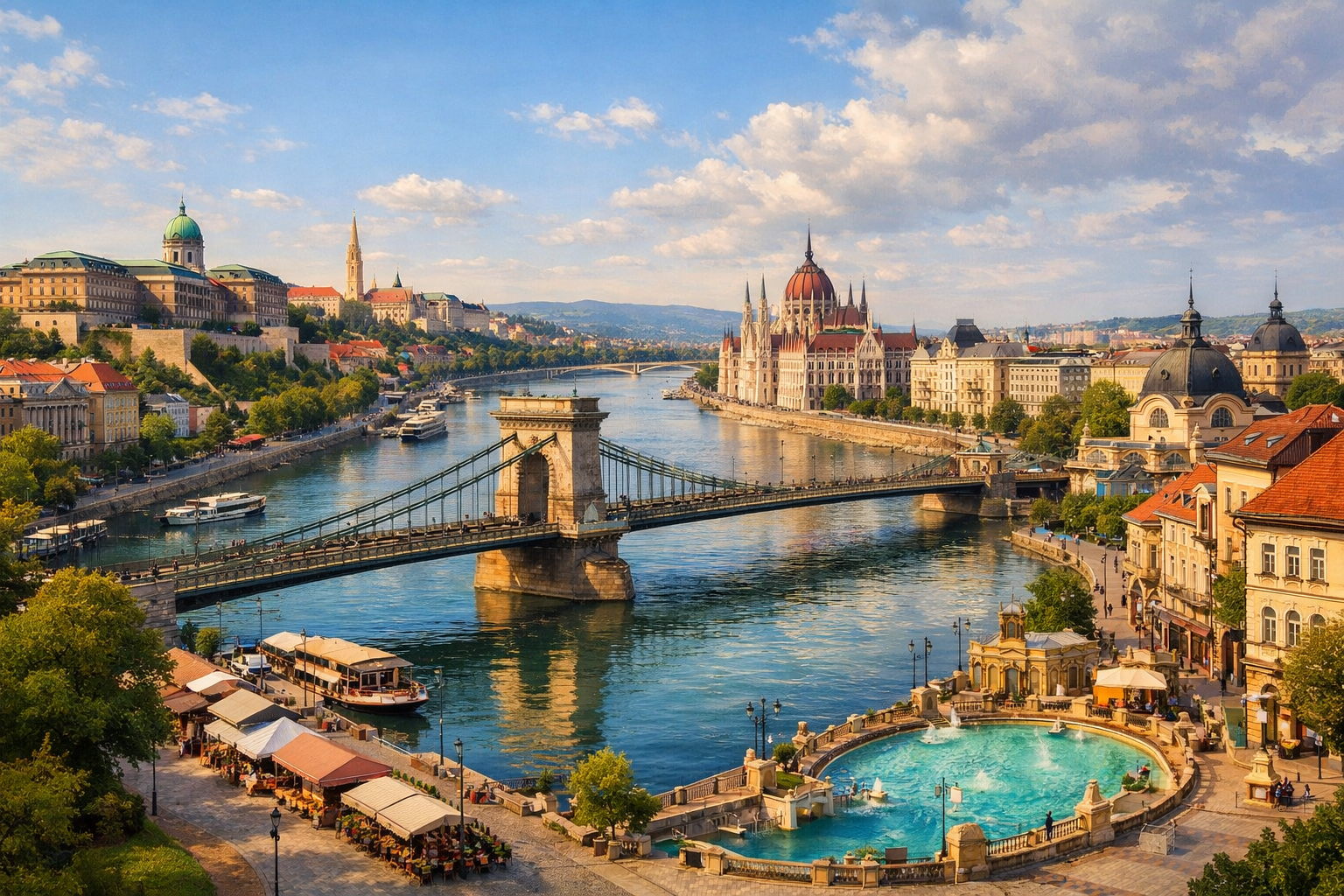
Hungary, Budapest. An inexpensive city break with walks along the Danube, visits to markets, free observation decks, historic quarters, and one of the city's baths. Season: March–November.

Hungary, Budapest. An inexpensive city break with walks along the Danube, visits to markets, free observation decks, historic quarters, and one of the city's baths. Season: March–November.

Budapest is an easy, affordable city break where grand riverside walks, lively markets, and historic quarters fill your days without rushing your budget. From free views over the Danube to a soothing soak in one of the city’s famous baths, it’s a trip that feels rich in atmosphere from March to November.

🧭 DAY-BY-DAY ITINERARY

Ready-made country and city routes with daily plans, sights, transport and accommodation. Buy PDF guides for independent travel.

🧭 DAY-BY-DAY ITINERARY


Day 1 — Arrival and the Pest embankments: Deák Ferenc tér → Danube → evening lights

  • 🚆 From Budapest Airport, the easiest option is usually the 100E Airport Express bus: it runs directly to Deák Ferenc tér, one of the main transport hubs in the center, and normally takes about 30–40 minutes. It is important to remember that the 100E requires a special airport shuttle ticket; a regular single ticket is not valid on this service. If you arrive late, public transport is still a workable option: the city has an extensive night network, and tickets are easiest to buy in the BudapestGO app or from BKK ticket machines.

  • 🚶 It is best to keep the first day light and pleasant: after check-in, head for an easy stroll through central Pest toward the Danube. The area around Deák Ferenc tér, Vörösmarty Square, and Váci utca is ideal for a gentle introduction to the city: you can already feel Budapest’s special rhythm here — a little imperial, a little bohemian, with broad facades, the ringing of trams, and ever-changing light over the river. In spring, summer, and early autumn, it is especially enjoyable to simply walk here without a strict plan, peeking into courtyards, small bakeries, and quiet side streets.

  • 🌉 Reach the Danube embankment and walk along Pest rakpart. This is often where Budapest makes its strongest first impression: hilly Buda rises opposite, the bridges reflect on the water, and the silhouette of the Royal Palace and Fisherman’s Bastion looks almost theatrical. Closer to sunset, the city becomes even more emotionally powerful — the warm stone of the facades, long shadows, yellow trams along the shore, and the slowly darkening river create exactly that “European city break” feeling people come here for.

  • 💤 End the evening early and without overloading it: after the flight and the journey into town, it makes sense to save energy for the fuller days ahead. Allow 2.5–3.5 hours for a calm walk around the center and the embankment, including a stop for coffee or an early dinner. In terms of safety, Budapest is generally considered a fairly calm city for a tourist trip, but standard caution is still necessary in the busiest tourist spots, near transport hubs, and on public transport: keep an eye on your bag, phone, and pockets, especially in the evening and in dense crowds.


Day 2 — Historic Buda: Chain Bridge, Castle District, Fisherman’s Bastion

  • 🚶 Start the day a bit earlier and cross the Danube via Széchenyi Lánchíd, the famous Chain Bridge, which is already part of the city’s grand spectacle in itself. A morning crossing from Pest to Buda is one of the most beautiful ways to feel Budapest’s geography: on one side, the strict and ceremonial urban facade of Pest; on the other, the rising hill with historic walls, towers, and palace buildings.

  • 🏰 Then walk up into the Buda Castle area. This is the best option for a budget itinerary: you do not spend money on the funicular and at the same time get a full panoramic ascent. The Castle District is not just a collection of postcard views, but one of the city’s most atmospheric historic quarters, where narrow streets, baroque houses, stone arches, old lanterns, and quiet inner squares create a sense of layered time. It is pleasant to move slowly here, without rushing, because the district’s main value is not a single point, but the walk through its very texture.

  • 🌤️ The main highlight of the day is Fisherman’s Bastion and the area around Matthias Church. The bastion is famous for its fairy-tale neo-Romanesque architecture and for offering one of the best views of the Danube, the Parliament building, and the wide panorama of Pest. Some terraces are accessible for free, and the most pleasant time for a budget traveler is early morning, when the light is soft, there are fewer people, and the city looks almost unreal in its beauty. This is one of those viewpoints where you do not just want to take a photo, but to stay a little longer and let your eyes adjust to the scale.

  • 🚶 After the bastion, devote another 2–3 hours to walking around the Castle District: explore the quiet streets around Holy Trinity Square, head to the viewpoints by the castle walls, and then descend at a relaxed pace. If you do it all without rushing, the day feels very comfortable: about 20–30 minutes to get from central Pest to the bridge, 20–30 minutes for the climb with pauses, and 4–5 hours for the district itself with breaks and coffee. This kind of day is especially good from March to November, when daylight lasts longer and you naturally want to spend more time outdoors.

Day 3 — Markets and old Pest: Central Market Hall, National Museum, Kálvin tér area

  • 🛍️ Dedicate the third day to a more “grounded” Budapest — markets, urban details, and historic Pest. Start with the Great Market Hall, the Central Market at Vámház körút 1–3, near Kálvin tér and Liberty Bridge. It is the largest and most famous covered market in the city, and even if you are not planning serious shopping, it is worth coming for the atmosphere alone: metal structures, a high colorful vault, and rows of paprika, sausages, cheeses, pastries, vegetables, and local products create a very lively, non-museum picture of everyday Hungary.

  • 🥨 For an affordable city break, the market is especially convenient as a food base: you can put together an inexpensive snack, try Hungarian pastries, buy fruit, sweets, or souvenirs, without feeling that the entire day has been spent only on restaurants. From the market, it is pleasant to step out to the Danube, look at the green Liberty Bridge, and then slowly make your way toward Kálvin tér. Walking distances here are short: the market, embankment, square, and neighboring streets are literally 5–15 minutes from one another.

  • 🏛️ After the market, head to the Hungarian National Museum at 1088 Budapest, Múzeum krt. 14–16. Even if you do not go inside, it is an important point on the route: the building itself and the adjoining garden square perfectly convey the image of 19th-century Budapest — ceremonial, cultured, and slightly academic. If you want to include one museum component in the program, this museum is a logical match for the historical content of the trip: it helps you understand the Hungarian context better, rather than simply looking at beautiful facades without any story behind them.

  • 🚶 Spend the rest of the day walking through the area between Kálvin tér, Ráday Street, and the central quarters of Pest. This is a good day for a freer pace: market in the morning, museum or the museum garden during the day, then coffee, a late lunch, and calm wandering through the streets. It is convenient to allow 5–6 hours for the whole route including breaks. This rhythm helps you avoid overload and makes the trip feel like an actual city break rather than a race through a checklist.

Day 4 — Gellért Hill and free panoramas: Liberty Bridge, Cave Church, Citadella

  • 🌉 Start the day at Liberty Bridge and Szent Gellért tér — one of the most photogenic places on the Danube. Budapest opens up especially beautifully here: the green bridge, the water, the slopes of Gellért Hill, historic facades, and the constant movement of trams create an almost cinematic scene. From here, it is convenient to go up to the Cave Church, located at 1114 Budapest, Szent Gellért rakpart 1. This unusual church built into the rock gives the route a rare shade of character: here Budapest appears not only as a capital of bridges and palaces, but also as a city where the natural landscape literally enters the architecture.

  • 🥾 Then follow the footpaths up Gellért Hill. This is one of the best free activities in the city: you do not pay for an observation deck, yet you get one of the most impressive panoramic routes. The climb is not extreme, but it does require comfortable shoes and a supply of water, especially in the warmer months. On average, it is worth allowing 35–60 minutes for the ascent with stops for photos and rest, depending on the path chosen and your pace.

  • 🌇 From the viewpoints around the Citadella and the upper paths of the hill, Budapest opens up broadly and almost monumentally: the Danube curves between the two parts of the city, the bridges line up in rhythm, domes and towers seem part of a huge set design, and the Parliament building in the distance looks like the finest carving. This is one of those cases where a free viewpoint is no weaker than a paid one, and sometimes even stronger — because the view is enriched by the climb itself, the air, the wind, and the feeling of earned height.

  • 💤 After descending, leave time for a calm rest on the embankment or in one of the cafés at the foot of the hill. The day will be physically more active than the previous ones, so it makes sense not to overload it with additional long transfers. In total, it is convenient to allow 4.5–6 hours for the Liberty Bridge area, the Cave Church, the ascent, the viewpoints, and the descent. For March, April, May, September, and October, this is actually one of the very best days of the whole itinerary: the weather is usually more comfortable for walking, and the light over the city is especially beautiful.

Day 5 — City bath and park: Széchenyi Bath, Heroes’ Square, Városliget

  • ♨️ One day should definitely be dedicated to Budapest’s bath culture, and for this itinerary the ideal choice is Széchenyi Thermal Bath at 1146 Budapest, Állatkerti körút 9–11. It is one of the most famous city baths in Europe, yet it fits especially well into a city break: people come here not for luxurious isolation, but for the feeling of Budapest as a living spa city, where thermal water is part of everyday urban life. For a first trip, this is an especially successful choice: historic facades, outdoor pools, steam above the water in cool weather, and the sensation that you have stepped inside one of the city’s most recognizable images.

  • 💧 It is best to allow at least 3 hours for the bath visit, and if you really want to relax — 4–5 hours. The optimal scenario for a budget trip is to come not too late, bring your own bathing essentials, go through everything calmly without rushing, and not try to turn the bath into a short checkbox stop. After several very walk-heavy days, this will be the right pause for your body, especially if you have spent a lot of time walking over hills and embankments.

  • 🌳 After the bath, take a gentle walk through Városliget, the city park, and Heroes’ Square. This area offers a different image of Budapest — not Danube-focused and not fortress-like, but more spacious, ceremonial, and park-oriented. It is pleasant here to simply walk among the greenery, broad alleys, and museum buildings, sit on a bench, or slowly continue to nearby places. Heroes’ Square, with its monumental composition, rounds off the day well because it adds a sense of state and historical scale to the itinerary.

  • 🚇 Getting here from the center is very easy on metro line M1, the oldest line in continental Europe, which is itself already a small attraction. From the central districts to the bath area, it usually takes about 20–30 minutes including the walk to the station and the exit at the destination. It makes for an excellent day without complicated logistics: the transport is short, there is one main focus, and around it you get park, architecture, and rest.

Day 6 — Parliament, Margaret Island, or free time before departure

  • 🏛️ The last day is best kept flexible so it can easily adapt to your flight time. If your flight is later, start the morning at the Hungarian Parliament building and Kossuth tér. Even if you do not plan a full tour inside, the area itself makes a very strong impression: it is one of Budapest’s most recognizable images, where neo-Gothic grandeur combines with a broad open space by the Danube. The Visitor Centre address is Kossuth tér 1–3, and if you want to go inside, it is best to book in advance.

  • 🚶 Then you can choose one of two gentle scenarios. The first is a walk along the embankment toward Margaret Bridge and out onto Margaret Island, if you want more greenery and calm before the journey. The island is good because it feels like a true “urban exhale”: less architectural intensity, more space, trees, and a sense of holiday lightness. The second option is to stay in central Pest, walk your favorite streets one more time, return to the market for edible souvenirs, or simply have a quiet coffee with a view of the city.

  • 🧳 For the trip to the airport, again allow about 30–40 minutes for the 100E bus from the center, plus extra time for getting to the stop, waiting, and airport formalities. For a stress-free departure, it is wise to leave with a noticeable time buffer, especially in the high season from March to November, when the tourist flow is significantly heavier. If you need a more direct door-to-door option, you can use the official miniBUD airport shuttle or official city taxis via app and licensed services.

  • ✅ As a result, this six-day itinerary gives exactly what is needed for an affordable, full, but not exhausting stay in Budapest: lots of walks along the Danube, real markets, free viewpoints, historic quarters, and one full city bath. The route is compact, logical, and works especially well in the season from March to November, when the city is particularly beautiful in a walkable format.

Flight tickets

eSIM for travel

Buy PDF guide

Buy PDF guide — 12.85 USD

PDF — 12.85 USD