
Buy PDF guide

Buy PDF guide — 10.71 USD

PDF — 10.71 USD

Hungary, Budapest and Szentendre. A budget trip around the capital and a small artistic town on the Danube using a suburban train and public transportation. Season: April - October.

Hungary, Budapest and Szentendre. A budget trip around the capital and a small artistic town on the Danube using a suburban train and public transportation. Season: April - October.

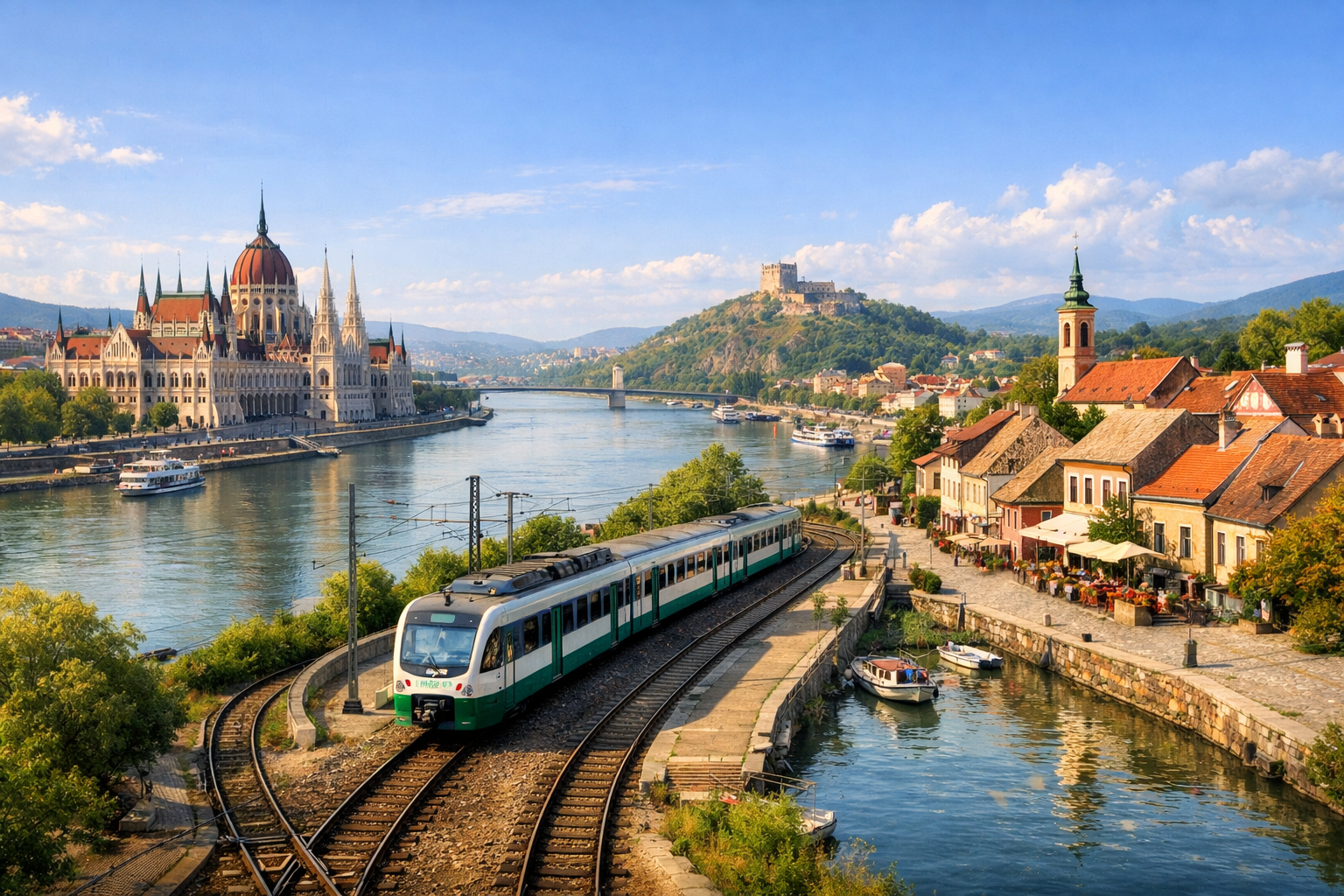
Discover Hungary on a budget with a trip that pairs Budapest’s grand riverfront and thermal-bath charm with the cobbled lanes and colorful galleries of Szentendre. From April to October, it’s an easy and scenic escape by suburban train and public transport, with the Danube tying the whole journey together.

🧭 DAY-BY-DAY ITINERARY

Ready-made country and city routes with daily plans, sights, transport and accommodation. Buy PDF guides for independent travel.

🧭 DAY-BY-DAY ITINERARY


Day 1 — Budapest: arrival, Pest, the Basilica, and the Danube embankment

  • 🚆 From Ferenc Liszt Airport, the most convenient way to get to the center is by the 100E Airport Express bus: it is a direct route to Deák Ferenc tér, a key transport hub in central Pest. The journey usually takes about 30–40 minutes with no transfers, buses run frequently during the day, and the route is especially convenient for a budget trip because it brings you straight into the heart of the city. After check-in, give yourself at least 1–1.5 hours to rest and have a light snack: Budapest is best taken in gradually, not in a rush, with a pause after the road.

  • 🚶 The first evening is ideal for getting acquainted with central Pest. Start at Deák Ferenc tér and walk to St. Stephen’s Basilica — one of the main symbols of the Hungarian capital. This is not just a large church, but an important visual axis of the city center: broad streets, cafés, historic façades, and the gentle rhythm of evening Budapest all converge around it. The stone here seems warm even at dusk, and the square itself feels calm and beautiful: some people sit on the steps, some photograph the dome, others head unhurriedly to dinner. In spring and summer, this part of the city is especially pleasant for a leisurely walk.

  • 🚶 Then walk to Széchenyi István tér and the Chain Bridge. Evening Budapest truly opens up by the water: the Danube here is wide, dark, and noble, and the two banks seem to speak to each other through lights, domes, and the silhouettes of hills. On the way, you can stop at the “Shoes on the Danube Bank” memorial — a quiet, very powerful place of remembrance. Then it is worth simply walking along the embankment at an easy pace, watching the Parliament light up and the reflections of the bridges tremble on the water. For the first day, this is more than enough: the route is short, logical, beautiful, and not too tiring after a flight.


Day 2 — Budapest: Parliament, the historic center, and the Hungarian National Museum

  • 🚶 Start the morning in the area around the Parliament building. The Hungarian Parliament on the bank of the Danube looks almost theatrical: the long neo-Gothic façade, the rhythm of towers, carvings, spires, and the huge dome create the feeling that this is not an administrative building, but a stone set from a historical epic. It is best to come early, while the streets are still not too noisy: then the scale of Kossuth Lajos tér and the monumentality of the whole composition are felt especially well.

  • 🚶 Then you can walk through the inner streets of Pest toward Vörösmarty tér and the pedestrian quarters of the central city. Here Budapest becomes lighter and more everyday: cafés, neat façades, arches, old hotels, small passageways, and an unhurried urban rhythm. This matters on a budget route: many of the capital’s strongest impressions come completely free of charge, simply through walking and observing the urban fabric. Allow at least 2–3 hours for the walk, coffee, and rest.

  • 🏛️ In the second half of the day, head to the Hungarian National Museum. It is one of the country’s main museums, and it is especially good for the first or second day of the trip because it helps bring together the full historical perspective of Hungary: from early eras and coronation stories to revolutions, the imperial period, and modern national memory. The building itself is also impressive — строгий классицизм, широкая лестница, просторный сад снаружи и благородные музейные интерьеры внутри. After the museum, do not overload the evening: it is better to return calmly to the hotel or end the day with a short walk near Kálvin tér.

Day 3 — Budapest: the Buda side, Fisherman’s Bastion, and Castle Hill

  • 🚆 Getting to the Buda side is convenient by public transport with a transfer through the center; depending on your starting point, the journey usually takes 20–30 minutes. It is better to start early so you can walk around the hill in the soft morning light and without unnecessary rush.

  • 🚶 Today the city opens from a different angle — more elevated, panoramic, and almost fairy-tale-like. The area of Buda Castle and Fisherman’s Bastion is the Budapest that stays in your memory for a long time: pale stone, terraces, turrets, stairways, arcades, and sweeping views over the Danube, Pest, and the Parliament building. Fisherman’s Bastion is often seen as a romantic backdrop, but in reality it makes an even stronger impression: you really want to linger here, stroll through the galleries, sit on a bench, and gaze at the city below for a long time.

  • 🚶 Be sure to see Matthias Church and then simply get lost in the streets of Castle Hill. In this area, it is not only about ticking off the main viewpoints, but about the feeling of the place itself: cobbled lanes, colorful houses, old courtyards, quiet beyond the busiest spots, unexpected arches, and descents. If you have the mood and energy, walk down toward the Danube — such a slow descent is a beautiful way to end the day. Considering the climb, the walk, photo stops, and rest, it is reasonable to set aside almost the whole daylight part of the day, but without a strict pace.

Day 4 — Szentendre: an artistic town on the Danube and, if desired, Skanzen

  • 🚆 A trip to Szentendre is the main out-of-town excursion of this route. From Budapest, it is convenient to take the H5 suburban line from Batthyány tér to Szentendre. This is exactly the kind of budget travel format that suits the route perfectly: no car rental, no complicated logistics, just a clear direct journey. You should allow about 40–45 minutes each way for the ride itself, plus 10–15 minutes for getting to the station and waiting.

  • 🚶 Szentendre sharply changes the mood of the trip. After the capital’s monumentality, you find yourself in a small, almost intimate town with an artistic character, narrow streets, colorful façades, stairways, Baroque houses, and the closeness of the Danube. Here it is pleasant not to “follow a program,” but to wander freely: go out to the Main Square, walk to the embankment, look at the roofs, churches, and little shop windows, step into courtyards, climb side streets, and catch the feeling of an old Danube town that has long lived in its own rhythm.

  • 🏛️ In the center of Szentendre, it is best to choose 1–2 museums according to your interests rather than trying to cover everything at once. The town is especially known for its art and local museum spaces, so the day turns out very lively: a little art, a bit of history, a walk by the water, and a calm lunch without the bustle of the capital. If you want a richer ethnographic experience and are ready for extra logistics, you can devote the second half of the day to Skanzen — the large Hungarian open-air museum. A local bus goes there from the HÉV station, and the territory itself is quite large, so it becomes almost a separate adventure. In that case, it is better to see the center of Szentendre compactly in the morning.

Day 5 — Budapest: City Park, the House of Music Hungary, and a final walk

  • 🚶 It is best to make the last day more relaxed and modern in mood. Head to Városliget — the city park, where Budapest shows itself not as an imperial postcard, but as a comfortable large European city for living and walking. There is plenty of air, trees, broad alleys, and space here, and the area works well for a final day: it does not require heroic walks and leaves room for rest before the journey.

  • 🏛️ One of the most interesting places here is House of Music Hungary, the House of Music of Hungary. It is a very striking modern building with light, almost floating architecture that contrasts beautifully with the city’s classic image. Even if you are not planning a long museum visit, it is worth coming here for the atmosphere of a new cultural Budapest itself: transparent surfaces, flowing lines, the proximity of the park, and the feeling that the city can be not only historical, but also unexpectedly contemporary.

  • 🚶 If you still have time, round out the day with the Museum of Fine Arts or simply a long walk through the park and around Heroes’ Square. After that, return to the center, collect your things, and allow enough time for the journey to the airport. For departure, the 100E Airport Express is convenient again, and if your flight is very early or late and you want fewer transfers, you can use an official airport transfer or taxi. This kind of finale makes the route feel complete: the capital, a suburban artistic town, historic panoramas, and one calm, beautiful closing day.

Flight tickets

eSIM for travel

Buy PDF guide

Buy PDF guide — 10.71 USD

PDF — 10.71 USD