
Buy PDF guide

Buy PDF guide — 10.71 USD

PDF — 10.71 USD

Bicycle tour in Germany

Bicycle tour in Germany

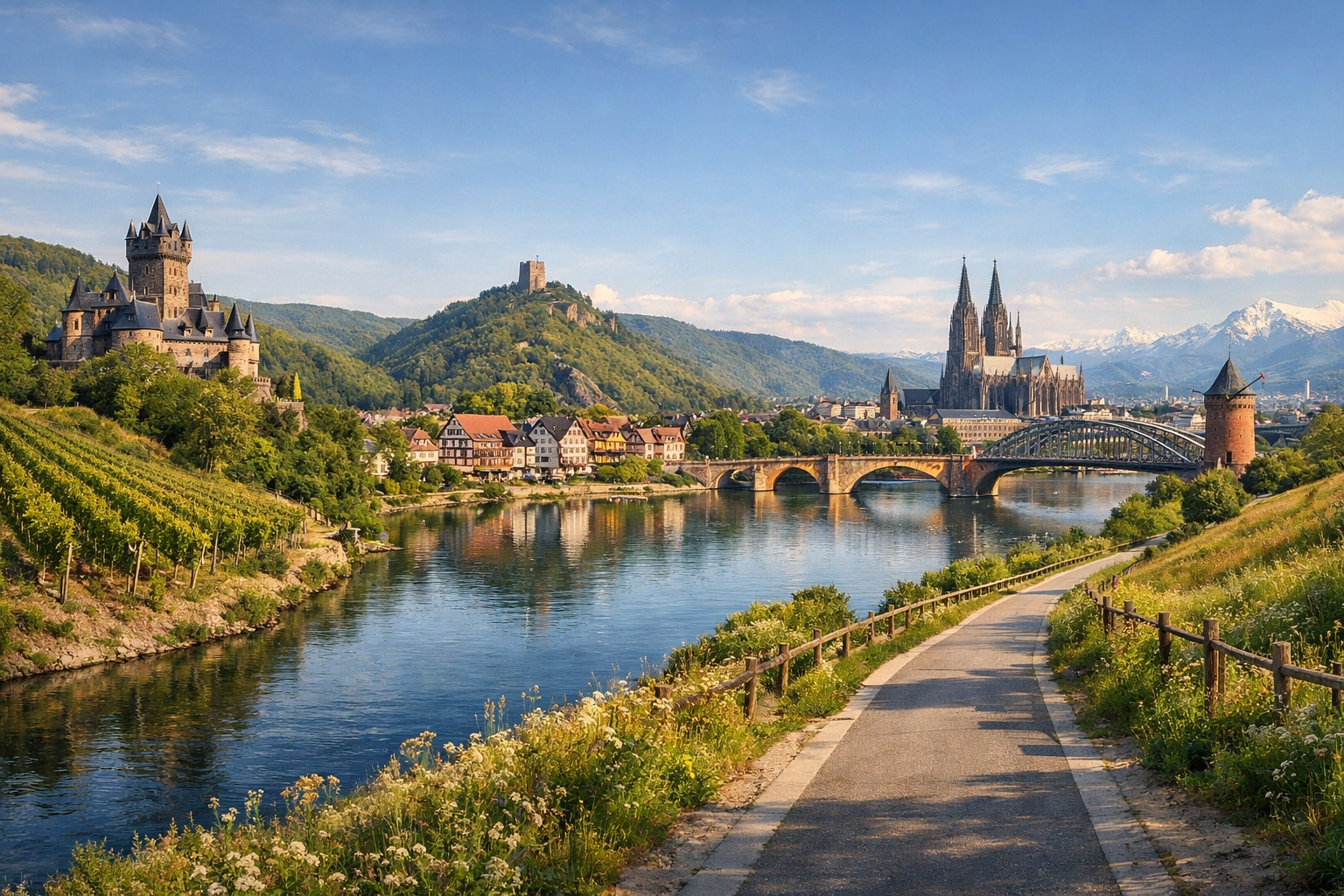
Pedal through the heart of western Germany on a scenic ride from Cologne to Mainz, following the Rhine past riverside towns, vineyard slopes, and storybook castles. With stops in Bonn and Koblenz, this route blends relaxed cycling with rich history, grand views, and classic German charm.

🧭 DAY-BY-DAY ROUTE

Ready-made country and city routes with daily plans, sights, transport and accommodation. Buy PDF guides for independent travel.

🧭 DAY-BY-DAY ROUTE


Day 1 — Cologne: arrival, cathedral, and Rhine promenades

  • 🚆 A convenient starting point for a cycling tour of western Germany is Cologne. From Cologne/Bonn Airport, it is usually easy to reach the city center by regional trains and S-Bahn in about 15–20 minutes, and the historic center itself is laid out so that after the journey you do not have to dive straight into complicated logistics: the station, cathedral, old town, Rhine, and many hotels are literally within a short walk. This is an ideal first day to ease into the rhythm of the trip, assemble or pick up your bike, catch your breath after the flight, and avoid overloading yourself with a long transfer right away.

  • 🚶 Cologne welcomes you not with flashy postcard perfection, but with vibrant urban grandeur: the enormous Cologne Cathedral rises directly above the station like a stone summit of the Gothic era, while around it hums a modern city full of cafés, museums, trams, and cyclists. When you step out to the Rhine, the picture changes: a wide river, sightseeing boats, long embankments, and the famous views of the Hohenzollern Bridge create a sense of space and movement. For the first day, it is best to keep your route gentle and not chase a checklist: the cathedral, a walk through Altstadt, the Konrad-Adenauer-Ufer embankment, then an easy ride or stroll along the riverside bike paths. Here it is especially pleasant to feel that the Rhine route is not only about sport, but also about culture, architecture, beer in historic brew houses, and long bright evenings by the water.

  • 🚴 If you still have energy after the trip, you can do a short warm-up loop around the city without serious strain: old town → embankment → area by Museum Ludwig → farther south along the river toward Rheinauhafen and back. Such a ride usually takes 1.5–2.5 hours with stops and helps you check your fit, brakes, luggage, navigation, and your own pace. It makes sense to stay overnight in central Cologne: in the morning it is easier to join the Rhine cycle route and start a full day in the saddle without stress.


Day 2 — Cologne → Bonn: a calm cycling transfer along the Rhine

  • 🚴 Transfer: Cologne → Bonn via the Rhine Cycle Route, approximately 35–40 km of actual route, usually 2.5–4 hours in the saddle without long stops. Including coffee, photos, rest by the water, and an easy pace, it is reasonable to allow almost a full day — about 5–7 hours total.

  • 🚶 This is one of the most comfortable and psychologically pleasant days to begin a big cycling journey. The route does not require heroics: it runs through an urbanized yet very bike-friendly Rhine valley, where you can often ride at a steady pace without battling mountains or difficult terrain. Along the way, urban and semi-urban scenery gradually shifts: residential neighborhoods give way to more open stretches, river views appear, green spaces and promenade sections emerge, and you get the feeling that you are truly moving along one of Europe’s great rivers rather than simply going from point A to point B.

  • 🚶 Bonn at the end of the stage feels like a more intimate and refined counterpoint to bustling Cologne. The former capital of West Germany does not try to overwhelm, but it quickly wins you over with its tidy streets, measured rhythm, university atmosphere, and beautiful embankments. After a day in the saddle, it is pleasant to slow down here: ride the final kilometers without rushing along the riverside district, walk to the historic center, have dinner on one of the quiet streets, and feel how the route begins to reveal not only the landscape but also the character of the cities. A night in Bonn is also practical: it divides the journey into reasonable parts and keeps the trip from turning into a nonstop marathon.

Day 3 — Bonn → Koblenz: a long but beautiful stage toward the Upper Middle Rhine

  • 🚴 Transfer: Bonn → Koblenz, approximately 60–70 km depending on the bank chosen, detours, and stop points. This is already a full riding day: 4.5–6.5 hours of pure pedaling, and with rest, lunch, and photo breaks it is better to plan for 7–9 hours.

  • 🚶 As you move south, the route becomes increasingly “Rhine-like” in the classic sense: the river feels more powerful, the landscape takes on the rhythm of a valley, and historic towns with more dramatic views begin to create that romantic image people come here from all over the world to see. This day is best done without rushing and with respect for your own strength: an early start, a light breakfast, regular stops every 15–20 km, and enough water work better than trying to heroically push through the stage on willpower alone.

  • 🚶 Koblenz is a very successful climax for the third day. The city stands at the confluence of the Rhine and Moselle, and this is not just a geographical fact but almost a theatrical scene: broad waters, terraces, viewpoints, old streets, and the imposing Ehrenbreitstein Fortress above the river. When you arrive here by bike after a long stage, the city feels like a truly earned finish. In the evening, it is better not to plan an intense museum program: it is much nicer to walk to Deutsches Eck, watch the two rivers meet in the soft sunset light, and let your legs rest. If you still have energy, you can take the cable car up in the evening or save that highlight for the morning.

Day 4 — Koblenz: recovery, Ehrenbreitstein Fortress, and panoramas

  • 💤 After two riding days in a row, it is very wise to have an easier day without a long transfer. For a bike tour, this is not “lost” time but a smart part of the route: your muscles recover, your back and hands get a rest, and your impressions finally have time to settle. On days like this, the journey starts to feel less like a sports task and more like a real acquaintance with the region.

  • 🚶 Koblenz is perfect for such a pause. The city’s main stage is Deutsches Eck, the famous headland at the confluence of the Rhine and Moselle, where the space literally opens up like a fan of water, sky, and banks. From here you can see especially clearly how strategic and beautiful this place has been for centuries. Above the city rises Ehrenbreitstein Fortress — a huge historic complex on a rocky ledge, easily reached by cable car. The ascent itself is already a separate experience: the cabins glide above the Rhine, and below you the embankment, old town, riverboats, and the receding lines of the valley unfold.

  • 🚶 At the fortress itself, it is worth doing more than just “checking the box” — give yourself time to walk along the bastions and panoramic terraces. Here the scale of the Rhine landscape is felt especially well: rivers, bridges, rooftops, green slopes, and transport corridors come together into an almost textbook picture of European river civilization. After lunch, you can do a short easy ride along the embankment without luggage or simply walk through the old center. A day like this helps restore your strength before the final transfer and makes the route feel more mature and comfortable, without overload.

Day 5 — Koblenz → Mainz: final transfer with logistical margin

  • 🚴 Transfer: Koblenz → Mainz in full along the river is too long for a relaxed one-day finale, so a realistic option for a 5-day route looks like this: regional train in the morning from Koblenz → Mainz, about 1–1.5 hours, then a cycling day already in Mainz without heavy luggage or with only a minimal load. This allows you to preserve the logic of the route and not turn the final day into an exhausting extra-long stage.

  • 🚶 Mainz is a very good finishing point: the city is linked with the name of Johannes Gutenberg, stands on the Rhine, has a compact historic center, and gives a sense of a cultural finale after the river route. It is a great place for a concluding urban cycling day: ride along the embankment, walk to the cathedral, explore parts of the old center, and end the trip with a museum visit rather than yet another battle with mileage. Mainz has a softer, more human scale compared with Cologne, and it suits the final day perfectly, when you want not only to ride but also simply enjoy the fact that the route came together.

  • 🚶 The main cultural focus of the finale is the theme of printing and urban history. The city does not look like a decorative museum exhibit; on the contrary, it is lively, student-oriented, wine-loving, a little businesslike, and at the same time deeply historic. It is pleasant to finish the route in such an atmosphere: not at a station in a rush, but in a city where you can calmly return the bike, have dinner, spend the night, and only leave the next morning. Such an ending makes the whole 5-day tour logical, sustainable in terms of effort, and truly doable.

Flight tickets

eSIM for travel

Buy PDF guide

Buy PDF guide — 10.71 USD

PDF — 10.71 USD