
Buy PDF guide

Buy PDF guide — 6.43 USD

PDF — 6.43 USD

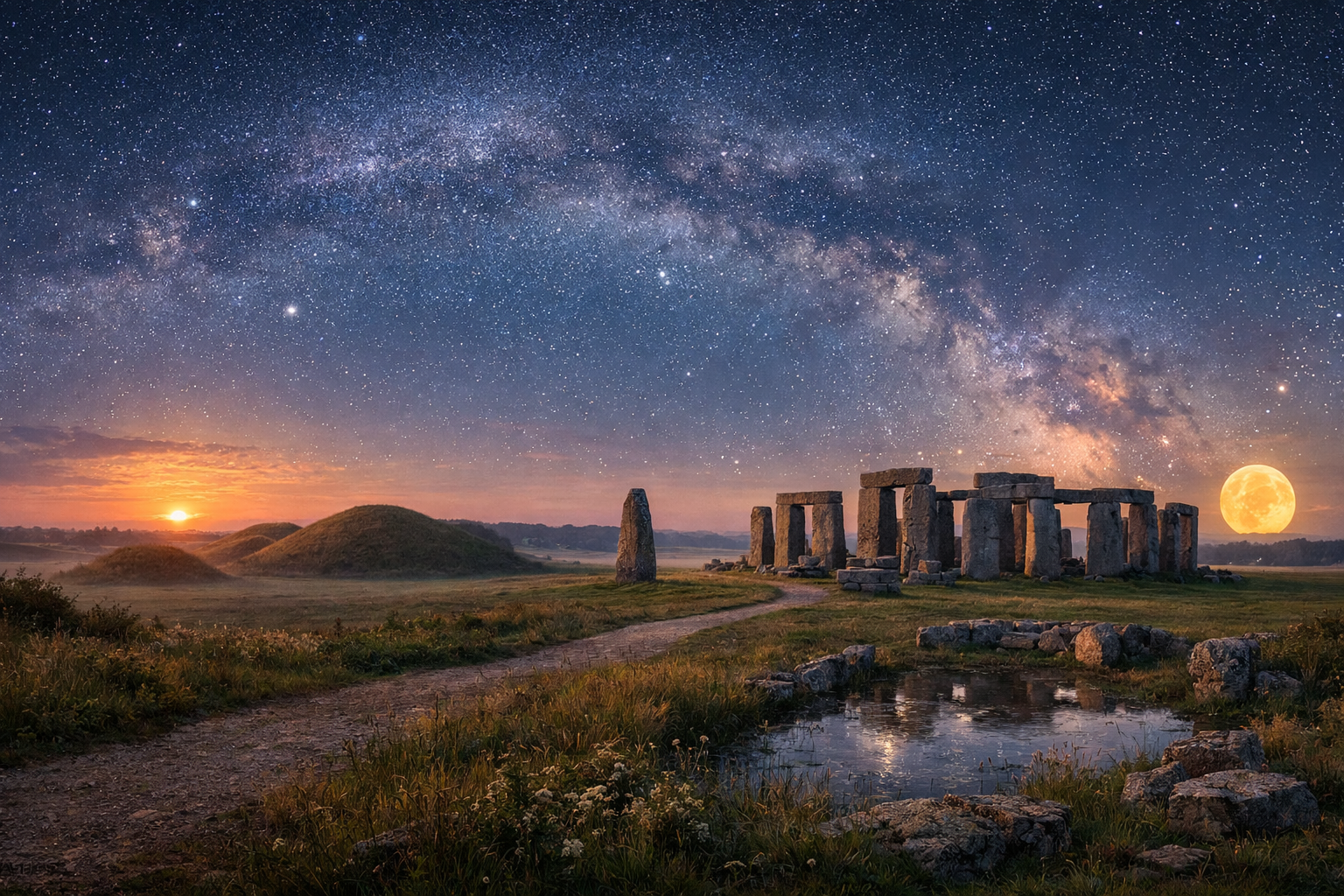
Great Britain, Wiltshire. Stonehenge and the mysteries of the ancient sky. A journey to Stonehenge, the surrounding barrows, and the ancient landscape with a focus on archaeoastronomy, the solstices, legends, and the atmosphere of one of the most mysterious places in Europe.

Great Britain, Wiltshire. Stonehenge and the mysteries of the ancient sky. A journey to Stonehenge, the surrounding barrows, and the ancient landscape with a focus on archaeoastronomy, the solstices, legends, and the atmosphere of one of the most mysterious places in Europe.

In Wiltshire, ancient skies still shape the land. Travel from Salisbury to Stonehenge, Avebury, and Devizes through a landscape of barrows, solstice alignments, and enduring legends, where every horizon seems to hold a secret.

🧭 DAY-BY-DAY ITINERARY

Ready-made country and city routes with daily plans, sights, transport and accommodation. Buy PDF guides for independent travel.

🧭 DAY-BY-DAY ITINERARY


Day 1 — Salisbury and Stonehenge: archaeoastronomy, sacred landscape, and evening atmosphere

  • 🚆 It is most convenient to plan your arrival via Salisbury — this is the most practical transport hub for a short route through southern Wiltshire. From Salisbury railway station, it is only a few minutes by taxi to the city centre and cathedral quarter, or about a 20–25 minute walk. For a trip to Stonehenge without your own car, the Stonehenge Tour tourist bus by Salisbury Reds is convenient; it links the station, central Salisbury, Old Sarum, and the Visitor Centre at Stonehenge. If you are flying into London or Southampton, allow extra time for connections: the region is not difficult logistically, but in Britain it is better to check timetables in advance, especially on Sundays and on days of major events at the monument.

  • 🚶 The first half of the day is for getting to know Salisbury as a historical prologue to megalithic Wiltshire. It is worth walking through Cathedral Close, where medieval architecture unexpectedly creates a calm contrast with the prehistoric landscape of the following days. At The Salisbury Museum, the collections on the prehistoric archaeology of southern Wiltshire are especially important: this is where it is convenient to get context before Stonehenge — to see objects connected with rituals, burials, craft, and everyday life in the Neolithic and Bronze Age. For an esoteric route, this is an important starting point: the museum helps separate real archaeological data from the romantic and occult interpretations that so often accompany conversations about Stonehenge.

  • 🚶 After the museum, you can make a short visit to Salisbury Cathedral. This is no longer a prehistoric sacred centre but a Christian one, yet it matters for the route as a place marking the смена spiritual eras: from the megalithic landscape to the Gothic cathedral. Here it is more appropriate to speak not of the “magic of the place,” but of how different sacred geographies in Britain overlap one another. Many travellers feel a strong atmosphere of silence in the church, but that is a subjective experience, not a provable property of the space. Inside, you should follow church rules, avoid disturbing services, and pay close attention to photography restrictions.

  • 🚌 In the daytime, head to the Stonehenge Visitor Centre. A standard visit is arranged so that you first enter the modern exhibition centre, then either take a shuttle bus or walk to the circle itself. During normal visiting hours, visitors are not allowed inside the circle: the route follows a path around the stones, at some points only a few metres away. This is fundamentally important both for preservation of the monument and for setting correct expectations. If you specifically want the experience of being inside the circle, you need a separate Stone Circle Experience, held early in the morning or in the evening outside normal opening hours, with mandatory advance booking and a very limited number of participants.

  • 🚶 Stonehenge is one of the most famous prehistoric structures in Europe, and much of its power as an impression lies in the combination of geometry, horizon, and sky. A verifiable fact is that the layout of the monument is linked to solar directions, above all the line of the summer sunrise and winter sunset, which makes the discussion of archaeoastronomy here appropriate and meaningful. But everything concerning “portals,” “transmission of cosmic energy,” a “machine of the druids,” or proven mystical effects belongs instead to the sphere of modern esoteric culture, popular books, neo-pagan practices, and tourist imagination, not to scientific consensus. And that is precisely the charm of the place: it allows for many meanings, but not all of them are equally well supported by evidence.

  • 🚶 After the main circle, give some time to the surrounding landscape: the Heel Stone, the approach axis, the distant lines of the relief, as well as the Visitor Centre exhibition with archaeological finds and reconstructed Neolithic houses. Here it is especially clear that Stonehenge is not an isolated object but part of a huge ritual landscape with barrows, processional routes, and neighbouring monuments. From an esoteric point of view, this kind of whole landscape is often perceived as a “place of power”; more accurately, however, it is a cultural and symbolic landscape of exceptional historical density, one that for centuries has inspired in people a sense of awe, mystery, and interpretive temptation.

  • 🌅 If you manage to book a Stone Circle Experience, the evening among the stones will become the climax of the day: the light is lower, there are fewer people, and the monument feels far less museum-like and much more contemplative. But it is important to remember the rules — you must not touch the stones, you must not go beyond the limits set by the guides, and the programme itself depends on weather, availability, and the site’s protection regime. On the days of solstices and equinoxes, separate managed open access arrangements, large crowds, and different logistics are possible, so for a more intimate esoteric journey it is calmer to choose ordinary dates outside peak festivals.


Day 2 — Avebury, West Kennet Long Barrow, and Silbury Hill: megaliths, barrows, and living folklore

  • 🚗 On the second day, it is best to head to the northern part of Wiltshire early, ideally by rental car or taxi/private transfer, because the Avebury — West Kennet Long Barrow — Silbury Hill combination is much more convenient by car. From Salisbury to Avebury, the drive usually takes about 1 hour 10 minutes to 1 hour 25 minutes depending on traffic; from Amesbury, a little less. If you do not have a car, the route is still possible, but it requires more careful coordination of buses and loses noticeably in pace.

  • 🚶 Avebury creates a completely different impression from Stonehenge. Here a huge prehistoric henge and stone circles are literally woven into the village: roads, houses, fields, and pubs coexist with the megaliths so closely that antiquity is perceived not as a museum object behind a fence, but as part of everyday space. Archaeologically, this is one of the key centres of Britain’s prehistoric ritual landscape, included in the same World Heritage Site as Stonehenge. Esoteric interpretations especially love Avebury precisely for its “accessible contact”: here you can walk more freely beside the stones than at Stonehenge, and so the place is often included in routes for neo-pagans, followers of earth energies, and admirers of sacred geometry. But such interpretations should be understood as cultural practices and personal beliefs, not as scientifically confirmed properties of the monument.

  • 🏛️ Be sure to visit the Alexander Keiller Museum. It helps you see Avebury not only as a beautiful mystical backdrop, but also as the result of excavations, research, and the complex history of monument preservation. Alexander Keiller himself is an almost novel-like figure: an archaeologist, patron, and a man of an era when prehistoric monuments began to be simultaneously studied, restored, and mythologised anew in the popular imagination. The museum is valuable because it brings the conversation back to artefacts, stratigraphy, reconstructions, and historical methodology — in other words, it provides a counterweight to modern legends.

  • 🚶 Next comes a walk to West Kennet Long Barrow. This is one of the most impressive Neolithic long barrows in southern England, and you can still enter its chambers. Physically, it is a very powerful place: the low entrance, chalk slope, long mound, silence, and wind create a feeling of a ritual threshold between light and the dark inner space. Historically, this is an early Neolithic funerary monument associated with collective burials and complex rites of memory. In esoteric circles, the barrow is often described as a place of contact with ancestors, the “womb of the earth,” or a point of concentrated energy; these are metaphorical and spiritual interpretations, not proven scientific facts. Inside, it is especially important to behave respectfully: do not make noise, leave nothing behind, and do not stage improvised rituals without regard for other visitors and the protected status of the site.

  • 🚶 On the way, view Silbury Hill from the viewpoint. This is the largest prehistoric artificial mound in Europe, and its very ambiguity generates especially many mystical hypotheses. It is scientifically confirmed that the mound was created by humans in prehistoric times, but its precise purpose remains a matter of interpretation. That is why the gap between facts and legends is especially visible here: some see it as an astronomical marker, others as a royal tomb, still others as a ritual centre or a symbol of landscape power. Modern access is usually limited to viewing it from outside, and you may not climb the hill: this is a matter of both monument preservation and safety.

  • 🌿 If you still have energy, you can walk part of the West Kennet trail between the key points of the landscape. This is the best way to understand why many people speak of the “sacred geometry” of these places: not because there is a proven supernatural network, but because the mutual arrangement of hills, barrows, paths, and monuments really does create a rare sense of spatial intentionality. Late day and soft light are especially good for photographs and contemplative walking. But keep the British weather in mind: wind, wet grass, and clay make shoes with good grip almost essential.

Day 3 — Devizes, Bronze Age gold, Woodhenge, and Old Sarum: ending the route through memory and interpretation

  • 🏛️ The morning of the third day is best devoted to Wiltshire Museum in Devizes. It is one of the best museums in the region for understanding the Bronze Age of Wiltshire and the world connected with the monuments around Stonehenge and Avebury. Its collections of gold, burial finds, ornaments, weapons, and status objects bring back into human scale what on the landscape can seem like an abstract “mystery of antiquity.” For an esoteric route, the museum is especially useful because it does not destroy the mystery, but makes it deeper: behind every megalith and barrow, you begin to see specific communities, elites, rites, and ideas about death, the sky, and memory.

  • 🚗 After Devizes, it makes sense to return to the southern part of the county and stop at Woodhenge on the way. Today, concrete markers stand on the site to indicate the former concentric circles of wooden posts, so visually the site is much more modest than Stonehenge or Avebury. But that is precisely its special strength for an attentive traveller: here you have to imagine, reconstruct, and mentally assemble the vanished architecture of ritual. Historically, Woodhenge is an important part of the same great prehistoric complex. In popular mystical culture, it is sometimes described as the “shadow twin” of Stonehenge or as a space for lunar-solar ceremonies, but that is an interpretive layer rather than a generally accepted proven reconstruction.

  • 🚶 If time allows, a short stop at Old Sarum is very appropriate. Formally, this is not a Neolithic monument but a multilayered place with a prehistoric, Roman, Saxon, and medieval past. For the theme of the journey, it matters as a reminder that sacredness and power in Britain were constantly relocated and reinterpreted: some centres were forgotten, others arose nearby, and still others absorbed the memory of their predecessors. By the earthworks and on the windy plateau of Old Sarum, it is easy to feel that very “liminal” mood that mystical routes love, but it is more accurate to speak not of the paranormal, but of a rare concentration of historical layers, open horizon, and human imagination.

  • 🌒 The finale of the route can be made contemplative: return to Salisbury in the early evening, have a calm dinner, and leave time for personal reflection. This three-day tour is deliberately designed to connect three levels of perceiving Wiltshire: the scientific — through museums and protected monuments; the landscape level — through roads, hills, barrows, and sightlines; and the cultural-mythological — through legends, neo-pagan practices, stories of places of power, and the symbolism of the sun, ancestors, and the cycle of the year. It is important to take away exactly this distinction: the ancient monuments are indeed grand and historically significant, and their mystical reputation is part of living modern culture, but not a set of proven supernatural facts.

Flight tickets

eSIM for travel

Buy PDF guide

Buy PDF guide — 6.43 USD

PDF — 6.43 USD