
Buy PDF guide

Buy PDF guide — 6.43 USD

PDF — 6.43 USD

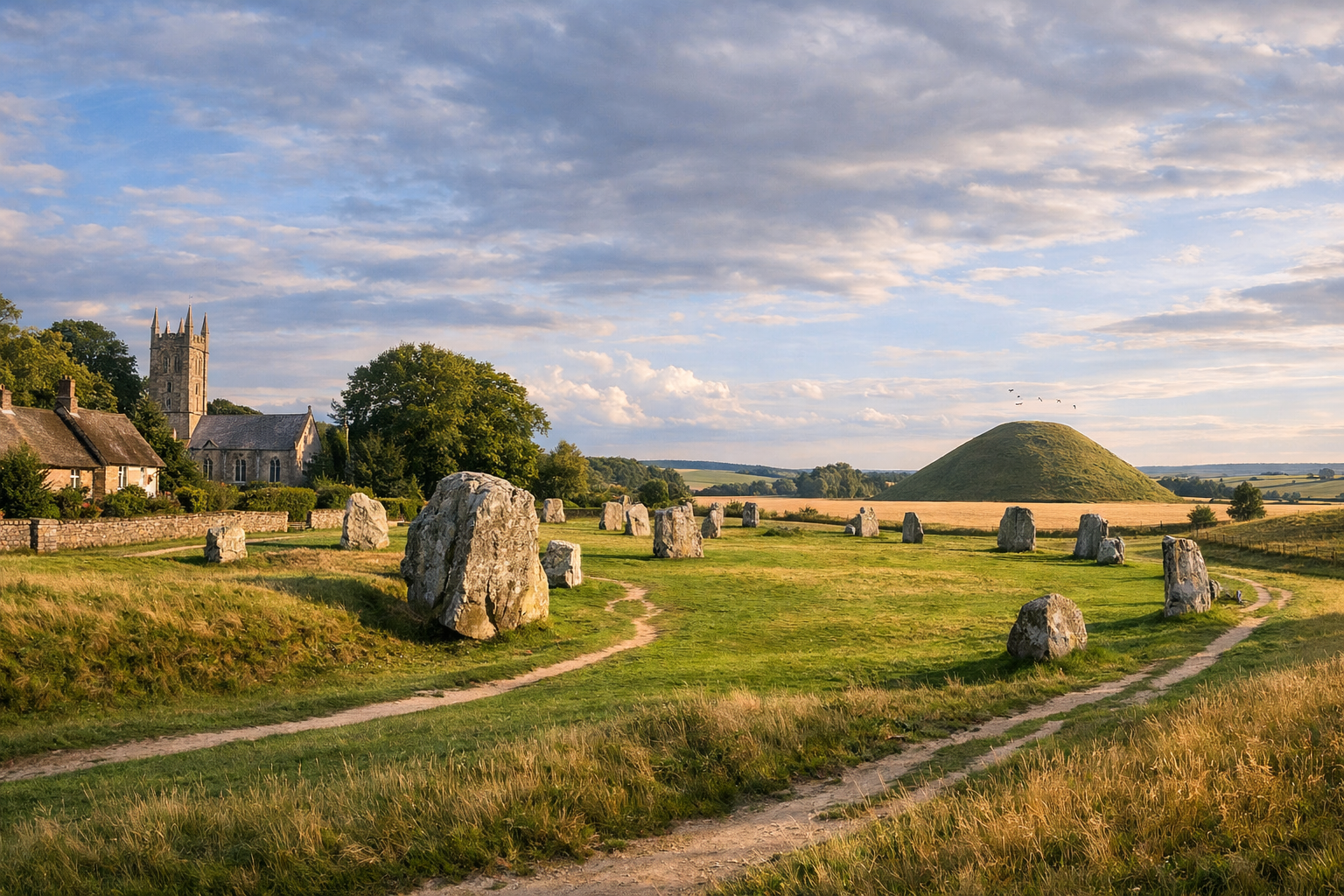
United Kingdom, Wiltshire. Avebury and the megalithic circle. A slow journey among the enormous stone circle of Avebury, Silbury Hill, and the ancient monuments of Wiltshire for lovers of megaliths, symbolism, and the history of pre-Christian Europe.

United Kingdom, Wiltshire. Avebury and the megalithic circle. A slow journey among the enormous stone circle of Avebury, Silbury Hill, and the ancient monuments of Wiltshire for lovers of megaliths, symbolism, and the history of pre-Christian Europe.

Wander through the ancient heart of Wiltshire, where the vast stone circle of Avebury rises from the landscape and prehistoric mysteries linger in every field and barrow. From nearby West Kennet to Silbury Hill, this is a slow, soulful journey through one of Europe’s richest megalithic landscapes.

🧭 DAY-BY-DAY ROUTE

Ready-made country and city routes with daily plans, sights, transport and accommodation. Buy PDF guides for independent travel.

🧭 DAY-BY-DAY ROUTE


Day 1 — Avebury: the stone circle, the village inside the henge, and the museum

  • 🚆 The route is easiest to base around Swindon or Marlborough. If you are arriving by train from London, a practical option is to travel to Swindon and then change to the Stagecoach 49 bus to the Avebury Red Lion stop. The journey from Swindon to Avebury usually takes about 35–45 minutes, depending on the service and stops. For a short three-day route, this is one of the most realistic ways to avoid stressful transfers and keep the trip’s “slow” rhythm.

  • 🚶 Avebury is one of the most impressive prehistoric sites in Europe and part of the World Heritage property “Stonehenge, Avebury and Associated Sites.” Unlike Stonehenge, the megaliths here are not separated from everyday life: the village is literally located inside a huge earthwork henge and stone circle. This is exactly what creates the special feeling here—not museum-like distance, but the coexistence of the ancient and the ordinary. Enormous sarsen stones rise right beside paths, pastures, houses, and the old parish church, and a walk here feels not like “visiting a site” but like a slow entry into an archaeological landscape.

  • 🚶 From a historical point of view, Avebury is an outstanding Neolithic ceremonial complex that took shape in the 3rd millennium BCE and includes a gigantic ditch and bank, an outer circle, and internal stone structures. One verifiable fact is that it is one of the largest surviving megalithic complexes in Britain. Stories claiming that the “energy of the earth lines” is especially strong here, that the circle was a precise astro-magical instrument, or that secret druid knowledge has been preserved in it belong not to scientific knowledge but to later esoteric interpretation, antiquarian romanticism of the 18th–20th centuries, and modern folklore. These narratives matter as part of the site’s cultural biography, but not as established fact.

  • 🏛️ Start the day at the Alexander Keiller Museum in the old farmyard. It is the best introduction to the Avebury landscape: here you will find discoveries from excavations, information about the construction of the circle, long barrows, avenues, and nearby monuments. The museum is especially useful for an esoteric-themed route because it helps separate archaeology from later myth-making. You will see how understanding of this landscape changed—from antiquarian guesses about “druid temples” to modern interpretations based on field research.

  • 🚶 After the museum, devote a few hours to a leisurely walking loop around the stone circle itself, the bank, and the village. In good weather from April to October, it is especially pleasant to walk without hurrying: soft light on the sarsens, sheep on the grassy slopes, views of St James Church, and garden walls create an almost meditative mood. If you want to add an aesthetic note, not only an archaeological one, you can also visit the garden of Avebury Manor. The house and garden are connected not to the Neolithic but to the later history of the estate; at the same time, in Avebury’s cultural memory the manor is often perceived as part of a “layered” sacred landscape where the medieval and the modern are superimposed on the prehistoric.

  • ⚠️ It is important to remember in practical terms: the stones and earth banks are in an open landscape that should be respected as both an archaeological monument and a rural area. You should not climb vulnerable sections, cross fences, disturb livestock, or stage “rituals” in passageways or near local residents’ homes. Legends of a “place of power” are alive here, but a traveler’s behavior should remain calm, respectful, and environmentally responsible.


Day 2 — West Kennet: the long barrow, Silbury Hill, the avenue, and the Sanctuary

  • 🚶 This day is best devoted to one continuous walk through the landscape southeast of Avebury. On foot from the village to West Kennet Long Barrow, you should usually allow about 45–60 minutes at an easy pace with stops, if you go via the area connected with West Kennet Avenue and views of Silbury Hill. The overall difficulty remains easy as long as you do not overload the day and take breaks; in spring, summer, and early autumn, this is one of the most beautiful routes in all of Wiltshire.

  • 🚶 West Kennet Long Barrow is one of the best-known chambered long barrows in Britain. Its earliest phase dates to the Neolithic, and it is one of those monuments where you can not only look from outside but also peek inside the chambered space. Historically, this is a burial and ritual monument of great antiquity, associated with collective burials and complex rites of early farming communities. In cultural memory, however, the site has long been surrounded by talk of the boundary between worlds, the “female womb of the earth,” initiations, encounters with ancestors, and altered states of consciousness. Such interpretations are not scientifically confirmed, but they are widely present in modern neo-pagan, esoteric, and tourist circles.

  • 🚶 When entering the barrow chamber, it is especially important to keep quiet and behave delicately. For some visitors, this is above all an archaeological site; for others, it is a symbolic place of memory, contemplation, or personal spiritual practice. The ethical approach here is simple: no loud music, no candles, no wax traces, no inscriptions, no leaving “offerings” that turn into litter and damage the monument. If you want to experience the atmosphere of the place more deeply, it is better simply to sit in silence for a few minutes and notice how the sound, light, and sense of space change.

  • 🚶 Next, head toward Silbury Hill. This is a gigantic artificial chalk mound, one of the most mysterious monuments of Neolithic Britain. A verifiable fact: the hill is man-made, monumental in scale, and belongs to the same sacred landscape complex as Avebury. You may not climb the hill itself: the monument is protected, and access is organized to preserve its structure. Silbury Hill should be viewed from the permitted points and paths around it. It is precisely from a distance that its strange geometry is felt best—as if the landscape had been given an ideal human form.

  • 🚶 For centuries, legends have grown around Silbury Hill: it has been linked to the burial of the mythical King Sil, to solar symbolism, astronomical constructions, and the later occult idea of a “sacred cone” in the body of the earth. There is no scientific consensus confirming such esoteric readings; however, the very fact of persistent myth-making around the hill is highly telling. Silbury almost provokes the imagination—through its disproportion, its silence, and the way it suddenly appears among soft fields and roads.

  • 🚶 If you still have energy, continue to The Sanctuary on Overton Hill—today this is not a place of “spectacular stones” but a marked outline of a former concentric timber-and-stone structure that once stood at one end of West Kennet Avenue. From an archaeological point of view, this is an important ceremonial node connected with processional movement through the landscape. For lovers of sacred symbolism, the very idea of the path is especially interesting here: from the circle to the avenue, from the avenue to the sanctuary, as if the space had been organized not only geometrically but ritually. This is an interpretation, but it is grounded in the real structure of the monuments.

  • 💤 It is best not to delay your return to Avebury or your base in Marlborough until after dark, especially if you are walking along roads and across field sections. You need footwear with good grip: even on an easy route, grass, chalk, damp ground, and uneven paths can be slippery. If you get tired, it is sensible to shorten the route to the Avebury — West Kennet Long Barrow — views of Silbury Hill combination without feeling obliged to reach every point.

Day 3 — Devizes and Marlborough: archaeology, memory of ancient Wiltshire, and a calm ending

  • 🚆 On the third day, it is convenient to make a short trip to Devizes or spend the morning in Marlborough, depending on where you are based. From Avebury and the surrounding area, you can reach Devizes by bus 49 with a real travel time of about 25–35 minutes. This is a good finale to the route: after two days in an open sacred landscape, move into a museum context where ancient Wiltshire is explained through finds, reconstructions, and scholarly commentary.

  • 🏛️ Wiltshire Museum in Devizes is one of the most important places for those who want not only to “feel the atmosphere” but also to understand the material culture of the region’s Neolithic and Bronze Age. The archaeological collections of Wiltshire are especially strong here, including material connected with the landscapes around Avebury and Stonehenge. For an esoteric journey, the museum is valuable because it brings you back to solid ground: after talk of druids, symbolism, landscape lines, and “threshold places,” you see real objects, burial complexes, ornaments, tools, and Bronze Age gold—that is, traces of specific societies, not only our modern projections onto them.

  • 🚶 After the museum, you can take a calm walk through the old streets of Devizes or return to Marlborough. Marlborough itself is not a megalithic center, but it is a pleasant historical base for the route: a long High Street, old facades, the feel of an English market town, and convenient logistics for trips to Avebury. Here the journey naturally slows down, moving from the “large forms” of the ancient landscape to the more intimate rhythm of a small town.

  • 🏛️ If you are interested in later cultural layers and in how England learned to look at its own past, visit The Merchant’s House in Marlborough. This is no longer the Neolithic and not esotericism in the direct sense, but a beautifully preserved 17th-century house that adds the theme of historical memory and interpretation of the past to the route. Places like this show clearly how different eras created their own ideas of antiquity—from religious readings to antiquarian curiosity and romantic mystification.

  • 🌿 End the tour without rushing: tea, a quiet walk, notes about the route, looking through photos, or a short return trip to the stones at sunset if you have a car or are staying very nearby. Avebury is especially powerful not because of the number of “stops” but because of how it gradually changes your perception of space. That is exactly why a three-day format suits this place better than trying to race through the whole south of England.

  • 📌 It is important once again to separate facts from beliefs: Avebury, Silbury Hill, West Kennet Long Barrow, and The Sanctuary are real, outstanding archaeological monuments of world-class importance. Their connection with “energies,” healing, occult power lines, druid initiations, or anomalous phenomena belongs to the sphere of legends, modern spiritual practices, local culture, and personal interpretations. That is the right way to perceive these narratives—with respect, but critically.

Flight tickets

eSIM for travel

Buy PDF guide

Buy PDF guide — 6.43 USD

PDF — 6.43 USD