
Buy PDF guide

Buy PDF guide — 6.43 USD

PDF — 6.43 USD

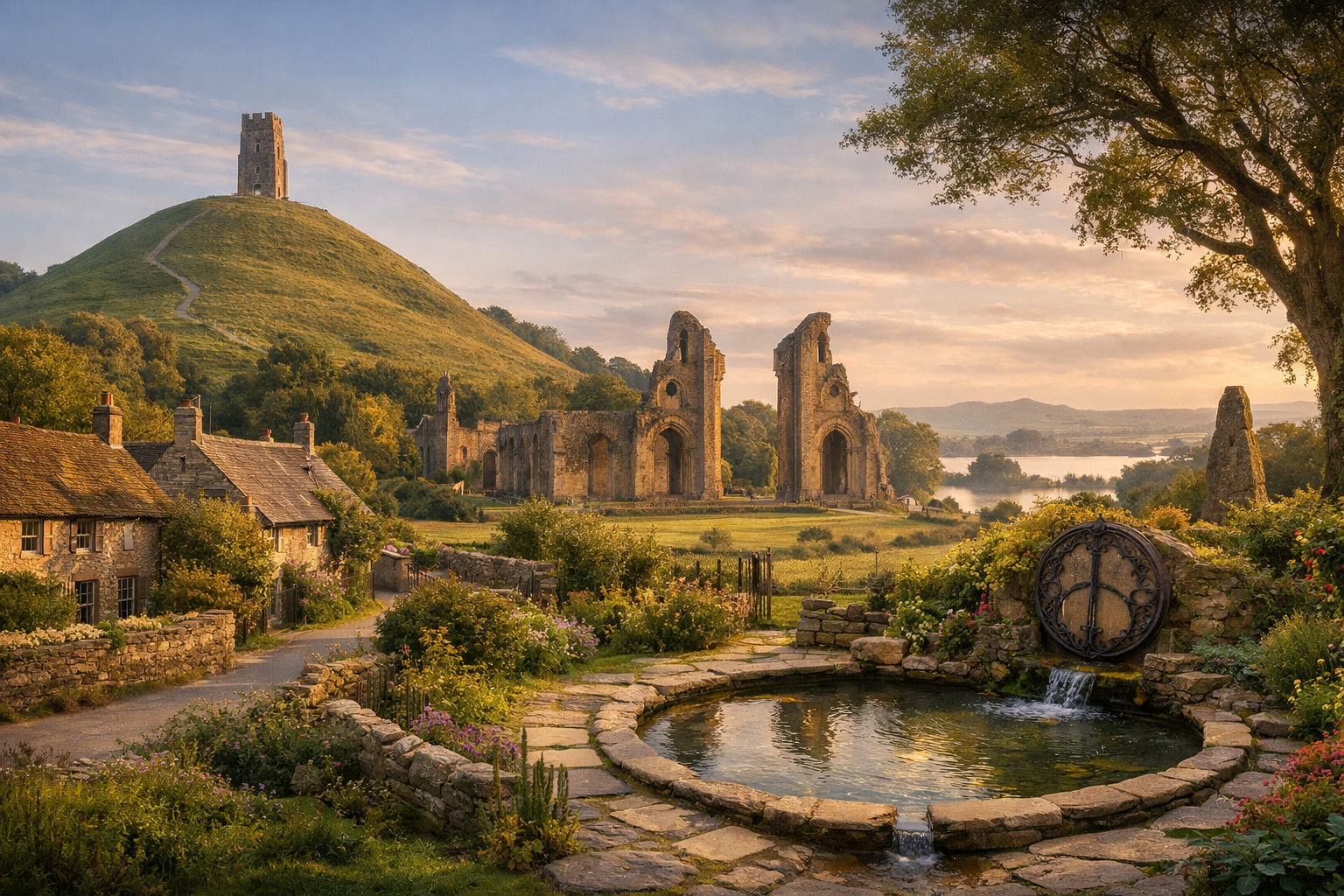
United Kingdom, Somerset. Mystical Glastonbury. Glastonbury Tor, abbey ruins, Chalice Well, and places associated with the legends of Avalon and King Arthur

United Kingdom, Somerset. Mystical Glastonbury. Glastonbury Tor, abbey ruins, Chalice Well, and places associated with the legends of Avalon and King Arthur

Step into mystical Glastonbury, where the hilltop Tor rises above ancient streets and the abbey ruins echo with legends of Avalon and King Arthur. From the tranquil gardens of Chalice Well to the wild beauty of the Avalon Marshes and nearby Wells, Somerset feels timeless, mysterious, and unforgettable.

🧭 DAY-BY-DAY ITINERARY

Ready-made country and city routes with daily plans, sights, transport and accommodation. Buy PDF guides for independent travel.

🧭 DAY-BY-DAY ITINERARY


Day 1 — Glastonbury: the Tor, Chalice Well, and the heart of town

  • 🚆 It is most convenient to plan your arrival via Bristol or the railway station at Castle Cary. From Bristol Temple Meads to Glastonbury, people usually travel with a bus connection toward Wells / Glastonbury / Street; from Castle Cary, the 567 bus link to Street and Glastonbury has been operating in 2025–2026. Allow about 1 hr 40 min – 2 hr 20 min from Bristol including connections, or roughly 50–75 minutes from Castle Cary to central Glastonbury. For an easy route, it is best to check into a hotel in town and then do most of the day on foot.

  • 🚶 Start your journey with Glastonbury Tor — Somerset’s most recognizable hill and perhaps the main symbol of the local mythological landscape. This is a real historical and geographical landmark: a high isolated hill with St Michael’s Tower on the summit, visible from far across the Somerset Levels. Today the site is managed by the National Trust; access to the hill is usually open from dawn to dusk, and the ascent follows a prepared path. The climb itself is not difficult, but it is better to wear comfortable shoes: in rain the slope can be slippery, and the wind at the top can be very strong. From the summit there are broad views over the former marshy expanses, often associated with the image of the “island of Avalon.” This is an important point for the route: as a verifiable fact, Glastonbury really did rise above waterlogged plains; as a legend and cultural interpretation, this is exactly why it was so readily identified with Avalon, the place of King Arthur’s final rest.

  • 🌿 After the Tor, head down to Chalice Well at the foot of the hill. It is one of England’s best-known spiritual and meditative gardens, a real place of pilgrimage and quiet contemplative practice. There is an ancient spring here whose water contains a high amount of iron and therefore has a characteristic reddish tint. The historical fact is the existence of the spring and the centuries-old tradition of revering it; esoteric interpretations — stories of the “divine feminine,” “sacred flow,” “healing,” and the special “energy” of the place — belong to the realm of belief, New Age symbolism, and local spiritual culture rather than scientifically confirmed effects. The gardens of Chalice Well are ideal for a calm day: quiet walks, meditation, journaling, reading, and unhurried rest all feel appropriate here. In season the garden is usually open longer, while winter hours are shorter, so it is best to come in the first half of the day or just after lunch.

  • ⛪ In the second half of the day, head to Glastonbury Abbey — one of England’s most legend-rich historic complexes. The abbey ruins in the town center are a verifiable monument of a vast medieval monastery, while the legends connected with Joseph of Arimathea, early Christianity in Britain, and the burial of Arthur and Guinevere are part of a centuries-old tradition of interpreting this place. The abbey should not be presented as the “proven site of Arthur’s grave,” but as a cultural node where monastic history, pilgrimage, and politically useful medieval legends merged into one powerful narrative, it is almost unique. It is reasonable to allow 2–3 hours to explore the ruins, gardens, and information materials. Entry is usually possible until evening, but the last admission is earlier than closing time, so do not leave the visit until the very end of the day.

  • 🏘️ It is best to finish the day with a slow walk along High Street and Market Place. Modern Glastonbury is famous not only for its history but also for its distinctive urban atmosphere: bookshops and stores focused on mythology, tarot, crystals, fragrances, and ritual symbolism sit side by side with ordinary provincial England. This is an important part of the experience, but it is better understood as the town’s contemporary cultural scene rather than proof of the place’s supernatural status. If you want a gentle evening activity, choose not a frantic sightseeing dash but an early dinner, a quiet walk around St John’s Churchyard, and a calm return to your hotel.


Day 2 — Glastonbury: ruins, museum layers, and the legends of Avalon

  • 🚶 Keep the second day almost entirely walkable so as not to overload the route. Start the morning at the Somerset Rural Life Museum on Abbey Farm, literally near the Tor and not too far from the center. At first glance this is not an “esoteric” stop, but it is very useful for understanding the myth of Avalon: the museum helps you see the material basis of the local world — rural Somerset, peatlands, crafts, daily life, and the very landscape from which the legends grew. When a journey is built around mythology, this contrast is especially important: first the soil, water, economy, and real people, and only then the legendary islands, saints, and kings.

  • 🏛️ Then head to Glastonbury Tribunal on High Street. It is a small but atmospheric historic building that now functions as a museum site and provides another layer of context. For lovers of occult history and Glastonbury’s mystical reputation, the value of the Tribunal lies in the way it brings you back to the reality of the late medieval town: law, trade, everyday life, and administrative functions. Against this background, it becomes especially clear how legends, romantic reconstructions of the 19th–20th centuries, and modern spiritual movements were later layered onto the town. As a result, the walk becomes deeper: Glastonbury stops being just an “esoteric postcard” and opens up as a place where history and imagination have argued with each other for centuries.

  • 🌾 After lunch, you can take a calm outing or a long walk to St Bride’s Chapel and Field / Bride’s Mound — a place associated with Saint Brigid and the western entrance to mythical Avalon. Today the area is being improved and is seen as a quiet space for walking, observing the landscape, and personal reflection. Here it is especially important to keep a clear framework: the connection of the site with the “gates of Avalon,” sacred flows, and ancient feminine mysteries belongs to local folklore, spiritual interpretations, and reconstructions, not to facts established by historical scholarship. At the same time, the cultural value of such stories is real: they shape local identity and the way people experience the landscape.

  • 🕯️ Dedicate the evening to a slow return to the center and a second, more contemplative encounter with the abbey or Chalice Well, if the schedule allows. Many people come to Glastonbury specifically for spiritual practices — meditation, prayerful silence, note-taking, reading Arthurian texts, symbolic work with the myth of the journey. This is appropriate as long as respect is maintained for the place, for other visitors, and for the fact that what stands before you is not a “power attraction” but a multilayered space with religious, historical, and personal value for many different people. For an easy route, this is the perfect unhurried day: 6–8 km of leisurely walking around town and nearby areas, with pauses for tea, a museum, and silence.

Day 3 — Avalon Marshes and Wells: the landscape of Avalon and a gentle finale

  • 🚌 Dedicate the morning of the third day to a trip to Avalon Marshes Centre, which is about a 10-minute drive from Glastonbury and serves as a gateway to the marshy and watery landscape of the Somerset Levels and Moors. It is convenient to get here by taxi, bicycle, or a combination of bus and a short walk; if you like, you can arrange local transport through your hotel. This is one of the best places to understand why the idea of an “island among waters” could arise around Glastonbury at all. In factual terms, what lies before you is a real natural region with marshes, reeds, wet meadows, and an archaeologically rich territory; in legendary terms, it is exactly such spaces that for centuries nourished images of Avalon, misty passages, hidden islands, and border worlds.

  • 🌫️ A walk through Avalon Marshes works best not as intensive hiking but as a contemplative finale: the paths here let you walk calmly, listen to birds, and look at the water, the sky, and the distant silhouette of the Tor. If you want a spiritual component without stepping beyond common sense, this is an excellent moment for mindfulness practice, a breathing pause, or a short note of impressions. Any stories about “portals,” “ley lines,” or the tangible “energy of the marshes” should be understood as part of local esoteric culture and the subjective experience of visitors, not as confirmed properties of the landscape.

  • ⛪ In the second half of the day, move on to Wells — a small cathedral city about 20–30 minutes by bus from Glastonbury on routes passing through Town Hall and Bus Station. For this short journey, Wells is needed as a historical counterpoint: if Glastonbury offers legend and misty symbolism, Wells brings you back to clear stone Gothic, structure, and medieval order. A walk around Wells Cathedral and the Bishop’s Palace helps bring the trip to a beautiful close: this is no longer the “esoteric core” of the route, but an important neighboring town that strengthens the sense of an ancient western English spiritual landscape.

  • 🌆 Before departure, leave time for a calm finale: tea in Wells or a return to Glastonbury for your things, depending on where it is more convenient to leave from. If your flight is via Bristol Airport, it is wise to keep a time buffer and travel via Bristol Temple Meads on the Airport Flyer A1, which runs 24 hours a day. If you are heading for a train, Castle Cary station is convenient, connected with the Glastonbury and Street area by the 567 bus. This final day is not overloaded and is well suited to lovers of mythology and gentle walks: it connects the legend of Avalon with a real waterscape and ends the journey without fuss.

Flight tickets

eSIM for travel

Buy PDF guide

Buy PDF guide — 6.43 USD

PDF — 6.43 USD