
Buy PDF guide

Buy PDF guide — 12.85 USD

PDF — 12.85 USD

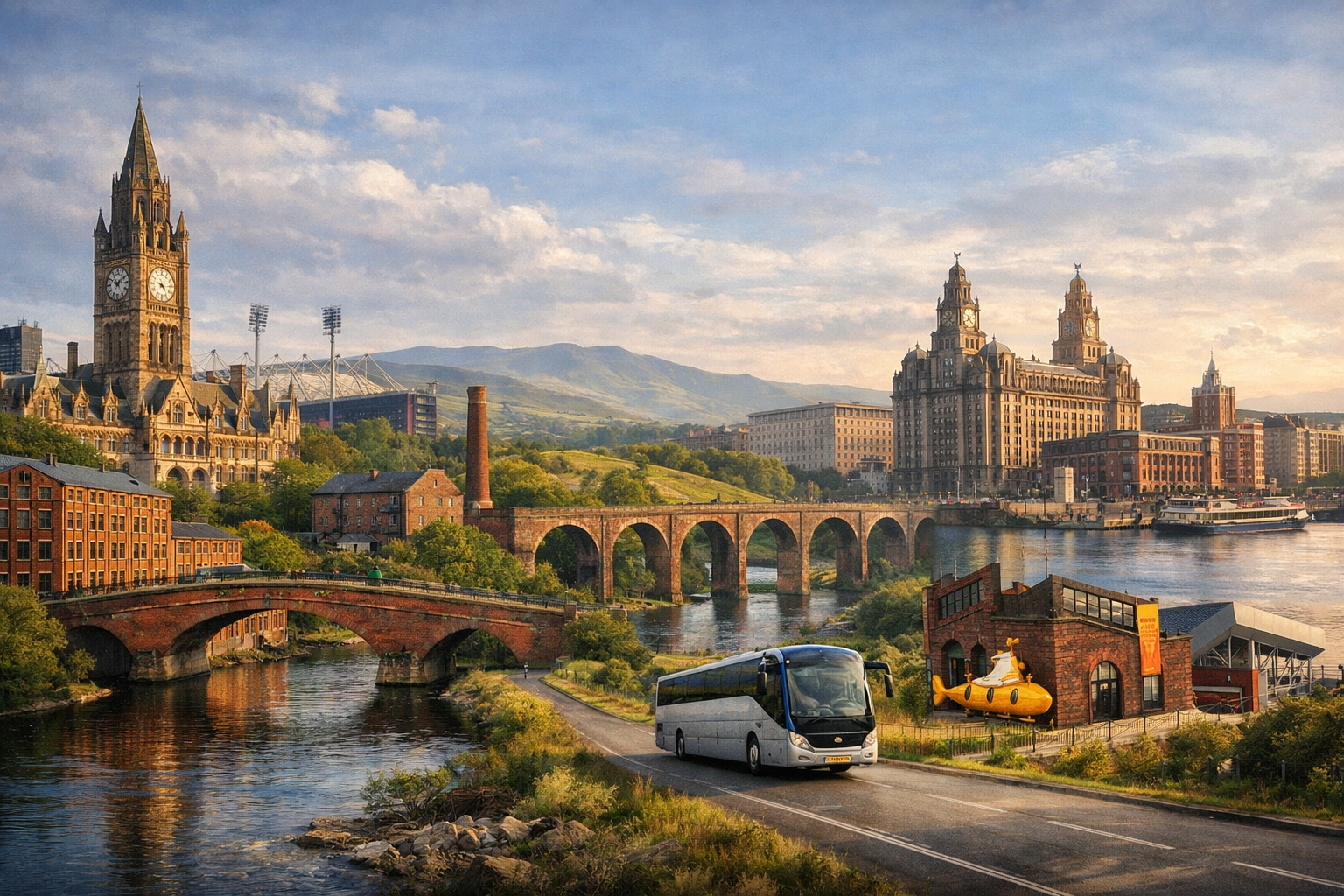
United Kingdom, Manchester and Liverpool. A relatively budget-friendly urban route through the musical, football, and industrial attractions of northern England with bus transfers.

United Kingdom, Manchester and Liverpool. A relatively budget-friendly urban route through the musical, football, and industrial attractions of northern England with bus transfers.

Discover northern England on a budget with a lively city route from Manchester to Liverpool. From legendary music scenes and iconic football grounds to striking industrial heritage, this easy bus-linked trip packs two characterful cities into one great-value escape.

🧭 DAY-BY-DAY ITINERARY

Ready-made country and city routes with daily plans, sights, transport and accommodation. Buy PDF guides for independent travel.

🧭 DAY-BY-DAY ITINERARY


Day 1 — Manchester: the industrial heart of the city

  • 🚶 Start getting to know Manchester in a calm and economical way: this city is especially good for a budget itinerary because its historic centre is compact, many key sights are within walking distance, and the industrial heritage is felt here literally in the brickwork, canals, former warehouses, and old railway districts. Manchester does not try to be “picture-postcard pretty” in the classic sense — its beauty is in its character. This is a city of factories, trade unions, working-class neighbourhoods, music, football obsession, and constant self-reinvention. So on the first day, it is better not to spread yourself too thin, but to feel it as a place where modern urban northern English energy was born.

  • 🚶 Science and Industry Museum, Liverpool Road, Manchester M3 4FP — one of the best starting points for the trip. The place itself is symbolic: the museum is located on the site of the world’s oldest inter-city passenger railway. Even if you are not a technology fan, the space impresses with the atmosphere of the early industrial era: massive halls, old steam engines, railway stories, engineering solutions, and the history of how Manchester became one of the driving forces of the Industrial Revolution. For a budget traveller this is an especially good stop, because basic admission to the museum is usually free, and there is enough here to fill several hours without extra spending. Allow 2–3 hours with a break to rest.

  • 🚶 After the museum, it makes sense to walk along Castlefield and the canals. This area is especially good because it requires no tickets at all: former warehouses, bridges, waterways, red-brick development, and preserved industrial contours create a very cinematic setting. Here it is easy to imagine Manchester not as a modern shopping hub, but as a 19th-century working metropolis where invention, freight transport, and textiles changed the economy of the whole country. If you like urban landscapes, this is one of the most atmospheric free places on the route.

  • 🍽️ For a budget lunch, choose simple chains or food halls in the centre: a good price guide is about £6–12 for a filling lunch, soup, sandwich, Asian bowl, or an inexpensive bakery set. For dinner, it is sensible to keep to the £10–18 range if you go for curry, a burger, an inexpensive pub, or Chinese noodles. Manchester is convenient because good budget options are found not only “on the outskirts,” but also in central districts.

  • 💤 It is best to end the evening without overloading yourself: early check-in, shower, washing a few small items, a small food supply from the supermarket, and an early night. This will help save both money and energy. For the first day, it is ideal if the whole programme fits into a walking loop or at most 1–2 bus rides.


Day 2 — Manchester: football, city history, and northern musical atmosphere

  • 🚶 Dedicate the morning to the National Football Museum, Cathedral Gardens, Manchester M4 3BG. Even if you do not collect scarves and do not know every FA Cup final, this museum does a good job of showing why football in northern England is not just a sport, but part of the social fabric. Working-class history, local identity, club memory, and mass culture all come together here. The exhibitions are usually easy to take in without academic overload: lots of objects, visual stories, and recognisable themes. This is not the cheapest stop on the route, so it is worth treating as Manchester’s main paid football highlight. A standard adult ticket is roughly £14–16, and buying online is often easier and less stressful.

  • 🚶 After the museum, walk through the Northern Quarter — it is the best way to feel musical Manchester without expensive tours. The district is known for its independent spirit, street art, small vinyl shops, live music reputation, and that same rough-edged northern aesthetic that fits so well with the history of the local scene. It is pleasant simply to wander through the blocks, look at facades, murals, old signs, and coffee shops. It is inexpensive, but very rewarding.

  • 🚶 Next, it makes sense to go to the People’s History Museum, Left Bank, Spinningfields, Manchester M3 3ER. This is a free museum with a strong focus on democracy, labour, trade unions, and social movements. For a route around northern England, it is no less important than the musical and football places, because it explains the social environment from which the local character, industrial memory, and the famous “working-class” energy of the region emerged. The space is modern and not boring: banners, posters, stories of voting, protests, and collective self-organisation. It works well as a cultural counterpoint to the football theme.

  • 🍽️ On the second day, it is convenient to eat as rationally as possible: breakfast from a supermarket or bakery £3–6, lunch £7–12, dinner £10–18. If you want to save more, get a meal deal from a supermarket, refill your water bottle, and keep snacks with you — in Britain this really does reduce the daily budget.

  • 🌙 In the evening, you can walk past musically significant streets in the centre and linger around Stevenson Square or the Piccadilly Records/Northern Quarter area. You do not have to go to a paid concert: the urban environment itself already gives you the feeling of musical Manchester — tense, honest, a little raw, and very recognisable.

Day 3 — Manchester: Old Trafford and an inexpensive bus transfer to Liverpool

  • 🚆 In the morning, head to Old Trafford, Sir Matt Busby Way, Old Trafford, Manchester M16 0RA. Even if you do not go for the full expensive match-day experience, the stadium area itself is essential for anyone interested in England’s football geography. This is not just an arena, but one of the most famous places in world football, where club mythology is quite literally built into the space around the stadium. If your budget allows, you can choose the Museum & Stadium Tour: you should usually allow roughly £25–35 depending on the format and availability. If you want to save more strictly, it is enough to come for an exterior look, the club area, photos, and the atmosphere — that also works.

  • 🚋 Old Trafford is easy to reach by public transport: most often people use the Metrolink tram from central Manchester, getting off near the Old Trafford/Exchange Quay area and then taking a short walk, or combine the journey with a bus. Allow 2 to 4 hours for exploring the area and, if you want, taking the tour. It is important to remember that the museum and tours may change on home match days and during special events, so it is best to check entry times in advance.

  • 🍽️ Before leaving for Liverpool, do not spend unnecessarily on stadium food: it is better value to have lunch in central Manchester or take food with you. A realistic lunch budget is £6–12, with coffee and pastries adding another £3–6.

  • 🚌 Transfer: Manchester → Liverpool, National Express intercity coach, Manchester Coach Station → Liverpool ONE Bus Station. The most budget-friendly option usually starts from around £4.50 one way if booked early; fast services take about 1 hour, while some departures may take a little longer depending on the timetable and stops. For a low-cost itinerary, the coach is preferable to the train if you are willing to adapt to the departure time.

  • 🚶 After arriving in Liverpool, do not overload the day. Check in, walk around the Liverpool ONE, Mathew Street, or waterfront area, and give yourself a light evening route. Liverpool immediately feels different from Manchester: more maritime, a little more theatrical, with a strong musical aura and open waterfronts. After full days in Manchester, it is pleasant here simply to walk.

Day 4 — Liverpool: Beatles, Cavern Quarter, and the waterfront

  • 🚶 The main musical stop of the day is The Beatles Story, Royal Albert Dock, Liverpool L3 4AD. This is the most obvious museum stop in Liverpool, but still a strong one: it works not just as a museum about the band, but as an emotional reconstruction of the environment from which The Beatles emerged. The story of early Liverpool, the club scene, Hamburg, the rise of popularity, and the transformation of a local city story into a global cultural myth is very well presented here. For music lovers, this is essentially a must-do paid stop on the route. A good guide price is about £18–22 for an adult, depending on dates and fare; it makes sense to book tickets in advance for a specific time.

  • 🚶 After the museum, walk around Royal Albert Dock and the Liverpool Waterfront. This is one of the best free parts of the trip: old docks, massive warehouse buildings, water, wind, the silhouettes of the "Three Graces", wide river views, and the constant feeling that the city has looked outward for centuries — toward trade, emigration, the sea, and music. Liverpool is especially beautiful here without spending anything: sometimes it is enough simply to walk slowly along the water, looking at brickwork, ships, and facades, to feel the historical depth of the place.

  • 🚶 In the evening, go to Cavern Quarter and Mathew Street. Even if you do not take expensive dedicated music tours, this area gives you that concentrated atmosphere of musical Liverpool: the legend of The Cavern, commemorative plaques, themed bars, street musicians, and the feeling that the city’s brand really did grow from a real music scene and not only from the souvenir industry. It is important to approach the place not as a “must-have photo,” but as a living quarter of memory and tourist theatre at the same time.

  • 🍽️ For a budget day in Liverpool, choose cafés away from the most tourist-facing dockfront spots or go for lunch deals in the centre. A realistic budget: breakfast £3–6, lunch £7–12, dinner £10–18. If you want to sit in a pub with music, it is wise to check main-course prices in advance and not order extra drinks — that way the evening stays atmospheric without becoming expensive.

  • 🌙 Liverpool is especially beautiful in the evening by the water and in the lights. If you still have energy, take an extra walking loop along Pier Head — it is a beautiful ending to a musical day without extra cost.

Day 5 — Liverpool: maritime history, city transport, and inexpensive museums

  • 🚶 Start the day at the Museum of Liverpool, Pier Head, Mann Island, Liverpool L3 1DG. This is one of those museums that is ideal for a budget itinerary: admission is usually free, and the content helps connect music, port history, migration, working culture, sport, and everyday city life into one big story. It shows especially clearly that Liverpool is not only The Beatles, but a much more complex and layered urban organism.

  • 🚶 Then go to the Merseyside Maritime Museum, Royal Albert Dock, Liverpool L3 4AQ. For our route, this is the key industrial-maritime stop: docks, shipping, transatlantic routes, port economics, emigration, and life at sea explain why Liverpool became what it did. This is not a glossy museum “about little ships,” but a powerful reminder that the city grew out of labour, trade, risk, and constant movement across the river and the ocean.

  • ⛴️ If your budget allows adding an inexpensive paid activity, take the River Explorer Cruise on the Mersey. A rough adult ticket price is around £14. It is not an essential part of the route, but a very good one: from the water, Liverpool reads differently, and the city’s musical, industrial, and port identity comes together in one panoramic image. If saving money is the priority, skip the cruise and replace it with a long walk around Pier Head and the waterfront — the day will not lose its meaning.

  • 🚆 On this day, it is convenient to use a local transport pass if you plan to combine bus, train, and possibly ferry. For a budget traveller in the Liverpool City Region, Saveaway is often especially useful — it is an off-peak 1-day ticket for buses, trains, and direct river crossings; it is not valid for journeys starting on weekdays between 06:31 and 09:29, so start after the morning peak. An alternative for train-only travel is the Merseyrail Day Saver. If you are mainly doing a walking day in the centre, you may not need a separate ticket at all.

  • 🍽️ This is a good day for maximum savings: free museums, lots of walking sections, a simple lunch in the centre for £6–10, and dinner for £10–16. If you choose the cruise, just cut spending on food and souvenirs — the overall daily balance will remain reasonable.

Day 6 — Liverpool: southern musical locations, a calm finale, and departure

  • 🚌 It is best to make the final day light and logical, without heavy transfers. If you want to round off the musical theme beyond just the centre, head to the south of the city toward Penny Lane and the area around Strawberry Field. Even without expensive packages and organised tours, these places work as cultural markers: what matters here is not only the fact of their connection with the songs, but also the feeling of a residential, more everyday Liverpool outside the tourist core. This lets you see how global musical mythology grew out of fairly ordinary urban fabric.

  • 🚶 Penny Lane is best seen as an atmospheric point in the neighbourhood rather than as a major museum object. A walk around the surrounding streets, stops, junctions, and residential roads gives an interesting contrast with Mathew Street: instead of a concentrated tourist symbol, you get a quieter, more local context. Strawberry Field, if you decide to go inside, can be an optional paid stop; if the goal is to hold the budget tightly, an exterior look and a walk are enough.

  • 🚌 The easiest way to reach the southern districts is by regular city bus from central Liverpool. This is exactly the day when it is useful to decide in advance what is better value: single rides, Saveaway, or Solo/another local ticket depending on your mix of journeys. In the region, bus tickets can be bought from the driver on board with some operators, at PayPoint locations, at the Merseytravel Centre, and at railway stations for some products; for rail journeys and the Day Saver, ticket offices and station machines are suitable, and Merseyrail also offers Tap & Go.

  • 🍽️ Keep the last day as calm as possible: late breakfast £4–8, light lunch £6–12, takeaway coffee £3–5. This helps preserve your budget and avoids rushing around the city with a suitcase. If you are flying from Liverpool John Lennon Airport, check the current bus routes and travel times in advance; if you are returning via Manchester, leave a sufficient buffer for the intercity coach or train.

  • ⚠️ Practical reminder: information about safety, weather, site accessibility, road conditions, and transport schedules can change. Before travelling, make sure to check official alerts, the forecast, museum opening hours, football tour status, site restrictions, and bus/train timetables. No destination can be considered completely safe, so keep a particularly close eye on your personal belongings at stations, in tourist districts, and in the evening.

Flight tickets

eSIM for travel

Buy PDF guide

Buy PDF guide — 12.85 USD

PDF — 12.85 USD