
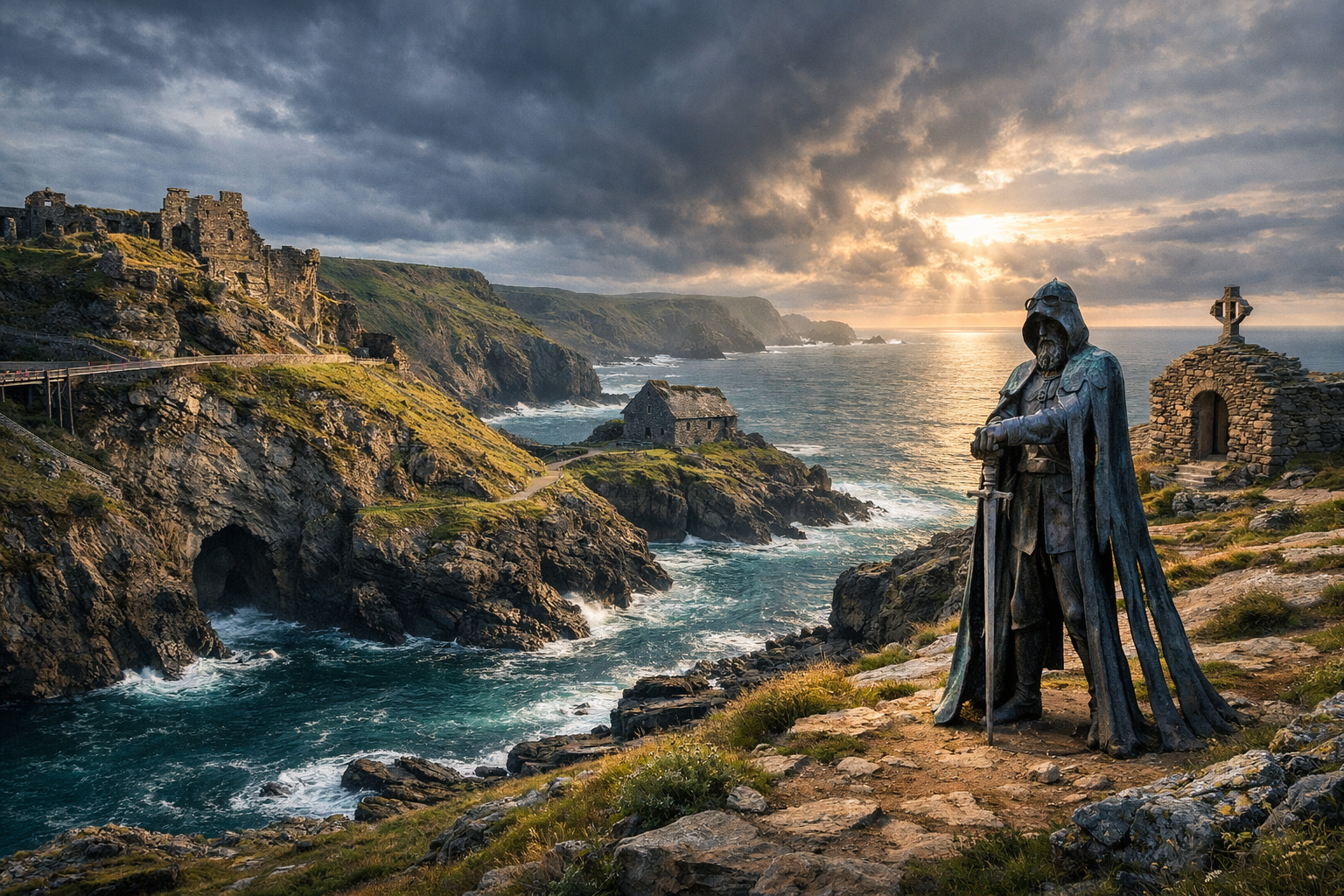
Day 1 — Tintagel: castle, Arthurian legends, and the sacred coastal landscape
🚗/🚌 Arrival in Tintagel is easiest to plan via Cornwall Airport Newquay or Bodmin Parkway railway station, followed by a transfer by car, taxi, or buses along the north coast. For a short 3-day route, the most practical option is to check into accommodation in Tintagel right away and keep the same base: this saves energy and lets you devote more time to trails, cliffs, and museum stops rather than moving around.
🏰 Tintagel Castle is the main site of the route, where it is especially important to separate history from legend. The verifiable fact: on the rugged headland and island section, the ruins of a medieval castle linked to Richard, Earl of Cornwall, from the 13th century survive, and the site itself has even earlier, early medieval connections. The cultural and literary layer is different: for centuries, Tintagel has been associated with the cycle of legends about King Arthur, Merlin, Camelot, and the origin of the ideal ruler. These stories are not proven historical facts, but they are deeply woven into local identity and the perception of the place. Visually, Tintagel works almost theatrically: stone precipices, sea wind, a narrow land bridge, traces of walls, and platforms create the feeling of a threshold between eras — which is why not only history lovers come here, but also admirers of myth, symbolism, and “borderland” landscapes.
🚶 A visit to the castle is best planned for the first half of the day with a timed slot, because access to the island section is organized by time, and from the village parking areas to the start of the approach you should allow at least 30 minutes on foot. The landscape here is uneven and steep in places; in strong wind and bad weather, access may be restricted. For the descent to Tintagel Haven beach and Merlin’s Cave, it is important to take the tide into account: the cave and shoreline are perceived as a mystical stage of the Arthurian cycle, but safe access depends not on legend, but on the water level, the condition of the steps, and the weather.
🕳️ Merlin’s Cave at the foot of the cliffs is one of the most atmospheric points on the route. In local folklore it is linked with the image of a sage, a magician, and a guide between worlds; in modern popular culture it is almost a mandatory “initiation” location for Arthurian journeys. However, it is important to phrase this carefully: the cave’s connection with Merlin is part of legendary tradition and the tourist-cultural narrative, not an established historical fact. On site, it is better to treat it as a rare combination of geology, sea, and mythopoetic imagination rather than as a proven “place of magic.”
⛪ After the castle, it makes sense to walk to St Materiana’s Church on the cliff. This is a real ancient church site that adds a spiritual but not sensational layer to the route: what matters here is silence, the graveyard, open sea views, and the sense of an old sacred landscape where Christian history, Celtic associations, and later legends coexist in one visual field. For an esoteric journey, this is especially valuable: not as a promise of a supernatural experience, but as an example of how religious topography and myth shape the image of a “place of power” in culture.
🛡️ In the second half of the day, it is worth stopping by King Arthur’s Great Halls on Fore Street — an unusual 1930s space dedicated to the Arthurian theme. This is not King Arthur’s medieval hall, but a later, romantic and symbolic interpretation of Arthurian heritage embodied in architecture, decorative design, and stained glass. That is exactly why the site is interesting on an esoteric route: it shows not so much the early history of Britain as the way the 20th century reinterpreted chivalry, the quest for the Grail, moral purity, the Round Table as an image of spiritual order, and the “mystical Middle Ages.”
🏚️ If you still have time and energy, end the day at Tintagel Old Post Office — a small medieval house on the main street. It is not an esoteric center in the direct sense, but an important counterpoint on the route: after grand myth and cliffside drama, it brings you back to the material everyday life of old Cornwall. This balance is useful for an honest perception of the region: legends do not live in emptiness, but among real houses, roads, farm buildings, and a long local history.
🌘 In the evening, it is useful to leave time for a quiet walk through the village and to viewpoints above the sea without a packed schedule. At sunset, Tintagel is especially expressive: mist, salt in the air, the cries of gulls, and the dark outlines of the rocks easily push the imagination toward mystical interpretations. It is important to remember that such sensations are subjective and culturally shaped, but they are exactly what makes Arthurian Cornwall so attractive to travelers.