
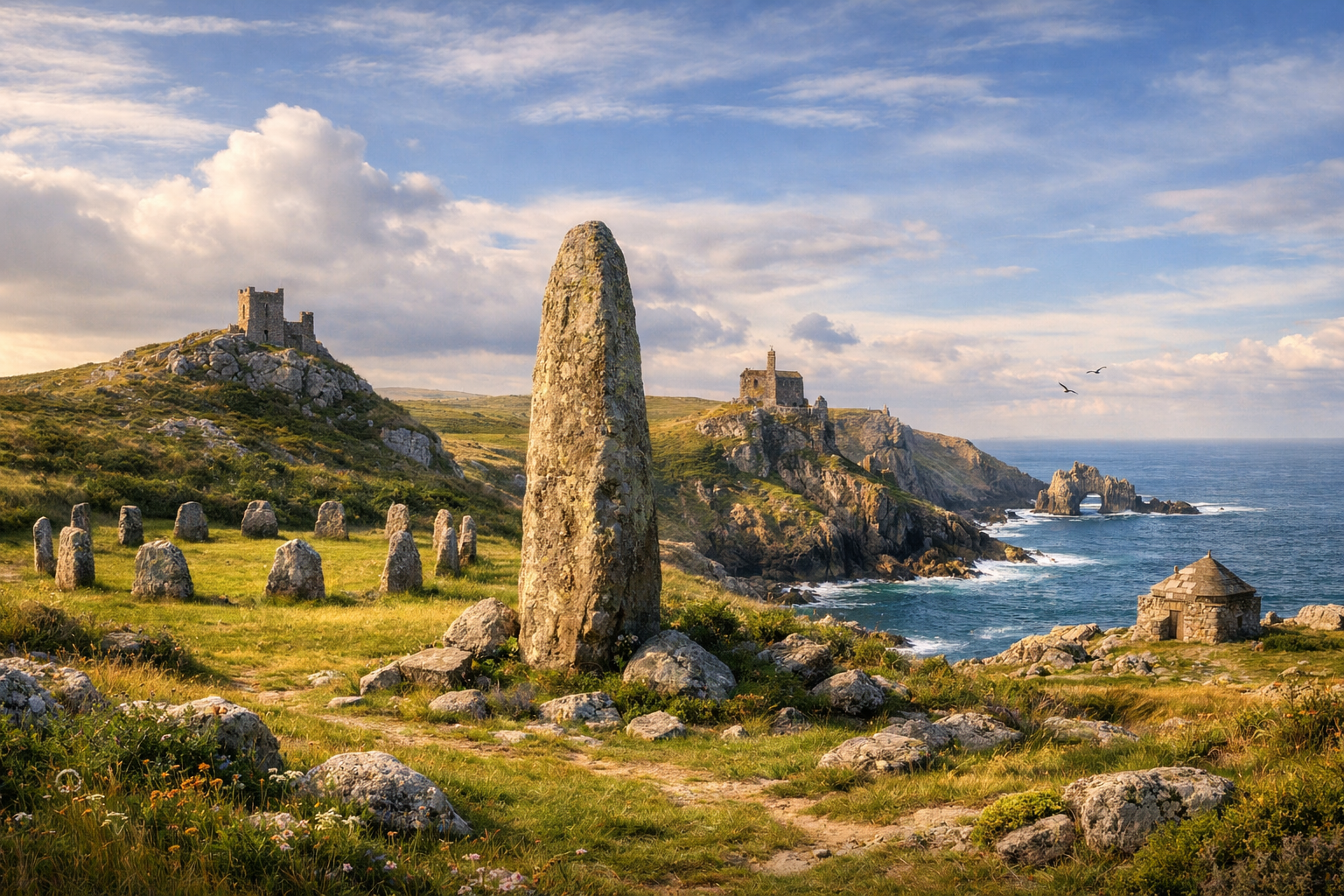
Day 1 — Penzance and Marazion: entering mythical Cornwall
🚆 The base for the route is Penzance, the most convenient West Cornwall hub for this journey. You can realistically get here by GWR train, and from the town it is easy to make short trips to cover Penwith, Marazion, and part of the north coast. For the first day, it is best not to plan long transfers: after arrival, leave time for check-in, rest, and a gentle immersion into the atmosphere of the region.
🚶 Start with Marazion and St Michael’s Mount — a real tidal island in Mount’s Bay, connected to the shore by a cobbled causeway at low tide and by boat service at high tide. This place matters on several levels at once: as a historic castle and religious complex, as a striking panoramic point on the coast, and as a landscape around which legends have accumulated for centuries. Verifiable fact: the island contains a medieval church and castle, and visiting depends on the season, ticket type, and tide schedule. The legendary layer is different: local stories connect the island with ancient pilgrimages, visions at sea, the protection of Archangel Michael, and a sense of a “threshold” space between land and water. These interpretations belong to folklore and spiritual interpretation, not to scientifically proven phenomena.
🚶 This is an especially good place to feel the character of an esoteric route without sensationalism: you are not “hunting for a miracle,” but observing how landscape, tides, church history, stone, and sea create a sense of the sacred for people. Wear comfortable shoes: the island and its approach are uneven in places, surfaces may be slippery, and access along the causeway depends on the tide. If the sea has already covered the path, use the boat service operating on the current schedule and allow extra time.
🌆 In the evening, return to Penzance and take a calm walk along the seafront and historic streets. This is a good moment to “adjust the lens” of the journey: Cornwall is perceived here not as a park of legends, but as a living land where myth, archaeology, the sea, and the memory of local communities exist side by side. If you wish, add Penlee House Gallery & Museum: it is not an occult museum, but it helps you see the visual image of West Cornwall — storm light, coves, granite, coastal settlements — without which it is hard to feel why stories of “places of power” are so enduring here.