
Buy PDF guide

Buy PDF guide — 6.43 USD

PDF — 6.43 USD

Veliko Tarnovo - the medieval capital of Bulgaria

Veliko Tarnovo - the medieval capital of Bulgaria

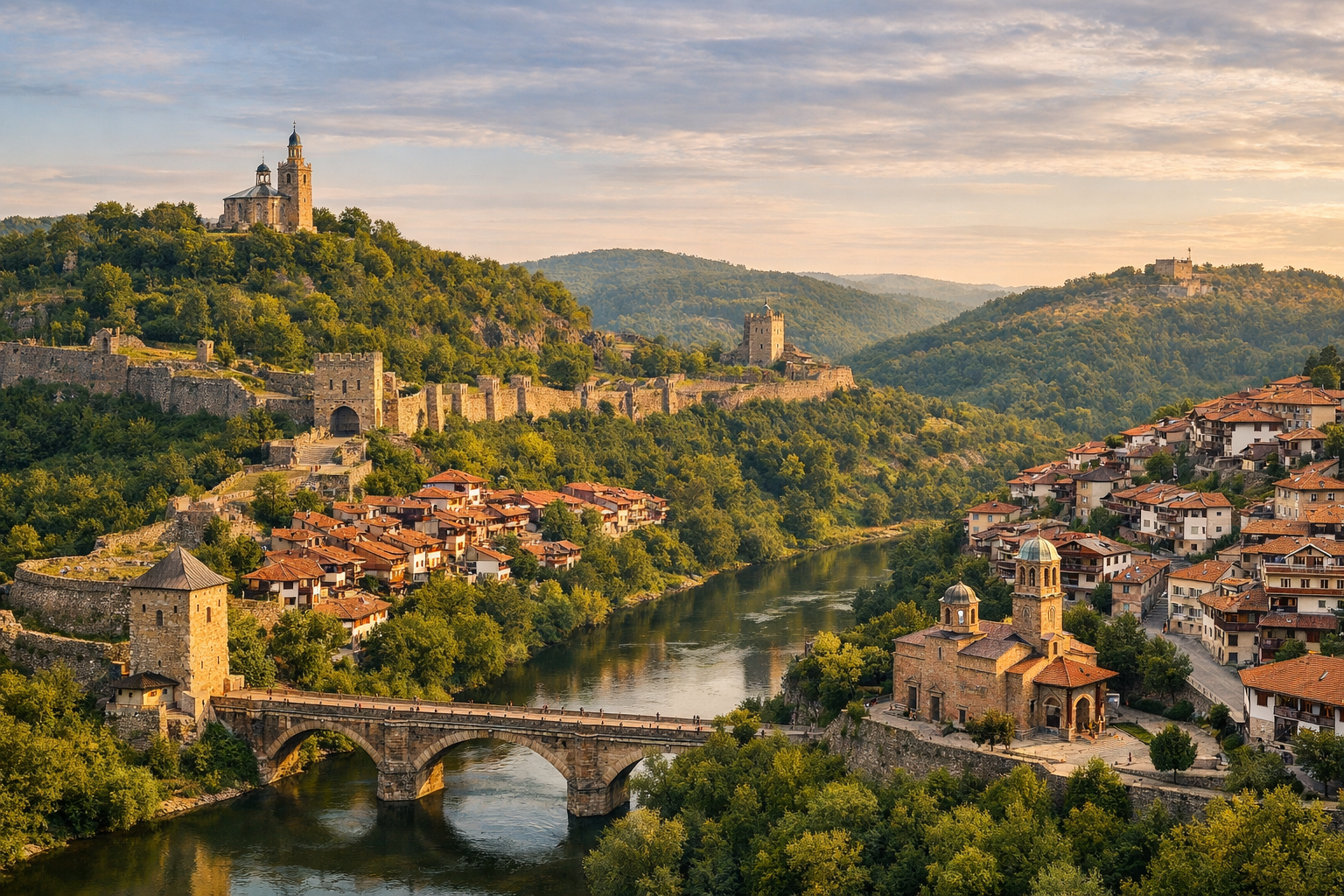
Veliko Tarnovo, Bulgaria’s medieval capital, rises dramatically above the Yantra River with the fortress of Tsarevets crowning its hills. Wander through the cobbled Old Town, take in the historic heights of Trapezitsa, and end in nearby Arbanasi, where grand old houses and quiet churches preserve the region’s timeless charm.

🧭 DAY-BY-DAY ITINERARY

Ready-made country and city routes with daily plans, sights, transport and accommodation. Buy PDF guides for independent travel.

🧭 DAY-BY-DAY ITINERARY


Day 1 — Veliko Tarnovo: Tsarevets, Asenova Mahala, and an evening in the Old Town

  • 🚶 It is best to devote the first day to the city’s main historical “core” — Tsarevets Hill and the quarters around it. Start the morning without rushing so you can reach the fortress early enough: it is convenient to allow 2.5–3 hours for the walls, gates, towers, medieval ruins, and the climb to the Patriarchal complex. Here Veliko Tarnovo reveals itself not as an ordinary provincial town, but as the former capital of the Second Bulgarian Empire: the powerful lines of the fortress walls, steep slopes, wind above the Yantra, and wide views of the opposite hills create a very complete sense of a “stone realm.” After the fortress, it makes sense to pause for coffee or a late breakfast below and then move on to Asenova Mahala — the historic district at the foot of Tsarevets. It usually takes about 10–15 minutes to walk downhill to the Church of the Holy Forty Martyrs and the surrounding area. Here the route becomes quieter and deeper in mood: instead of a panoramic “imperial” perspective, there is an almost monastic concentration, old stones, traces of royal memory, and the river nearby. Allow another 45–60 minutes for visiting the church and taking a short walk around the district, after which it is worth having a full lunch and at least 1–1.5 hours of rest — the city is hilly, and accumulated fatigue is felt faster than it seems on the map. In the second half of the day, climb back to the Old Town and walk along Samovodska Charshia: this is the craft and promenade part of Veliko Tarnovo, where you can feel not only the medieval capital, but also the Bulgarian National Revival. The streets here look lively and photogenic, and the houses seem almost suspended over the slopes. Then continue your walk along General Gurko Street and around the viewpoints above the Yantra — it is convenient to set aside 2–3 hours for this part at a relaxed pace, with stops for photos and short breaks. In the evening, do not overload the program with museums: it is better to leave time for dinner with a view, a slow walk through the illuminated center, and, if the seasonal schedule matches, to watch the sound-and-light show at Tsarevets as a beautiful emotional ending to the first day.


Day 2 — Veliko Tarnovo: Trapezitsa, central museums, and Yantra panoramas

  • 🚶 The second day is best built around the second great hill — Trapezitsa — to see the city not only “from the front,” but in a more archaeological, calm, and contemplative way. In the morning, start with the ride or walk to the Trapezitsa area: from the central part of Veliko Tarnovo, the journey usually takes about 10–15 minutes by taxi or 25–35 minutes on foot, depending on where you are staying and your pace. It is worth setting aside about 1.5–2 hours for the hill itself and a walk around the site. Unlike Tsarevets, the atmosphere here is less theatrical and more “archaeological”: the spaces are wider, there are often fewer people, and the sense of the ancient city comes together through the terrain, foundations, fortification lines, and views of the opposite bank. This is an excellent day for those who want not just to “tick off” the sights, but to understand the logic of medieval Tarnovo as a city built on several natural fortresses. After Trapezitsa, return to the center and take at least an hour for lunch. In the afternoon, move on to the Archaeological Museum: it helps bring together what you have seen on the hills into one historical line — from deep antiquity to the royal period. It is enough to allow 60–90 minutes for the museum, especially if you read the captions and do not rush through the halls. Then you can add the Museum of the Bulgarian Revival and Constituent Assembly — another 45–60 minutes if the subject interests you. These two museums together balance the route well: one shows the material and state depth of the region, the other its political and cultural memory in modern Bulgaria. Between locations in the center, it is usually convenient to move on foot in 10–20 minutes, but because of the stairs and slopes, it is better to allow a little more time than in a flat city. At the end of the day, leave room for a long walk without a strict script: stroll through the viewpoints, bridges, and bends of the streets above the Yantra to see how the city changes at sunset. Veliko Tarnovo is especially beautiful at this time: the houses begin to “glow” on the slopes, the river darkens, and the stone history stops feeling museum-like and becomes almost cinematic.

Day 3 — Arbanasi from Veliko Tarnovo: churches, old houses, and a gentle end to the trip

  • 🚶 The third day is best devoted to Arbanasi — a historic museum village above Veliko Tarnovo, which is convenient for a half-day trip or almost a full day. From the center of Veliko Tarnovo to Arbanasi, the road usually takes about 10–15 minutes by car or taxi; public transport is possible depending on the situation, but for a short trip a taxi or a pre-booked transfer is more convenient. It is worth starting early, while the light is still soft and there are fewer people. The most pleasant thing about Arbanasi is the contrast with Tarnovo’s dramatic terrain: here the atmosphere is more intimate, enclosed, almost manor-like. High stone walls, fortress houses, courtyards, old churches, and quiet streets create the feeling not of a noisy tourist center, but of a prosperous Balkan settlement of past centuries. First visit the Church of the Nativity and the Church of Saints Archangels Michael and Gabriel: for these two locations together, including the walk between them and an unhurried visit, it is reasonable to allow 1.5–2 hours. Then move on to Konstantsalieva House — one of the most expressive examples of local residential architecture; 40–60 minutes is enough for it. If you want a little more context, you can add a leisurely walk through the village itself and lunch with a view of the surrounding hills. After lunch, return to Veliko Tarnovo and do not overload the second half of the day: leave 2–3 hours for a free finale — buy small local souvenirs on Samovodska Charshia, walk your favorite street once more, sit on a terrace overlooking the Yantra, or climb to one of the viewpoints for a farewell look. This rhythm works especially well for a three-day trip: you have time to see the capital’s medieval heritage, the city of the Bulgarian National Revival, and the calmer, almost manor-like historical layer of the region, without turning the journey into an endless race between points.

Flight tickets

eSIM for travel

Buy PDF guide

Buy PDF guide — 6.43 USD

PDF — 6.43 USD