
Buy PDF guide

Buy PDF guide — 8.57 USD

PDF — 8.57 USD

Varna - the maritime capital of Bulgaria

Varna - the maritime capital of Bulgaria

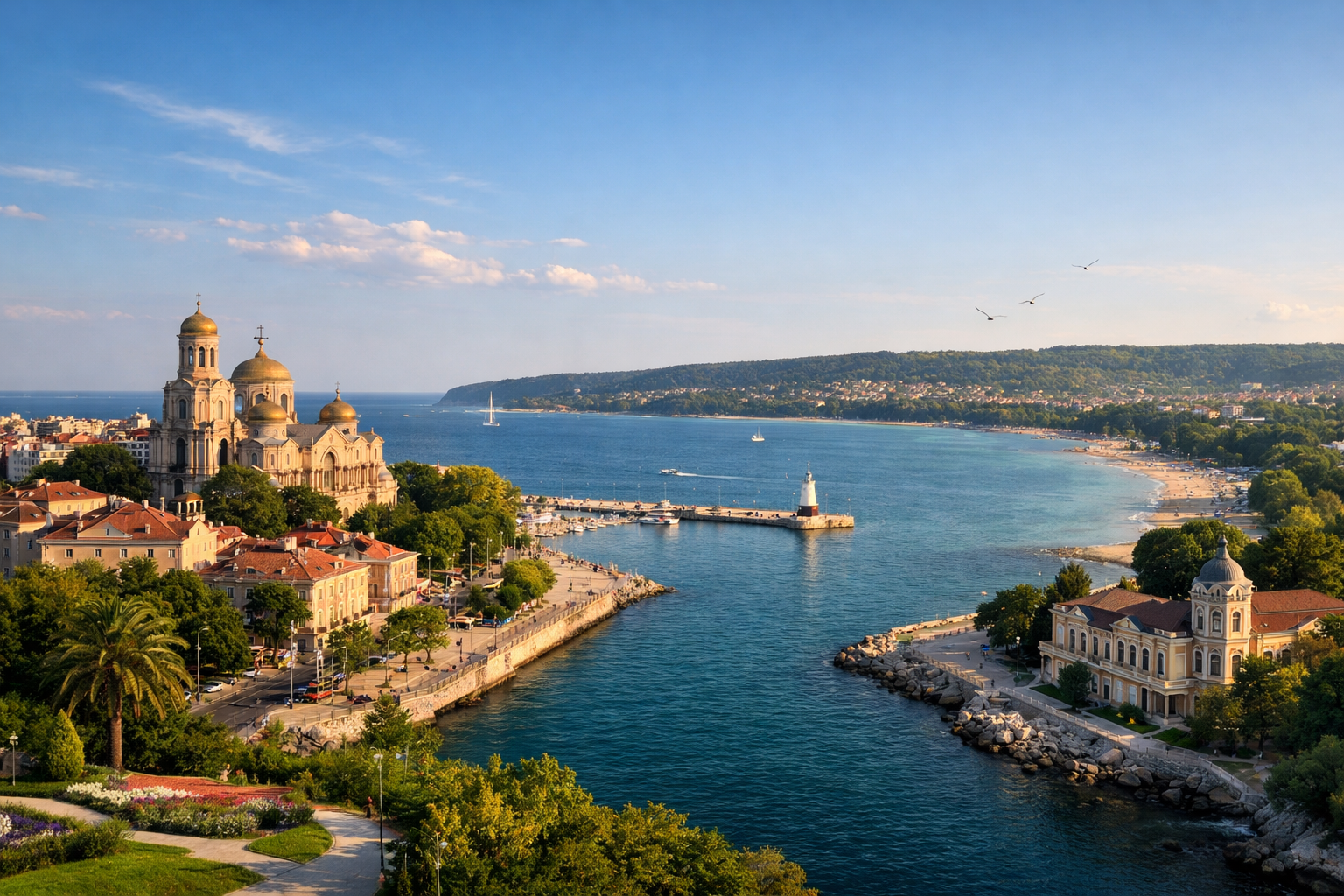
Varna, Bulgaria’s maritime capital, blends a lively city center with breezy seaside charm. Stroll from elegant streets into the Sea Garden, uncover the Old Town’s museums and history, then venture to the cliff-carved Aladzha Monastery and the sunlit Black Sea coast.

🧭 DAY-BY-DAY ITINERARY

Ready-made country and city routes with daily plans, sights, transport and accommodation. Buy PDF guides for independent travel.

🧭 DAY-BY-DAY ITINERARY


Day 1 — Varna: center, cathedral, and a first introduction to the maritime capital

  • 🚶 Start your route in Varna’s historic center to immediately feel the character of the city: it is not only resort-like lightness, but also a true Balkan urban fabric with wide boulevards, old facades, and the lively rhythm of everyday life. A logical starting point is the area around the Cathedral of the Assumption of the Virgin, one of the city’s main symbols. From here, it is convenient to walk along the central streets toward the pedestrian zone and Independence Square, gradually getting used to Varna’s calm yet very насыщенный pace. After a flight or transfer, it is better not to overload the day with museums: a gentle route with 4–5 hours of pure walking is ideal, allowing 20–30 minutes for coffee and at least another hour for lunch or rest. In the second half of the day, head down closer to Knyaz Boris I Boulevard and then toward the seaside part of the center: here the city seems to open up — the architecture becomes lighter, the air saltier, and the mood noticeably more vacation-like. In the evening, it is nice to walk to the Sevastopol area and reach the beginning of the Sea Garden: this is the perfect place for your first sunset photo and for the feeling that you have truly arrived at the Black Sea. If you still have energy, finish the day with a leisurely walk to the promenade and dinner with a sea view; if not, leave the shoreline for the next day and simply spend a calm evening in the center without rushing.


Day 2 — Varna: the Sea Garden, dolphinarium, and sea panorama

  • 🌿 It is best to dedicate the second day to the Varna people love most — the long green ribbon of the Sea Garden. This is not just a park, but the city’s true seaside framework: alleys, stairs down to the sea, viewpoints, shaded corners, flower beds, open spaces, and cultural sites come together here in a very cohesive route. Start the morning early, while the light in the park is soft and there are fewer people, and move from the main entrance toward the coast. For a walk through the main part of the Sea Garden with short stops, it is reasonable to allow at least 2.5–3 hours, and if you go into the dolphinarium, planetarium, aquarium, or simply stop often for photos and coffee, the day easily stretches into all daylight hours without ever feeling rushed. Along the way, it is better to choose one main site to visit — for example, the dolphinarium or the aquarium — and not try to fit in everything at once. In Varna, it is very important to leave time not only for “seeing,” but also for “being”: to sit by the sea, walk along the edge of the park, go down to the beach, or pause in a café. After lunch, the route is best continued in the northern part of the Sea Garden, where it becomes a bit quieter and more spacious, and the sea horizon feels especially strong. In the evening, it is worth returning to the livelier part of the park and meeting the sunset at a panoramic point or on a terrace by the sea: at this time Varna looks especially cinematic — the greenery darkens, the city lights come on gradually, and the sea becomes almost metallic.

Day 3 — Varna: archaeology, Roman Baths, and the city’s cultural layers

  • 🏛️ This day is best made more “historical,” bringing together Varna’s main cultural layers into a compact but rich route. Start with the Archaeological Museum — one of the city’s most important sites, where it becomes especially clear that Varna is not only a seaside resort, but also a land of deep antiquity. Allow at least 1.5–2 hours for the museum, and if you love archaeology, even the full 3 hours: the collection truly deserves an unhurried visit. After the museum, take a lunch break in the center and only then move on to the Roman Baths — ruins that impress with their scale and work very well in creating the feeling of an ancient city right inside the modern urban environment. It is easy to move between these points on foot in the center, usually taking 15–25 minutes, so the route remains logical and does not tire you with unnecessary transfers. If you want to add an everyday and human layer to the grand history, in the second half of the day you can visit the Ethnographic Museum or the Retro Museum: the first shows regional culture, crafts, and daily life, while the second presents a later, almost nostalgic era of socialist everyday life. It is important to leave at least 40–60 minutes of free time with no fixed stops: Varna reveals itself especially well in the transitions between locations — on old streets, in courtyards, near small squares, and in those places where antiquity, port character, and resort softness meet literally within a single block. In the evening, you can head back to the coast or stay in the center for a quiet dinner: after a museum-filled day, it is better not to plan a long forced march.

Day 4 — Varna: Aladzha Monastery, the northern coast, and a final maritime accent

  • 🌊 The final day is best dedicated to going beyond the dense center to see Varna not only as a city, but also as the gateway to a broader seaside landscape. The best option for a 4-day route is Aladzha Monastery, a medieval monastery complex carved into rock in a wooded area north of the city. It is a good contrasting point after the center and museums: instead of boulevards and city noise, you get cliffs, greenery, silence, and a completely different rhythm of perception. For the trip from Varna in this direction by bus or taxi, it is worth allowing about 30–50 minutes one way depending on traffic and your exact starting point, and for the visit itself at least 1.5–2 hours, especially if you want to do the route calmly and without rushing. After the monastery, you can make a gentle continuation of the day toward the coast — for example, through the Chaika area or toward the resort strip — to see the sea once again not from the center, but in a more open and “resort-like” context. This is a good day for a long lunch with a view, for a beach break, or at least for sitting on a terrace by the water. It is better to plan your return to the city without starting too late, so that you leave yourself a final evening in Varna: walk through your favorite part of the center, stop by the Sea Garden once more, buy a few small souvenirs, and finish the trip not by racing to one last attraction, but with a beautiful and calm farewell to the city. This rhythm is the most organic for Varna: a little history, a lot of air, the sea as a constant backdrop, and the feeling that it would be easy to want to come back.

Flight tickets

eSIM for travel

Buy PDF guide

Buy PDF guide — 8.57 USD

PDF — 8.57 USD