
Buy PDF guide

Buy PDF guide — 4.28 USD

PDF — 4.28 USD

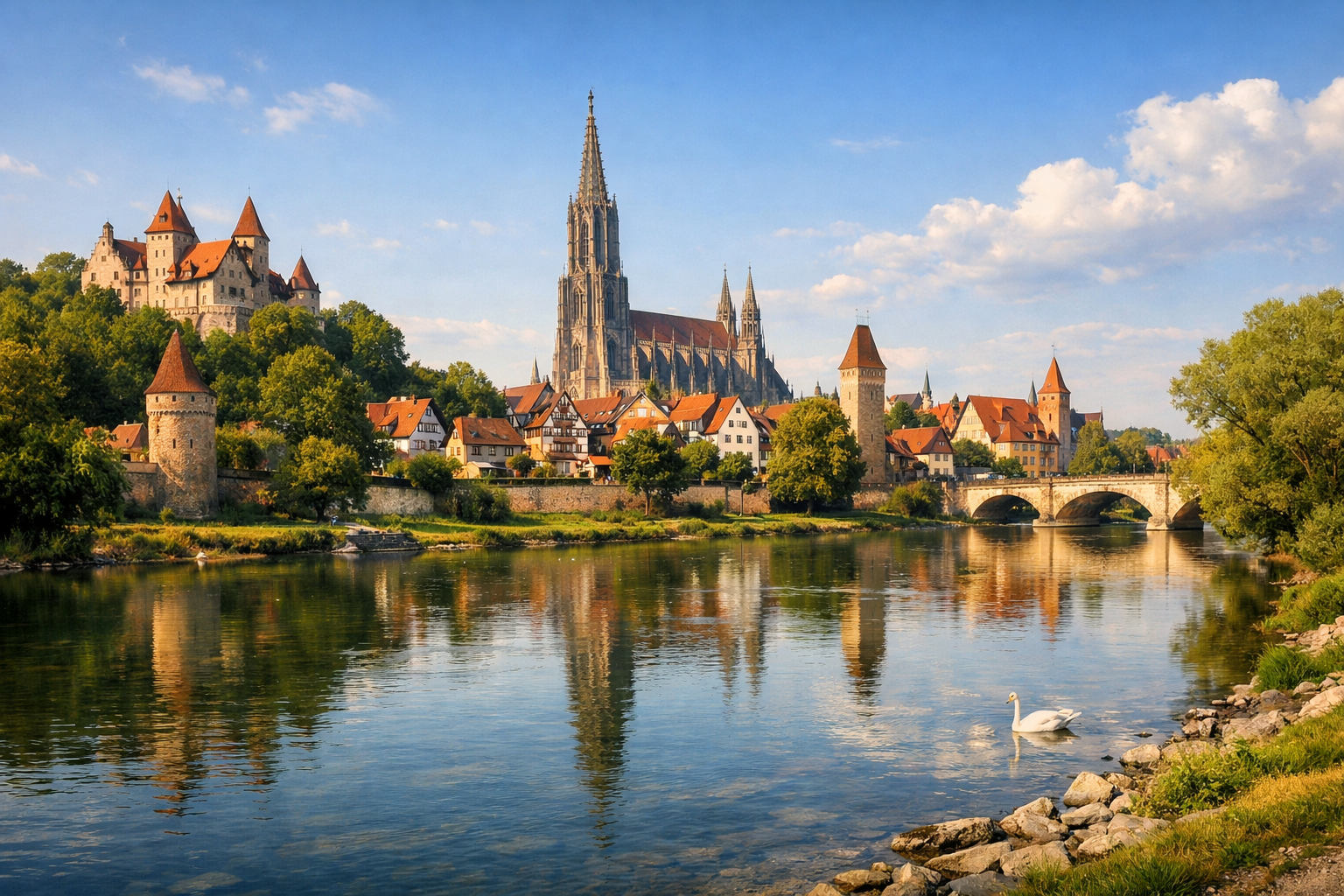
Ulm castles and Danube landscapes

Ulm castles and Danube landscapes

Follow the Danube from Ulm’s soaring spires to the baroque calm of Wiblingen and the blue spring at Blaubeuren. Beyond, the Upper Danube Valley unfolds in cliffs, forests and river bends, ending at the fairytale silhouette of Sigmaringen Castle.

🧭 DAY-BY-DAY ROUTE

Ready-made country and city routes with daily plans, sights, transport and accommodation. Buy PDF guides for independent travel.

🧭 DAY-BY-DAY ROUTE


Day 1 — Ulm: old town, the Danube, and the Baroque abbey of Wiblingen

  • 🚶 Start your trip in the historic center of Ulm — one of the most expressive cities in southern Germany, where majestic Gothic architecture, old craft quarters, and the calm river line of the Danube come together in a highly cinematic urban landscape. The heart of the city is Ulm Minster, famous for its grand spire, considered the tallest church spire in the world. Even if you do not go up, the square in front of the minster already makes a strong impression: all around are historic facades, the bell-tower silhouette, a sense of large medieval scale, and the remarkable clarity of southern German light. Then it makes perfect sense to walk to the Fishermen’s Quarter — Fischerviertel, one of the most atmospheric corners of Ulm. Here the streets narrow, houses lean over the water, little bridges connect the banks, and the river canals reflect the half-timbered facades as if this were not a city but a carefully staged theater set. A walk through this area is especially good without rushing: with stops by the water, in small squares, by old towers, and along the Danube promenade.

  • 🏛️ If you want to add some museum depth to the day, it is convenient to include Museum Ulm and kunsthalle weishaupt. It is important to check the current opening format: the main Museum Ulm is in the process of transformation, but part of the exhibitions and signature objects are shown at nearby venues, while kunsthalle weishaupt serves as an important point on the contemporary art route in the center. This museum block works well in the first half of the day or after lunch, especially if you want to alternate walking with a warm interior, a coffee break, and an unhurried pace.

  • 🚋 After lunch, head to Kloster Wiblingen — a Baroque monastic complex in the south of Ulm, easily reached by public transport in about 20–30 minutes, or by taxi in 15–20 minutes depending on your starting point. This place sharply changes the mood of the route: after urban Gothic and riverside cityscapes, you enter a world of late Baroque and Rococo, where everything is built on grandeur, symmetry, and almost theatrical beauty. The main jewel is the library hall, which made Wiblingen famous far beyond the region: a bright, fluid, almost airy interior with a rich decorative rhythm looks like a perfect visualization of an era in which knowledge was understood not only as useful but also as an aesthetic wonder. It is worth remembering that the basilica is undergoing major restoration, so visits may be partly limited, but the ensemble itself, the courtyard, and the museum section still make the trip very worthwhile.

  • 💤 It is best to spend the evening back in central Ulm. Once you return to the Danube, enjoy a slow walk along the embankment between Ulm and Neu-Ulm: in the soft evening light the city is especially beautiful, the water gathers reflections of bridges and towers, and the old quarter feels even more cozy. This is the right ending for the first day — without long transfers, with enough time for rest, dinner, and an early night before heading into the Danube landscapes the next day.


Day 2 — Blaubeuren, Danube landscapes, and Sigmaringen Castle

  • 🚆 In the morning, leave Ulm for Blaubeuren. The regional train ride to Blaubeuren takes about 15–20 minutes, and trains run frequently, so the route is very convenient and not tiring. This trip is appealing because almost immediately after a city morning you find yourself in a completely different setting — at the foot of the Swabian Alb, beside one of the region’s best-known natural symbols. Blautopf is a famous karst spring with a fantastic blue-green water color, a place that is at once geological, poetic, and almost fairy-tale-like. Because of renovation works in the area, access to the spring zone is currently partly restricted, and this is important to keep in mind in advance; however, the trip to Blaubeuren still remains very worthwhile: the magic of the place has not disappeared, and the town retains exactly the intimate atmosphere people come here for.

  • 🏛️ Near the spring, it makes sense to visit the Urgeschichtliches Museum Blaubeuren — a prehistory museum connected with the caves and Ice Age art of the Swabian Alb. This is not just a “tick-the-box museum,” but a rare opportunity to see the context of one of the most important layers of European antiquity: these places are associated with humanity’s earliest works of art and first musical instruments. After the natural site, the museum works perfectly as an intellectual continuation of the route, adding depth and meaning to the beautiful landscape.

  • 🚗 Then begins the most scenic part of the two-day tour — traveling along the Danube toward the Upper Danube Valley and Sigmaringen. If you are using a car or car sharing, allow about 1 h 10 min–1 h 30 min from Blaubeuren to Sigmaringen without long stops; if traveling by train from Ulm Hbf to Sigmaringen, it is usually about 1 h 15 min–1 h 35 min. The car option gives more freedom for panoramas: chalk slopes, folded hills, forest stretches, river bends, and characteristic rock outcrops make the road part of the experience rather than just movement between points. This is exactly the kind of case where the landscape works not as a background but as a full part of the journey’s content.

  • 🏰 The final main point is Sigmaringen Castle, rising above the Danube and the town like a dramatic setting from a historical novel. Its position on the rock makes the first impression especially strong: the river, the stone outcrop, the elongated silhouette of the castle, and the gentle provincial development below create a very coherent and noble picture. Inside, the route is interesting because this is not an abstract “ruin with a view,” but a large residence with aristocratic history, ceremonial spaces, and a vivid sense of dynastic past. Even if you limit yourself to seeing the exterior, the viewpoints near the castle and the walk along the embankment are already worth the trip. If time allows, stay here for a calm late lunch or coffee, and leave an unhurried evening slot for the return to Ulm. This will let you finish the second day not as a race, but as a beautiful, well-thought-out ending to a short yet насыщенного journey.

Flight tickets

eSIM for travel

Buy PDF guide

Buy PDF guide — 4.28 USD

PDF — 4.28 USD