
Buy PDF guide

Buy PDF guide — 25.71 USD

PDF — 25.71 USD

Tash Rabat

Tash Rabat

In Kyrgyzstan, the Tian Shan rise over yurt-dotted pastures and glassy alpine lakes. From Bishkek and the Burana Tower at Tokmok, weave through Naryn and At-Bashy to the stone caravanserai of Tash-Rabat. Finish with Karakol’s mountain trails and the turquoise arc of Issyk-Kul at Cholpon-Ata.

🧭 DAY-BY-DAY ITINERARY

Ready-made country and city routes with daily plans, sights, transport and accommodation. Buy PDF guides for independent travel.

🧭 DAY-BY-DAY ITINERARY


Day 1 — Bishkek: an “entry” into history

  • 🚶 Arrival in Bishkek and gentle acclimatization. Walk around Ala-Too Square with a panorama of the State History Museum — a strict modernist mass that became a “showcase” of official historiography. Around the perimeter: the rhythm of Soviet urban planning, mosaics, ensemble axes. In the evening — a short overview of the center (Erkindik Boulevard, small parks, Soviet bas-reliefs), tuning in to the continuing theme “nomadic culture ↔ stone architecture”.


Day 2 — Bishkek: museums (context and the “language” of forms)

  • 🚶 State History Museum: a narrative from ancient burial mounds and Turkic balbals to the post-Soviet period. Treat the exhibition as a “legend for the route”: many motifs (clan signs, ornament, sacred objects) will later resurface in Naryn and around Issyk-Kul.

  • 🚶 G. Aitiev Museum of Fine Arts: wood carving, felt, ornamental schemes, painting — an excellent “key” to reading décor and symbolism. Then — the M. V. Frunze House-Museum: a rare example of a “museum under a cap,” where the historical core (a log house) is enclosed within a later protective concrete volume.

Day 3 — Tokmok / Don-Aryk: Burana Tower (Balasagun)

  • 🚌 Transfer from Bishkek to Burana Tower (≈ 80 km, 1–1.5 h): remains of the Balasagun settlement and an 11th-century Karakhanid minaret. This is an “architectural marker” of the medieval Tien Shan: brickwork, shaft proportions, traces of 20th-century restorations; around it — balbal grave stelae and fragments of mausoleums.

  • 🚶 Nearby — a small museum pavilion with finds, and the open space reads like a “portrait of a vanished city”: ramparts, foundations, ancient canals. Return to Bishkek (in the evening) or continue toward the Chuy Valley — according to the plan for the next day.

Day 4 — Bishkek → Kochkor → Naryn: the pass road

  • 🚌 Transfer Bishkek → Kochkor (≈ 190 km, 3–3.5 h) → Naryn (another ≈ 110–130 km, 2–2.5 h) via Dolon Pass (≈ 3030 m). The road is an important part of “reading” the landscape: plateaus, scree fields, riverbeds — later this becomes the backdrop for the architecture of Tash-Rabat.

  • 🚶 Evening in Naryn: a short stroll along the river, adjusting to altitude, a light dinner, and rest before heading out to the At-Bashy sites.

Day 5 — Naryn: museum and Salkyn-Tor park

  • 🚶 Naryn Regional Museum of History and Local Lore: regional archaeology, ethnography, weapons, costumes, expedition photos. This helps “assemble” images of nomadic life alongside stone fortifications and caravanserais.

  • 🚶 Salkyn-Tor Nature Park (the entry valley 20 km east): a walk along forest terraces and canyons, observing the “transition” from a river valley to high mountains. In the evening — return to Naryn.

Day 6 — At-Bashy: Koshoy-Korgon and the valley to Tash-Rabat

  • 🚌 Naryn → At-Bashy (≈ 70–80 km, 1–1.5 h) → Koshoy-Korgon: ruins of an earthen fortress (a tradition of Karakhanid fortifications), earthen ramparts and the citadel plan. The space reads as a “defense matrix” along caravan routes.

  • 🚌 Continue toward Tash-Rabat (another ≈ 90–110 km, 2 h; last kilometers are dirt road). Settle into a yurt camp in the Kara-Koyun gorge. The silence of the high mountains and the starry sky are the best “prologue” to tomorrow’s architecture.

Day 7 — Tash-Rabat: a stone caravanserai in the heart of the Tien Shan

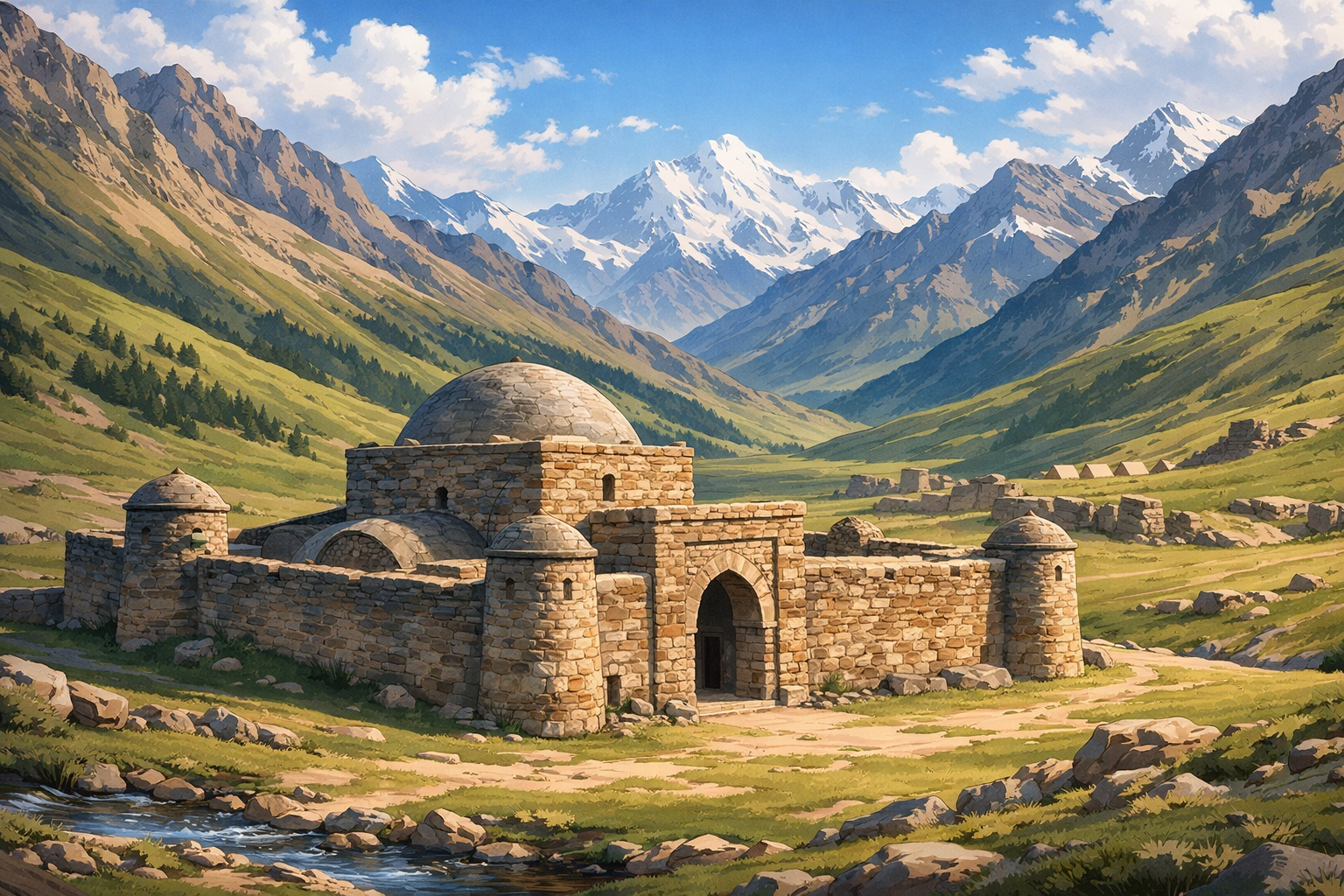
  • 🚶 Main visit of Tash-Rabat (≈ 3200 m): a rare stone caravanserai for the region with a domed central hall, a grid of cell-like rooms, niches, and arched passages. Pay attention to the dome construction and “small” engineering solutions (narrow slit windows, wall thickness, thermal regulation). The contrast of harsh stone and alpine meadows heightens the sense of a refuge on the Silk Road.

  • 🕯 The interior reads as a sequence of “compressions and expansions”: from the portal into a dark corridor and then into the domed hall. Outside — a low volume merging with the slope: architecture subordinated to climate and caravan security.

Day 8 — Tash-Rabat: radial walks and the pass

  • 🥾 Morning trek to Tash-Rabat Pass with views of high-mountain plateaus. In good weather, the Chatyr-Kol area is visible (border zone; direct access to the lake requires a pre-arranged permit). Return to the camp, rest; during the day — unhurried shots of stone in side light.

  • 🚌 Afternoon transfer back to Naryn (≈ 2–3 h) — hot dinner, a warm shower, rest before the long road to Issyk-Kul.

Day 9 — Naryn → Kochkor → south shore of Issyk-Kul → Karakol

  • 🚌 Big drive: Naryn → Kochkor (2–2.5 h) → south shore of Issyk-Kul (via Tamga/Barskoon) → Karakol (total 5.5–7 h with stops). Along the way — panoramas of the Terskey Ala-Too range and snowy peaks. In the evening — get acquainted with Karakol’s wooden buildings, dinner with Dungan noodles ashlyan-fu.

Day 10 — Karakol: museums and city architecture

  • 🚶 Przhevalsky Museum (Pristan-Przhevalsk, ≈ 9 km from the center): expeditions, maps, household items — a rare “time capsule” of the late 19th century. In the city — the wooden Orthodox Holy Trinity Cathedral and the Dungan Mosque in Chinese carpentry traditions (external visit) — a contrast of faiths and techniques with not a single nail in the frame.

Day 11 — Karakol → Cholpon-Ata: petroglyphs and a cultural center

  • 🚌 Transfer Karakol → Cholpon-Ata along the north shore (≈ 140 km, 2.5–3 h). The open-air petroglyph museum (a stone “garden” on a slope with views of the lake) is an “encyclopedia” of rock art from the Saka period to the Turks. In town — the historical and cultural museum and the Rukh Ordo complex on the shore (a multi-format open-air exhibition). In the evening — rest by the shore and a wrap-up of the “Issyk-Kul” part.

Day 12 — Cholpon-Ata → Bishkek: route finale

  • 🚌 Return to Bishkek (≈ 260–280 km, 4–5 h). In the evening — free time: a favorite spot in the center, buying souvenirs, a second look at museums (optional) — the travel line comes together: nomadic steppes → medieval minarets and fortresses → a stone caravanserai in the high mountains.

Flight tickets

eSIM for travel

Buy PDF guide

Buy PDF guide — 25.71 USD

PDF — 25.71 USD