
Buy PDF guide

Buy PDF guide — 6.43 USD

PDF — 6.43 USD

Zugspitze and the heart of the Bavarian Alps

Zugspitze and the heart of the Bavarian Alps

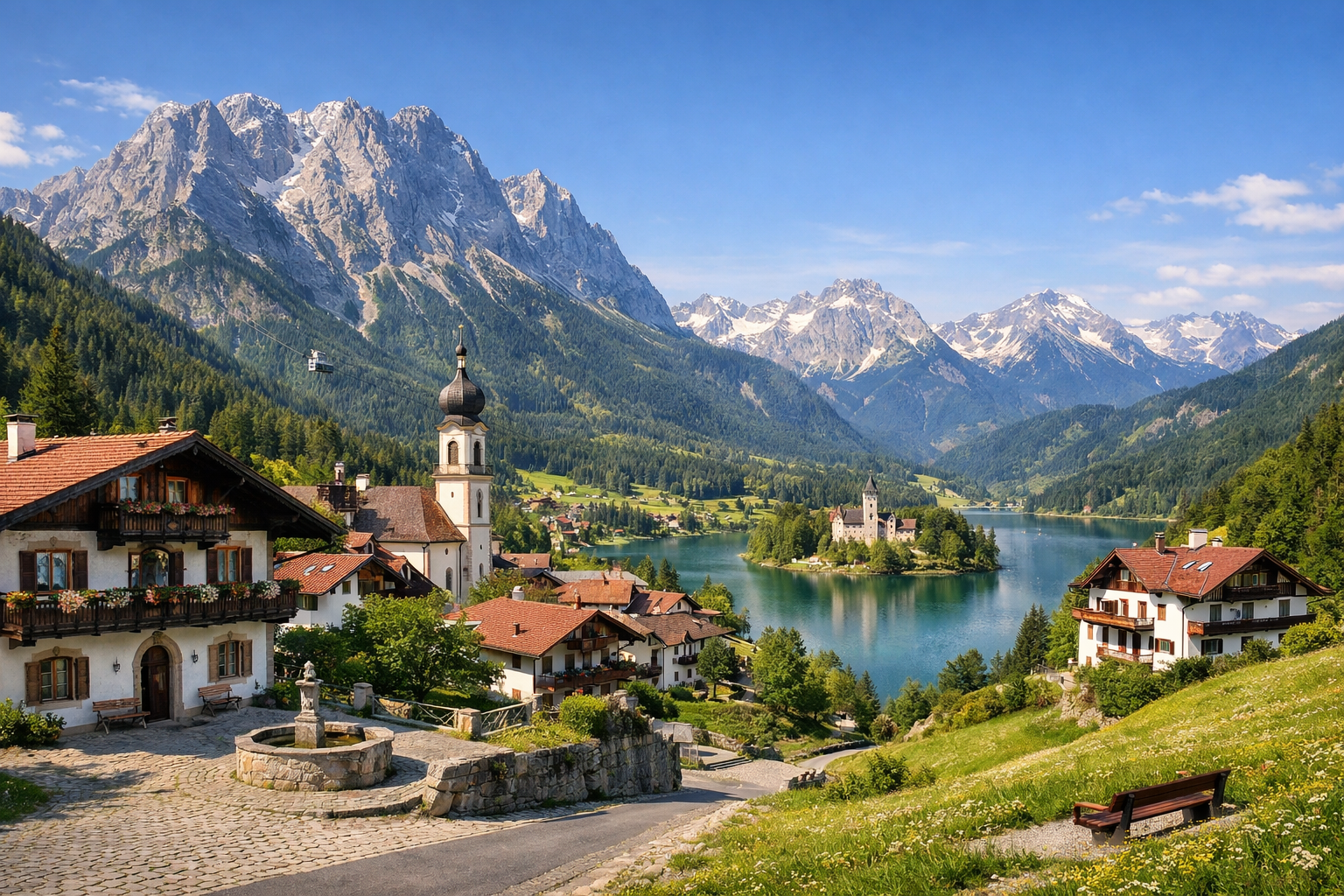
From Munich to Garmisch-Partenkirchen, this journey leads straight into the heart of the Bavarian Alps. Glide across the mirror-like waters of Eibsee, then rise to the summit of Zugspitze for sweeping mountain views and crisp alpine air.

🧭 DAY-BY-DAY ITINERARY

Ready-made country and city routes with daily plans, sights, transport and accommodation. Buy PDF guides for independent travel.

🧭 DAY-BY-DAY ITINERARY


Day 1 — Garmisch-Partenkirchen: a resort-style alpine start

  • 🚆 Transfer: Munich → Garmisch-Partenkirchen by regional train — usually about 1 hr 15 min–1 hr 25 min without feeling like a tiring transfer. This is one of the most comfortable ways to reach the heart of the Bavarian Alps: the train gradually takes you from the big city toward increasingly dramatic mountain silhouettes, and the final approach to the resort already works as a prologue to the trip itself.

  • 🚶 Garmisch-Partenkirchen is not just a convenient base at the foot of Zugspitze, but one of Bavaria’s main alpine resorts, where sporting history, old Bavarian facades, and a mountain rhythm of life can be felt in almost every quarter. It’s pleasant not to rush here: after check-in, it’s worth giving yourself a gentle acclimatization day without overload, strolling through the center, breathing the cool air, checking train and lift schedules for tomorrow, and tuning in for the main mountain day. The architecture here is very atmospheric: houses with painted facades, flower-filled balconies, views of the Wetterstein massif, and that rare type of resort where the urban fabric does not compete with nature, but lives within it.

  • 🚶 In the second half of the day, it makes sense to head toward the Olympic area and then in the direction of Partnachklamm, at least for a walk along the approach paths and viewpoints on the route. Even without doing a long trek, the path itself is already impressive: forest, river, rocky slopes, and the feeling that the resort is gradually giving way to the real Alps. Partnach Gorge is one of the most striking natural locations in the region: water roars through a narrow limestone cleft, and the high damp walls create an almost theatrical effect. If you want an easier evening, instead of a long walk you can choose central Garmisch, coffee with a view of the peaks, and an early rest before the ascent to Zugspitze.

  • 💤 It’s best to plan your overnight stay in Garmisch-Partenkirchen itself or in nearby Grainau. The first option is more convenient for walks around the resort and dinners without a car, while the second is better for the fastest possible start to Eibsee and the cable car. In the evening, be sure to check the current operation of the lifts and the cog railway: on Zugspitze, weather and technical maintenance really affect logistics, and it’s better to know about closures of individual sections in advance than to find out when already standing at the station.


Day 2 — Zugspitze: Germany’s highest summit, 2962 m

  • 🚆 The main day of the trip is dedicated to Zugspitze — the highest mountain in Germany, 2962 m. You can plan the ascent in two classic ways: either from Eibsee by the Seilbahn Zugspitze cable car, or by the Zugspitzbahn cog railway from Garmisch-Partenkirchen via Grainau and Eibsee to Zugspitzplatt. The most scenic and logical format for a short trip is to do a “round-trip” route: go up one way and come down the other. The official Zugspitze ticket usually allows a combination of Zahnradbahn, Seilbahn Zugspitze, and the Gletscherbahn glacier cable car, so the day becomes not just a transfer to the mountain, but a full alpine experience.

  • 🚶 If you start from Eibsee, the boarding point by the lake already makes a powerful impression: the water here is unreal turquoise, the forests are dark green, and above them rises an almost sheer rock wall. Seilbahn Zugspitze takes you to the summit in about 10 minutes, and it’s one of those ascents where you want to look in all directions at once. If you choose the cog train instead, the journey is slower and more grounded, but it has a completely different charm: it’s a classic alpine railway that gradually carries you from the resort valley into the harsh high-mountain environment of Zugspitzplatt. According to official information, the trip from Garmisch-Partenkirchen to the upper part of the route takes about 75 minutes, and from Eibsee about 40 minutes.

  • 🚶 At the summit, it’s worth allowing at least 2.5–4 hours with extra time for weather, photos, walks around the viewing platforms, and a relaxed lunch. The main thing here is not just the fact of “I was at the highest point in Germany,” but the panorama: mountain ridges stretch across several countries at once, and on a clear day the landscape looks like an endless 360-degree map of the Alps. Gletscherbahn runs between the summit and Zugspitzplatt; it usually runs frequently, so you can head down to the glacier plateau without rushing, take in the harsher, almost high-alpine lunar landscape, and then continue your route downward. It is exactly this combination of summit + plateau that makes the trip rich and visually varied.

  • ⚠️ Very important: you need to check the schedule and operating status of the lifts right before the trip. For Zugspitze, this is not a formality. The cable cars and railway may close or change service because of wind, poor visibility, technical maintenance, and scheduled inspections. Current timetables sometimes include specific periods of service interruptions on individual sections, so checking the evening before the trip and again in the morning on the day of departure is an essential part of the route.

  • 🚶 After returning down, the day ends beautifully at Eibsee. Even a short walk along the shore after the high-mountain section creates exactly the right contrast: in the morning — a grand summit, by day — glacier plateau and cliffs, in the evening — calm water, forest, and soft light over the lake. If you still have energy, you can do a short part of the lakeside trail, but without overdoing it: this is the kind of day when it matters more to leave room for rest, a warm dinner, and a sauna at the hotel than to try to add one more “checkmark.”

Day 3 — the heart of the Bavarian Alps: Eibsee, culture, and a gentle finale

  • 🚶 The third day is best not turned into a second summit assault, but dedicated to the very essence of the region — the heart of the Bavarian Alps. Start with Eibsee: it is one of the most beautiful mountain lakes in Germany, famous for the incredible clarity of its water and the way the Zugspitze massif reflects in it. A full circuit of the lake takes a noticeable amount of time, so on a short trip it is wiser to choose a calm walk along the most scenic stretches of shore, pause for breakfast or coffee with a view, and simply experience the place without rushing. It is especially easy to feel here why the area around Grainau and Garmisch is loved not only by tourists, but by Germans themselves for short alpine escapes.

  • 🚶 Back in Garmisch-Partenkirchen, you can put together a more cultural finale. Richard-Strauss-Institut or Museum Werdenfels are excellent for this: the first adds an intellectual and musical layer to the trip, while the second helps you understand the region itself, its traditions, alpine way of life, and local identity. This is especially enjoyable after a day on Zugspitze: the route stops being just a set of beautiful views and becomes a story about a place where alpine nature, sporting fame, music, the old Bavarian way of life, and modern tourism all exist together.

  • 🚶 If you want a little more nature but without serious effort, Michael-Ende-Kurpark or a walk through the resort part of town with mountain views is ideal. It’s a gentle ending to the trip: you’ve already seen grand heights, walked the alpine approaches, heard the sound of mountain water, and now the region opens up more calmly — through gardens, neat streets, cafés, and the chance to buy last local souvenirs without any rush.

  • 🚆 Return: Garmisch-Partenkirchen → Munich — usually again about 1 hr 15 min–1 hr 25 min. This three-day route turns out very cohesive: no exhausting transfers, one convenient base, the main focus on Zugspitze, and still enough time for rest. This is an important advantage specifically in the Alps: here it’s better to see less, but experience each location more deeply and more beautifully.

Flight tickets

eSIM for travel

Buy PDF guide

Buy PDF guide — 6.43 USD

PDF — 6.43 USD