
Buy PDF guide

Buy PDF guide — 25.71 USD

PDF — 25.71 USD

Troy

Troy

From the energy of Istanbul to the windswept ruins of Troy, Turkey unfolds in layers of legend, sea views, and living history. Wander ancient Assos above the Aegean, trace the shores of Çanakkale, and return to Istanbul with the feeling of having crossed both continents and centuries.

🧭 DAY-BY-DAY ITINERARY

Ready-made country and city routes with daily plans, sights, transport and accommodation. Buy PDF guides for independent travel.

🧭 DAY-BY-DAY ITINERARY


Day 1 — Istanbul: arrival and a gentle start before the road to the Troad

  • 🚶 It’s best to make the first day calm and settling. Check into a hotel in the historic center or near a convenient transport hub, rest after your flight, and spend the evening walking along the waterfront or through the old quarters. This day is not for racing through landmarks, but for finding the right rhythm: ahead of you is not just a trip to ruins, but a journey into one of the most mythologized landscapes of the ancient world — the region of the ancient Troad, where epic poetry, archaeology, and northwestern Anatolia come together in one great historical narrative.


Day 2 — Transfer Istanbul → Çanakkale: the road to the straits and a first encounter with the Troy region

  • 🚌 Transfer: Istanbul → Çanakkale. By land, the journey usually takes about 5.5–7 hours depending on the service, connections, and traffic; if flying to Çanakkale, travel time is shorter, but you need to allow for the trip to the airport, waiting time, and transfer into town.

  • 🚶 After arrival, don’t overload the day. In the evening, walk through central Çanakkale: it is a convenient base for historical excursions, a city with sea air, a lively waterfront, and a sense of being on the boundary between the European and Anatolian shores of the strait. Here it becomes especially clear that Troy is not an isolated archaeological site, but part of a large network of ancient routes, trade paths, and military crossings that controlled access to the Dardanelles.

Day 3 — Troy: the ancient city and an introduction to layered archaeology

  • 🚗 In the morning, depart from Çanakkale to Troy. The road to the archaeological zone usually takes about 35–45 minutes by car or taxi; if using local transfers and waiting for transport, allow more time.

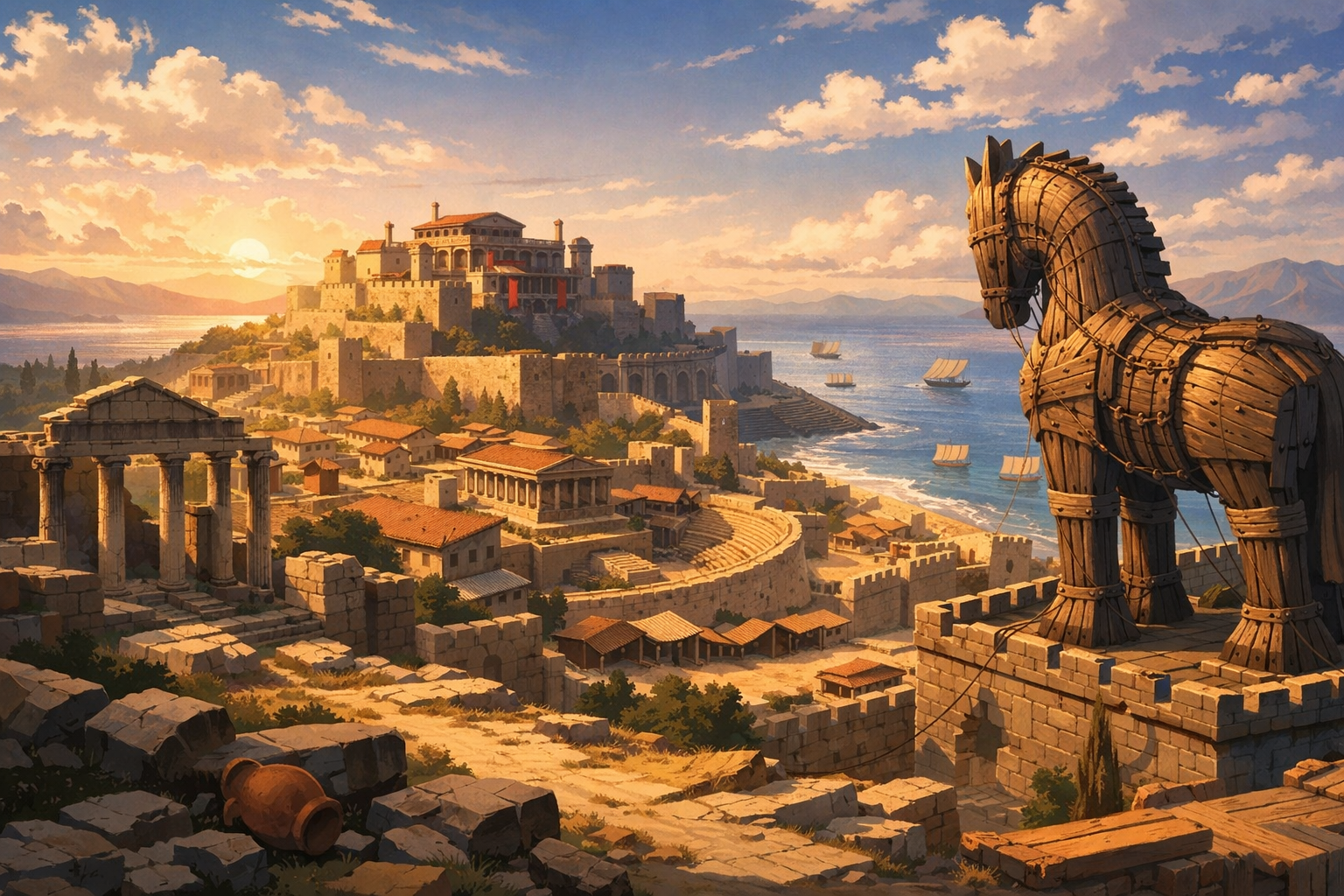
  • 🚶 Today is the main day of the itinerary. Troy impresses not as a “complete ancient city” in the manner of Ephesus, but through its archaeological depth. Before you is not one era, but a whole vertical of time: the city was built, destroyed, rebuilt, and accumulated layer upon layer of memory from different cultures, technologies, and political worlds. Along the route, it is important to look at the fortification lines, remains of walls, entrance areas, fragments of urban structure, and the way the hill of Hisarlık itself becomes a historical cross-section. Here the difference between literary myth and archaeological reality is felt especially sharply: Troy is not only the “city of the Iliad,” but also a real settlement of the Bronze Age, late antiquity, and Roman times.

Day 4 — Troy Museum: the objects that give the ruins their voice back

  • 🚶 It makes sense to devote the second day in Troy to the museum. The Troy Museum is located at the entrance to the archaeological zone, so the logistics are convenient: you can take the same route from Çanakkale and spend half a day or more in the complex. Here the ruins gain substance and meaning: ceramics, jewelry, everyday objects, sculptural fragments, materials from the Troad, and finds from different eras help you see the hill not as an abstract “legendary city,” but as a living space of trade, craft, war, belief, and contact between the Aegean world and Anatolia.

  • ☕ After the museum, leave time to rest — at least 1–1.5 hours without a packed program. This kind of itinerary is better absorbed without rushing: the museum is dense with context, and it is precisely the pause that helps connect the archaeological layers, the Homeric story, and the geography of the region in your mind.

Day 5 — Tevfikiye and the rural landscape of the Troad: archaeology beyond the fence

  • 🚶 This day is best kept slower. Devote it to the surroundings of Troy and the village of Tevfikiye, next to which the archaeological complex is located. Such a day is important for a proper perception of the place: Troy is not only the entrance gate, the wooden horse, and the museum exhibition, but also a rural, windy, open landscape in which it is easy to understand why control over this zone was strategically important. The space between fields, roads, and low rises lets you feel the scale of the area, not just the excavation point.

  • 📷 In the second half of the day, it’s best to leave time for unhurried photography, lunch, and rest. After two intensive days on site, this kind of “airy” day reduces fatigue and makes the following excursions more comfortable.

Day 6 — Çanakkale: a city day, museum context, and resetting the pace

  • 🚶 Return to a calmer urban rhythm. Çanakkale is useful as a base not only logistically, but also conceptually: here it is convenient to reread notes, reorganize photos, walk through the center, and understand Troy as part of a broader historical region. Unlike the archaeological site itself, the city offers an everyday pause: cafés, the waterfront, short journeys, and the chance not to get up too early.

  • ☕ It’s best to build the day around a long pause after lunch. This is a deliberate rest before the next major excursion — to Assos, where ancient architecture is perceived in a completely different way: not as a layered excavation, but as an expressive panorama of an acropolis and temple above the sea.

Day 7 — Transfer Çanakkale → Assos/Behramkale: a change of scale and landscape

  • 🚗 Transfer: Çanakkale → Assos (Behramkale). The road usually takes about 1.5–2 hours by car or transfer, depending on the departure point and stops along the way.

  • 🚶 Assos is a different kind of ancient impression. If Troy speaks in the language of archaeological layers and contested reconstructions, Assos acts immediately through the power of place: acropolis, height, sea, stone, and an almost theatrical staging of the landscape. By evening, the first walk through Behramkale is especially rewarding: the rough texture of the old buildings, the slopes of the streets, the view of the Aegean Sea, and the feeling that ancient architecture here still holds the summit of space.

Day 8 — Assos: the Temple of Athena and the acropolis

  • 🚶 This is one of the most photogenic and at the same time historically rich days of the itinerary. Head up to the acropolis in the morning or closer to the softer light of the second half of the day. The Temple of Athena in Assos is not just a “beautiful colonnade on a hill,” but a key to understanding how ancient architecture worked with panorama, relief, and symbolic dominance. Even though it survives only in fragments, the temple makes a strong impression precisely through its placement in the landscape: columns, a stone platform, wind, and the sea horizon create a sense of the ultimate clarity of ancient thought.

  • 🚶 After the acropolis, be sure to leave time for a slow walk around the ancient sections and viewpoints. Assos reads especially well in pauses: what matters here is not only the ruins themselves, but the way the ancient city holds your gaze above the coast and shapes an almost philosophical experience of space.

Day 9 — Assos: a second day on site, city details, and rest by the coast

  • 🚶 A second day in Assos is needed not as a repetition of the first, but as a deepening. Today you can walk the sections of the ancient city more attentively, see how the acropolis connects with the lower parts of the settlement, and compare your perception of the place in different light. Where on the first day your attention is caught by the panorama and the temple, on the second day the details begin to work: stone masonry, the rhythm of the slopes, breaks in visibility, the materiality of the local stone, and the connection between the ancient heritage and the later village environment.

  • 🏖️ In the second half of the day, give yourself some rest. A small pause by the sea, a late lunch, and a slow evening matter no less than the sightseeing itself: the itinerary is historical, but it is designed as a journey, not a checklist marathon.

Day 10 — Excursion to Alexandria Troas: another chapter of the ancient Troad

  • 🚗 From the Assos area or after returning toward Çanakkale, it is convenient to plan an excursion to Alexandria Troas. Travel time depends on your base and route, but is usually around 1–2 hours, taking local roads into account.

  • 🚶 Alexandria Troas is important as an extension of the historical map of the region. After Troy and Assos, it becomes clear that the Troad is not one legend and not one great hill, but a whole network of ancient centers linked by the sea, trade, and politics. On site, it is especially interesting to grasp the scale of the former port city and imagine how the roles of the coast changed in the Hellenistic and Roman eras. This is a day for those who want to see the region not as isolated points, but as a multifaceted historical territory.

Day 11 — Return to Çanakkale: final day in the region and buffer for weather/pace

  • 🚗 The drive back to Çanakkale usually takes about 1.5–2 hours from the Assos area, not including stops.

  • 🚶 It is useful to keep this day semi-free. You can use it as a buffer in case of wind, heat, transport changes, or the wish to return to Troy once more. If everything has gone according to plan, devote the day to a calm city walk, buying books or museum publications, reviewing the itinerary, and one last evening walk along the waterfront. A final day in the region helps bring the journey to a close without a sense of rush.

Day 12 — Çanakkale → Istanbul: return and final reflections

  • 🚌/✈️ Transfer: Çanakkale → Istanbul. By land, the trip again takes about 5.5–7 hours; if flying, be sure to allow time for the airport transfer and early arrival.

  • 🚶 It’s best to leave the final evening in Istanbul free. After the Troad, the former capital is perceived differently: as a huge layered city to which you return with a different historical scale in mind. Troy, Assos, and the coast of northwestern Anatolia give the rare feeling that the ancient world is not an abstraction from books, but a real space of wind, stone, sea, and very long memory.

Flight tickets

eSIM for travel

Buy PDF guide

Buy PDF guide — 25.71 USD

PDF — 25.71 USD