
Buy PDF guide

Buy PDF guide — 25.71 USD

PDF — 25.71 USD

CROATIA

CROATIA

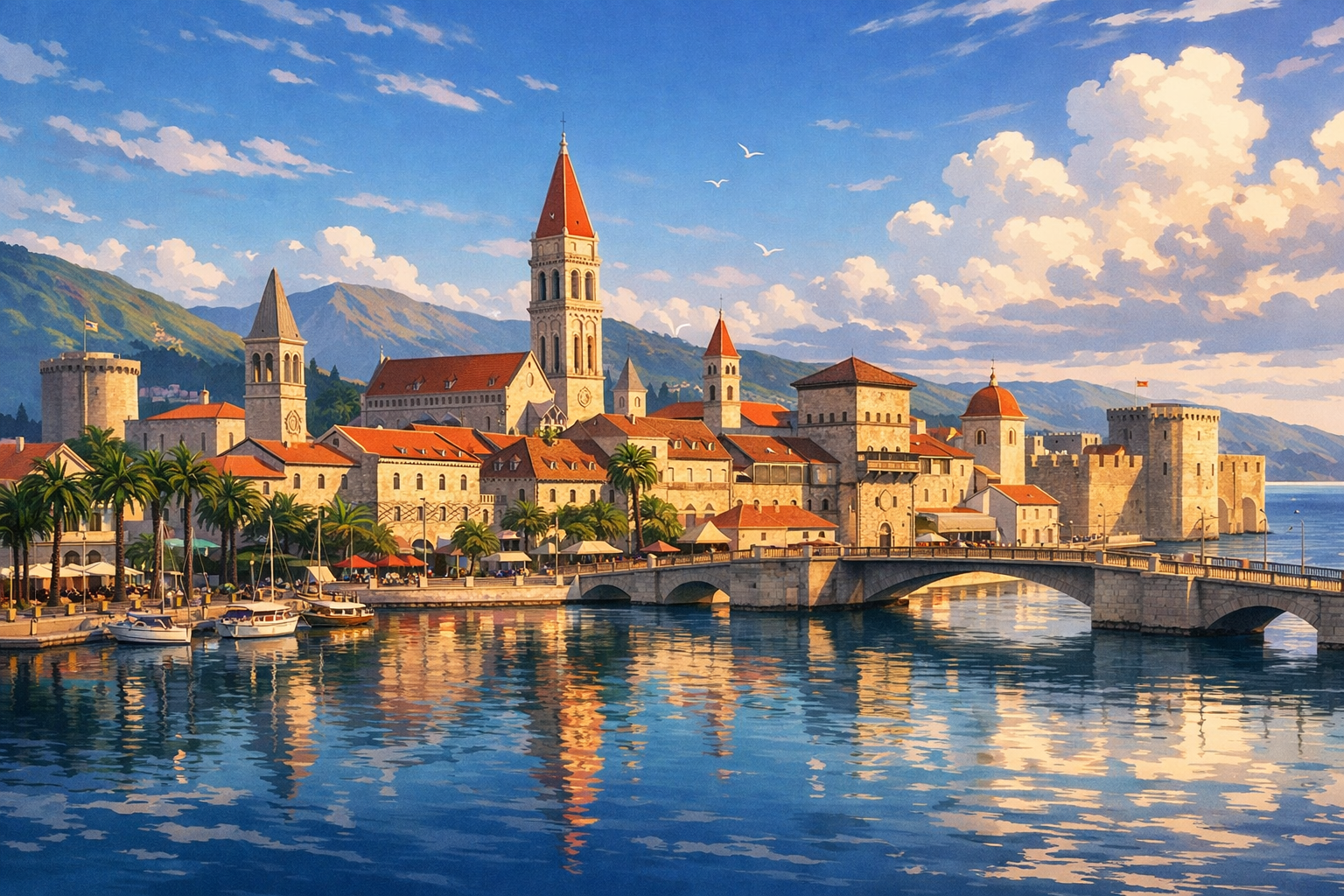
Discover Croatia’s Dalmatia on a loop from Trogir’s medieval island lanes to beachy Čiovo and Split’s living Roman palace. Continue through Solin’s ancient Salona and the hilltop stronghold of Klis to Šibenik, then return to Trogir as the Adriatic glows at sunset.

🧭 DAY-BY-DAY ROUTE

Ready-made country and city routes with daily plans, sights, transport and accommodation. Buy PDF guides for independent travel.

🧭 DAY-BY-DAY ROUTE


Day 1 — Arrival in Split (SPU) → Trogir: a first look at the island-town

  • ✈️ Upon arrival at Split Airport (SPU), take the Promet Split city bus No. 37 (stop by the airport) to Trogir ≈ 15–25 minutes travel time, or the official shuttle to Split (Pleso Prijevoz) and continue along the route. Taxi/transfer from SPU to central Trogir — ≈ 10–15 minutes with light traffic.

  • 🚶 Evening orientation walk: from Kamerlengo to John Paul II Square. Old Trogir is a rare “museum-island” laid out like an ancient polis: narrow stone lanes, the rhythm of loggias and courtyards, the smell of sea and limestone. At sunset the walls and towers “flare up” with warm light—an ideal start for reading the city as a single ensemble.


Day 2 — Trogir: St. Lawrence Cathedral and the square as a “stone stage”

  • 🚶 St. Lawrence Cathedral is the heart of the ensemble: a three-aisled Romanesque-Gothic basilica (13th–15th c.) with the Adriatic’s greatest portal—by Master Radovan (1240). Read the façade as a “stone book”: lion caryatids, Adam and Eve, months of the year, scenes from Christ’s life. Climb the bell tower (if open) for a panorama of tile-roofed quarters and the line of the walls.

  • 🚶 John Paul II Square with the Loggia and Clock Tower is the lively “forum” of the medieval city. On the opposite side of the cathedral is the Cipiko Palace: trace how a noble urban residence was woven into the dense fabric of the island and “worked” to project the family’s status.

Day 3 — Trogir: fortress lines and sea defense

  • 🚶 Kamerlengo Fortress (15th c., Venice) and the Tower of St. Mark capture the confrontation between sea and land. From above you can read the layout of the island, the harbors, and the link in the defensive chain (walls, towers, glacis). Walk the perimeter—you’ll see how the bastions “embrace” the waterfront and how the city connects coastal routes with inner streets.

  • 🛶 In good weather, check out the western waterfront: old slipways down to the water and views of Čiovo help explain why Trogir was a convenient harbor for centuries and a “gateway” into the Dalmatian hinterland.

Day 4 — Trogir: monasteries and “treasuries” (the Kairos Collection)

  • 🚶 The Benedictine Monastery of St. Nicholas houses the famous Kairos Collection—a rare Greco-Roman relief of the “happy moment” and a trove of Trogir’s sacred art. What matters is not only the exhibit but also the context: a women’s monastery by the city wall, its link to the city’s patron St. John of Trogir, centuries-old manuscripts, and liturgical objects.

  • 🚶 The Monastery and Church of St. Dominic on the waterfront is a classic “coastal” cloister: courtyard silence, austere façades, and the reflection of arcades in the water. Compare the two monasteries: different monastic discipline—different solutions in plan and decoration.

Day 5 — Čiovo Island: the Prizidnica hermitage and coastal churches

  • 🚶 The hermitage of Gospa od Prizidnice near Slatina is a 16th-century chapel literally “stuck” to a cliff above the sea. The footpath and small elevation gain create a “cinematic” reveal of the shrine: white limestone, Adriatic turquoise, and the scent of maquis. It’s a key to understanding Dalmatia’s “ascetic landscape.”

  • 🌊 Then—beach/pause by the shore and return to Trogir. In the evening—a leisurely walk along the waterfront with views of Kamerlengo at dusk.

Day 6 — Split: Diocletian’s Palace as a “city within a palace”

  • 🛥️/🚌 Transfer Trogir → Split: the Bura Line fast boat by sea (≈ 60 min) or bus No. 37 (Promet Split) ≈ 45–65 min depending on traffic.

  • 🚶 Diocletian’s Palace is a rare example where an imperial residence (3rd–4th c.) became a medieval city. Follow the “right” trajectory: Bronze Gate → underground substructures → Peristyle → Temple of Jupiter / Cathedral of St. Domnius. Look at the cardo/decumanus grid, how houses “grow into” the ancient walls, and how porticoes set the rhythm of the squares.

Day 7 — Split: archaeological collections (antiquity + early medieval Croatia)

  • 🚶 The Split Archaeological Museum (Zrinsko-Frankopanska 25) is key to reading Salona and Split: inscriptions, sarcophagi, mosaics, everyday objects. Ask for a plan of ancient Salona—it will be your “map” for tomorrow.

  • 🚶 The Museum of Croatian Archaeological Monuments (Stjepana Gunjače bb): the post-Roman chapter—early medieval tombstones, stone sculpture, princely artifacts. Together the two museums provide the link “Romans → early medieval Croatia.”

Day 8 — Solin (Salona): the capital of Roman Dalmatia

  • 🚌 Transfer: Trogir → (if necessary via Split) → Solin. On site—Salona Archaeological Park: Manastirine (early Christian necropolis), the amphitheater, city gates, and sections of the street network. It’s important to walk it “like a citizen”: from the gate to the forum, to the baths and the amphitheater—this is how the scale of Roman life becomes legible.

  • 🕰️ Finish in Tusculum (a museum residence in the park): reconstruct in your mind the lost fragments of façades and layouts seen the day before in Split’s museums.

Day 9 — Klis: “the rock above Dalmatia”

  • 🚌/🚕 Transfer to Klis Fortress (Trg Mejdan, town of Klis) from Split: city bus/taxi; from Trogir it’s faster via Split. At the top is a powerful fortified acropolis that controlled the entrance to coastal Dalmatia. From the bastions—views of Salona, Split, and Kaštela; inside—weapons and reconstructions of garrison life.

  • 📸 Viewpoints along the wall route show “military geography”: passes, sea approaches, valleys—why a “castle on the rock” arose именно here.

Day 10 — Šibenik: the stone poem of St. James’s Cathedral and the sea stronghold of St. Nicholas

  • 🚌 Transfer Trogir → Šibenik (≈ 1–1.5 h). St. James’s Cathedral (UNESCO) is a phenomenon of an all-stone vault and dome without traditional mortar masonry: the cathedral is “assembled” from stone slabs and dovetails. Notice the frieze with the townspeople’s heads—a rarest urban “album” of the 15th–16th centuries.

  • ⛵ St. Nicholas Fortress (16th c., UNESCO) is a maritime triangular bastion at the entrance to the St. Ante Channel; visited via the official boat line from the center (in season). Combine it with a climb to St. Michael’s or St. John’s Fortress for panoramas.

Day 11 — Trogir: details and a deep reading of stone

  • 🚶 Return to your favorite places in Trogir: study the portals of parish churches, window tracery, and loggia ceilings. Drop into the City Museum (Garagnin-Fanfogna Palace)—here you can see how aristocratic interiors “reassemble” elements of ancient and medieval structures.

  • 🕯️ In the evening—warm illumination of the cathedral and walls: a great time for photos without crowds and to compare the ancient, Romanesque, and Renaissance “song of stone” in a single frame.

Day 12 — Weather/rest buffer + flight

  • ☕ A leisurely morning: a café by the waterfront, buying local publications about Trogir and Salona, one last loop along the Kamerlengo walls.

  • ✈️ Transfer to Split Airport (SPU): Promet Split No. 37 (≈ 15–25 min) or taxi/transfer. Put together the “timeline”: Greek Tragurion → Roman Salona → Byzantine-medieval Trogir and Split → Venetian fortresses—a coherent history of the Adriatic.

Flight tickets

eSIM for travel

Buy PDF guide

Buy PDF guide — 25.71 USD

PDF — 25.71 USD