
Buy PDF guide

Buy PDF guide — 6.43 USD

PDF — 6.43 USD

Strasbourg

Strasbourg

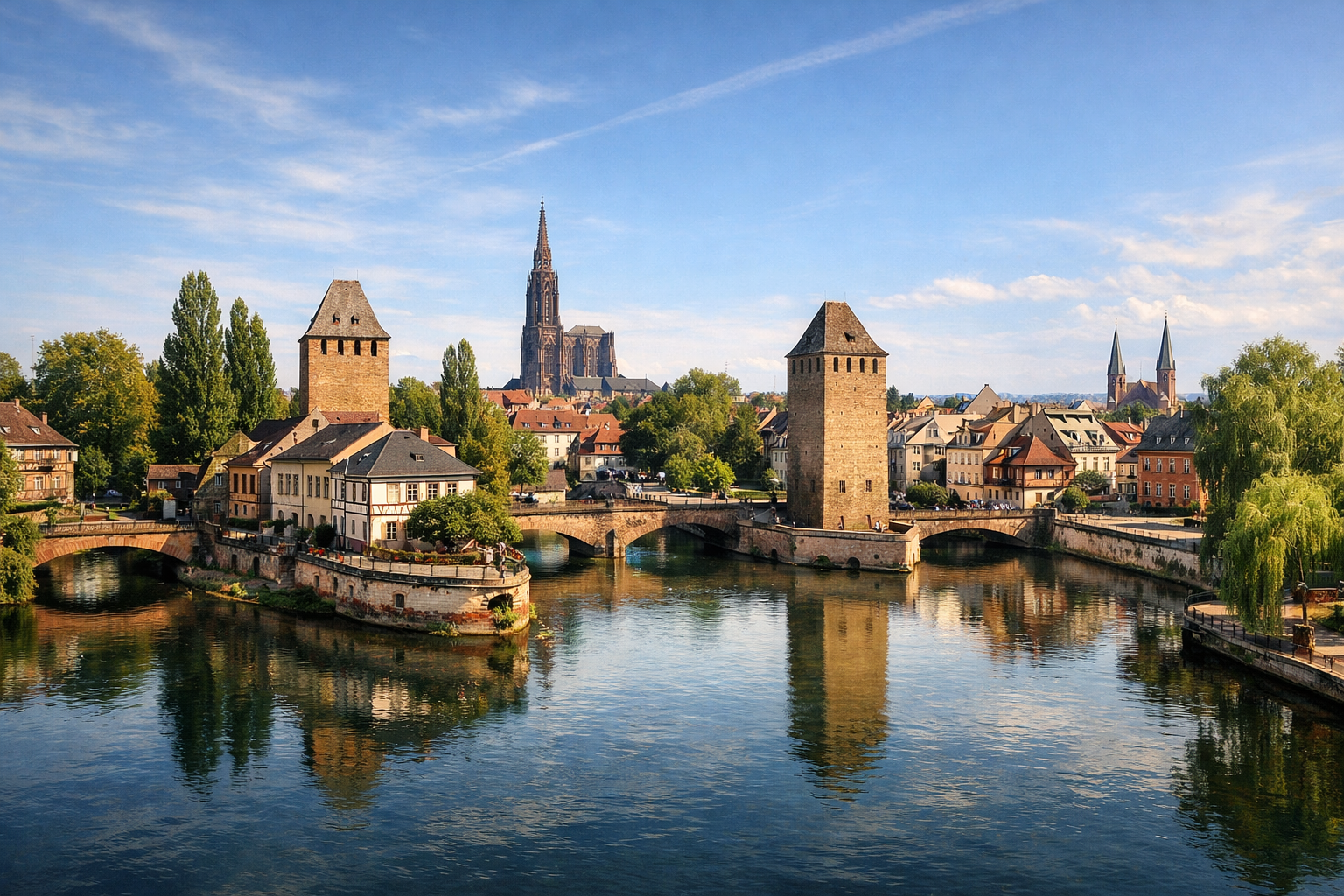
Strasbourg blends storybook charm with cosmopolitan flair, from the canals and timbered houses of Petite France to the grand avenues of the European Quarter. Wander from the heart of the Grand Île to leafy Parc de l’Orangerie and discover a city where medieval beauty meets modern Europe.

🧭 DAY-BY-DAY ITINERARY

Ready-made country and city routes with daily plans, sights, transport and accommodation. Buy PDF guides for independent travel.

🧭 DAY-BY-DAY ITINERARY


Day 1 — Strasbourg: Grand Île, the cathedral, and the historic center

  • 🚶 It’s best to dedicate the first day to the heart of Strasbourg — Grand Île, the historic island where the city reveals all its layers at once: medieval, commercial, religious, and almost fairy-tale-like. Start the morning at Cathédrale Notre-Dame de Strasbourg: pink Vosges sandstone, a carved façade, and the vertical line of the spire create the sense not just of a monument, but of a true urban axis around which life revolved for centuries. After the cathedral, move slowly and without rushing through the area around Place du Château, peeking into narrow streets, arches, and small squares. This is a good place to take your first long coffee break and give yourself time not to “rush through” the center, but to feel its rhythm. It makes sense to allow about 2.5–3 hours for the cathedral and the surrounding quarter, including photos, a short rest, and a possible line at the entrance.

  • 🏛️ Then it makes sense to continue the day with the museum cluster near the cathedral: Musée de l’Œuvre Notre-Dame helps you see Strasbourg not only as a beautiful postcard, but as a city of craftsmanship, religious art, and Upper Rhine tradition. If you want more urban context, add the Musée Historique — it brings together Strasbourg’s story from the Middle Ages to the European era very well. Between the two museums, it’s better not to try to fit in too much: choose one as the main stop, and the second only if you still have the energy. It’s worth setting aside about 3–4 hours for the museum portion and lunch so the day doesn’t turn into a marathon.

  • 🌆 In the evening, walk to Place Kléber and then toward the banks of the Ill. At this moment, the center is especially lovely: the daytime crowds ease a little, shop windows glow more warmly, and the old town begins to feel not like a set of sights, but like a living European space. If you still have energy, make a gentle evening loop via Maison Kammerzell, Place Gutenberg, and back to the cathedral — at dusk, stone, water, and light create that very “Strasbourg” effect people come here for. Walking distances during the day are short: usually 5–15 minutes between key points, so the route remains comfortable even after travel.


Day 2 — Strasbourg: Petite France, covered bridges, and contemporary art

  • 🚶 Dedicate the second day to the city’s most photogenic and at the same time most atmospheric district — Petite France. In the morning, the quarter is especially pleasant: less bustle, softer light on the water, and the architecture of the old half-timbered houses, once associated with craftsmen, millers, and tanners, comes through better. Walk along the canals without a rigid plan: in this area, what matters is not so much “checking off sights” as watching how water, little bridges, reflections, and old façades come together into a complete scene. From Place Benjamin Zix to Barrage Vauban and Ponts Couverts, you can walk unhurriedly in 20–30 minutes, but with photo stops and short breaks the district easily fills 2–3 hours.

  • 🌉 Be sure to go up to Barrage Vauban: it is one of the best points from which to capture a panorama of Petite France, the covered bridges, and the towers in a single frame. After that, head to the Musée d’Art Moderne et Contemporain de Strasbourg — the contrast after postcard-perfect Strasbourg works wonderfully. The city suddenly shows another side: not only the past and lace-like façades, but also a contemporary visual language, spacious halls, and a calmer, more contemplative rhythm. Allow about 10 minutes on foot from Barrage Vauban to the museum, and another 1.5–2.5 hours for the museum itself and a rest after your walk.

  • 🍷 Leave the evening for a slow return to the center via the quays and old streets. This is a good moment for dinner in a winstub or simply for a walk without fixed goals: Strasbourg rewards repeat viewing very generously once you’ve already gotten to know it by day. You can walk through Petite France again along the opposite bank to see how the district changes in the evening light. The whole day remains compact and realistic: walking is the main part of the route, with occasional short tram rides if you want to save energy.

Day 3 — Strasbourg: the European Quarter, Orangerie, and a calmer finale

  • 🚋 It’s best to make the third day feel lighter and more modern in mood. In the morning, head to the European Quarter — this is a completely different Strasbourg: broader avenues, stricter lines, more space between buildings, and a stronger sense of the city’s role as one of the symbolic capitals of Europe. If the institutional side of the city interests you, include a visit to the European Parliament: it’s a rare opportunity to see not only the outward image of European institutions, but also the space where politics feels almost physical. From the center to the Wacken / European Quarter area, it is usually convenient to get there by tram in about 15–25 minutes depending on your starting point and transfers.

  • 🌳 After a stricter architectural and political section, it is ideal to move on to Parc de l’Orangerie. This is the best way to end the trip gently: a large park, old trees, walking alleys, ponds, and that feeling of an urban breather that busy itineraries often lack. There is no need to hurry here — you can simply stroll, sit by the water, take a long break for lunch or coffee, and let Strasbourg end not with museum fatigue, but with calm. It’s worth allowing no less than 2 hours for the park, and better 3 if you really want to rest.

  • 🖼️ If you still have time and the mood for one more cultural accent, add the Musée Tomi Ungerer or a short walk to the area around the university and the botanical garden. But in general, it’s better not to overload the third day: after two historically dense days, it is precisely the combination of European architecture, a park, and more spacious quarters that gives the right ending. Returning to the center from the Orangerie area usually takes about 10–20 minutes by tram or 35–45 minutes on foot at a calm pace.

Flight tickets

eSIM for travel

Buy PDF guide

Buy PDF guide — 6.43 USD

PDF — 6.43 USD