
Day 1 — Stara Zagora: ancient Augusta Traiana, Neolithic heritage and the city center
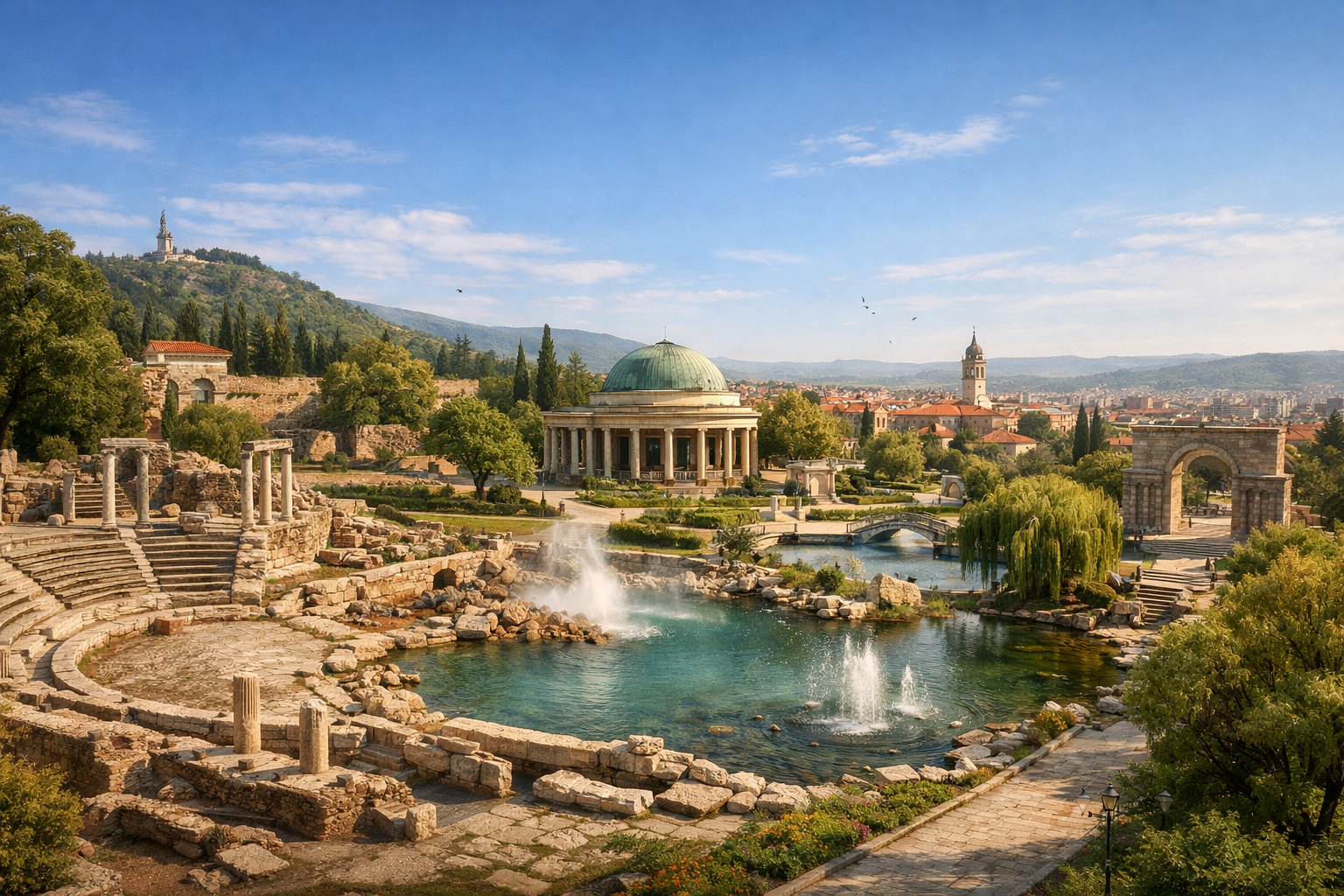
🚶 It’s best to dedicate the first day to the very heart of Stara Zagora — a city that knows how to reveal history in layers, almost without long transfers. Start with the Regional History Museum: it is a great “entry point” because the exhibition brings together the site’s many-thousand-year biography — from prehistory to modern times. After the museum, it makes sense to walk to the Ancient Forum of Augusta Traiana: here you can especially feel the scale of the Roman city that was once an important center of Thrace. The space does not look like a closed museum site — it is a living urban stage where ancient ruins stand next to modern life, and this contrast is exactly where Stara Zagora is at its strongest. It is convenient to allow about 3–4 hours for the “museum + forum + short stops for photos and rest” combination without rushing.
🏛️ Then head to the Museum of Religions — one of the city’s most unusual places. This site is valued not for its “grandeur” but for its rare historical depth: in different eras, the same plot housed a pagan sanctuary, a Christian church, and a Muslim mosque. Inside, you can strongly sense the idea of continuity and how the city experiences changing eras not through the destruction of memory, but through its layering. After the museum, take a break for a late lunch in the center: distances here are compact, and walking transfers between the day’s key locations usually take 10–20 minutes, so the route feels very comfortable.
🏺 In the second half of the day, head to the Neolithic Dwellings Museum. This is one of the main reasons to come to Stara Zagora at all if you are interested in deep antiquity: the remains of a two-story dwelling from the 6th millennium BC are preserved here, and the impression of the place is often stronger than the name suggests. This is not just a display case with artifacts, but a direct contact with a very early chapter of European settled life. Inside, it is easy to imagine people’s daily life, ovens, grain storage, pottery, ritual elements — and suddenly realize that “antiquity” here is not abstract, but very material and almost tangible. It is convenient to leave 1–1.5 hours for the visit, plus about 10–15 minutes from the center by taxi or approximately 25–35 minutes by public transport with a walking segment.
🌆 End the evening with an easy walk through the central quarters and October 5 Park (the city garden). After an intense historical day, this gives the right balance: instead of one more “must-see stop,” you get calm city air, broad alleys, and the feeling that Stara Zagora is not only about archaeology, but also about a comfortable rhythm of life. If you still have energy, you can add a short climb for evening views near the Samara Flag monument, or simply keep that accent for the second day. The whole first day realistically fits into 8–10 hours with museums, lunch, walking, and breaks.