
Buy PDF guide

Buy PDF guide — 10.71 USD

PDF — 10.71 USD

Slovenia

Slovenia

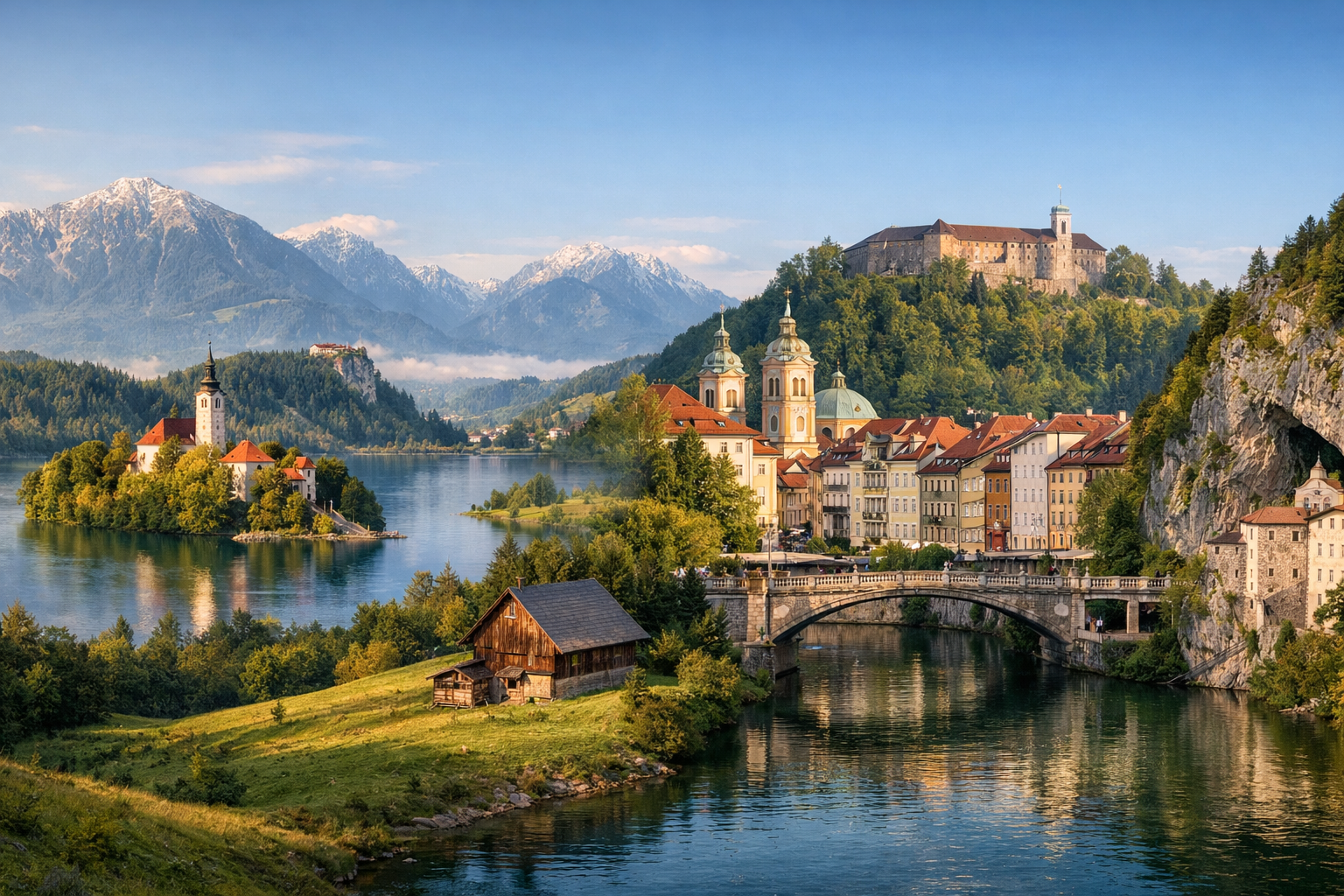
Slovenia packs storybook charm into every stop, from Ljubljana’s riverside buzz to the emerald stillness of Lake Bled. Venture underground at Postojna, marvel at dramatic Predjama Castle, then end by the Adriatic in Piran’s sunlit streets.

🧭 DAY-BY-DAY ITINERARY

Ready-made country and city routes with daily plans, sights, transport and accommodation. Buy PDF guides for independent travel.

🧭 DAY-BY-DAY ITINERARY


Day 1 — Ljubljana: old town, Triple Bridge, and castle

  • 🚶 Ljubljana is perfect for a gentle start to the trip: Slovenia’s capital is compact, green, and surprisingly human in scale. It doesn’t feel like an exhausting metropolis — instead, you’re welcomed by a city where Baroque elegance, the modernist ideas of Jože Plečnik, and the unhurried embankment along the Ljubljanica River come together into a very cohesive and cozy picture. Start the day in the historic center at Prešeren Square and the Triple Bridge — one of the city’s most recognizable symbols. The central stone bridge has stood here since the 19th century, and in 1929–1932 Plečnik added two side pedestrian crossings, turning an ordinary river crossing into an architectural stage. From here it’s especially pleasant to fan out into the old streets: toward the market, along the river, to cafés under the arcades, and to the famous dragons on Dragon Bridge, which seem to guard the entrance to old Ljubljana.

  • 🚠 In the second half of the day, head up to Ljubljana Castle. The most comfortable option is the funicular, which saves energy and immediately gives you a beautiful view of the red roofs of the old town. The castle itself is not just a decorative postcard, but a living historical point on the hill above the center: a fortress with a layered history, viewing terraces, exhibitions, and inner courtyards where it’s especially nice to linger toward evening. From here Ljubljana opens up as a calm capital surrounded by greenery and hills. Allow about 3–4 hours for visiting the castle, walking the walls, taking a coffee break, and making an unhurried descent or return by funicular, so the day doesn’t turn into a race.


Day 2 — Bled: lake, island, and castle

  • 🚆 Transfer: Ljubljana → Bled, intercity bus usually about 1h 15m–1h 30m; in high season it’s better to leave earlier to avoid the heavy tourist flow.

  • 🚶 Bled is that classic Alpine postcard that in real life usually turns out even more beautiful than in photos. The lake here is not just a body of water, but a full theatrical stage: mirror-like surface, wooded slopes, an island with a church in the middle of the water, and a castle suspended on a cliff above the lake. This day is worth living without haste. Start with a walk along the lakeside and part of the circular path around the lake: the full loop takes several hours, but for a rich and comfortable route it’s enough to choose a scenic section without trying to do everything at once. Then it makes sense to head to the island by traditional pletna boat or a rented boat, where the main atmosphere is built not on scale but on silence, the soft ringing of bells, and a sense of intimacy. Bled works through mood: here it’s important to leave yourself time simply to look at the water, sit on a bench, drink coffee, and not try to “tick off” the location too quickly.

  • 🏰 After lunch, head up to Bled Castle — the oldest castle in Slovenia, standing on a steep cliff about 130 meters above the lake. The views from here are one of the main reasons to climb up: the island, mountain slopes, changing light, and the feeling that the whole landscape has been assembled like a perfect composition. Allow at least 2 hours for the castle, photo stops, museum spaces, and rest. If you still have energy, finish the day with dessert overlooking the lake and an early quiet evening: Bled is especially beautiful in the soft pre-sunset light, when the tourist noise fades a little.

Day 3 — Ljubljana: Tivoli and museums without overload

  • 🚆 Transfer: Bled → Ljubljana, bus usually about 1h 15m–1h 30m. If staying overnight in Bled, it makes sense to leave after a relaxed breakfast so the day doesn’t start too early and feel overloaded.

  • 🌳 It’s best to return to Ljubljana not to repeat the center, but for a calmer, more “inner” acquaintance with the city. The day is well suited to Tivoli Park and the museums nearby. Tivoli is not just a city park, but a green breathing space that makes Ljubljana feel especially comfortable to live in. Broad avenues, old trees, hilly sections, and the smooth transition from the city rhythm to almost suburban quiet make it an ideal place for a slow day after tourist-heavy Bled. It’s pleasant here simply to walk without a strict plan, alternating the stroll with museum stops.

  • 🏛️ The best combination for the day is the City Museum of Ljubljana or the National Museum of Slovenia in the first half of the day, and the National Museum of Contemporary History of Slovenia in the Tivoli area in the second. This route gives both historical depth and a healthy pace without museum fatigue. The City Museum helps you see Ljubljana as a living layered city, while the National Museum gives a broader view of the country’s history. The Museum of Contemporary History is especially good because it shifts the conversation from “antiquities and artifacts” into the 20th century, war, the socialist period, and the path to independence. Between visits, be sure to leave a long break for lunch and rest in the park: this day should feel like a breath in, not like a checklist.

Day 4 — Postojna and Predjama: cave and castle in the rock

  • 🚗 Transfer: Ljubljana → Postojna, by car about 45–50 minutes; by bus usually about 1 hour, but with connections and the approach to the sites the day becomes longer. For this pairing, a car, transfer, or organized tour is especially convenient.

  • 🕳️ Postojna Cave is one of those natural sites that impress not only by scale, but also by the very logic of the space. Here the journey begins almost cinematically: part of the route goes by underground train, and then the walk continues on foot through huge halls, galleries, and corridors of the karst world. The light catches stalactites, stone curtains, and giant vaults in such a way that the space feels ancient, theatrical, and almost unreal at the same time. This is not a “quick cave for half an hour,” but a full experience, for which, together with the road, waiting to enter, and rest, it is reasonable to allow no less than 3 hours.

  • 🏰 After the cave, it makes sense to go to Predjama Castle, located just a few kilometers away. The contrast between the locations here is ideal: first you find yourself in the underground world of karst, then at a castle literally grown into a 123-meter cliff. Predjama looks like a set from a medieval legend: the fortress seems not built, but grown out of the rock, and behind its walls lies a network of caves and passages connected with the legend of the knight Erasmus. This place works on the imagination more strongly than many of Europe’s “grand” palaces. Between the two sites, don’t try to compress time to the minimum: allow for a lunch break, short rest, and transfer so the day remains impressive rather than tiring.

Day 5 — Piran: Adriatic, Tartini, and the maritime museum

  • 🚗 Transfer: Ljubljana → Piran, by car about 1h 30m–1h 45m without long stops; by bus the trip is usually noticeably longer, so for a day trip an early start and clear logistics are especially useful.

  • 🌊 Piran is already a completely different Slovenia: not Alpine, not capital-city, and not karst, but Adriatic, Mediterranean, a little sun-faded and therefore especially charming. The town seems made for a beautiful finale to a short route. Its narrow lanes, stone facades, laundry on the windows, the sound of gulls, and the salty air create the feeling that for a few hours you have entered another cultural world — closer to Istria and Venice than to the Alpine north of the country. Start at Tartini Square — an elegant urban heart where architecture, light, and open space by the sea come together into a very photogenic scene. From the square it is pleasant to branch out in every direction: to the waterfront, to the churches, to scenic climbs, and simply into the maze of old alleys.

  • 🏛️ On this day it’s especially good to add a museum touch — the Sergej Mašera Maritime Museum, located in a historic palace building by the waterfront. It helps you see Piran not only as a beautiful resort town, but as a place with a real maritime biography: salt, trade, ships, navigation, and coastal life. After the museum, leave time for a long walk without a goal: climb to the town walls or to the viewpoint by St. George’s Church, linger over coffee with a sea view, and finish the route very slowly. Piran does not like haste — it should be taken in with your eyes, not rushed through on foot.

Flight tickets

eSIM for travel

Buy PDF guide

Buy PDF guide — 10.71 USD

PDF — 10.71 USD