
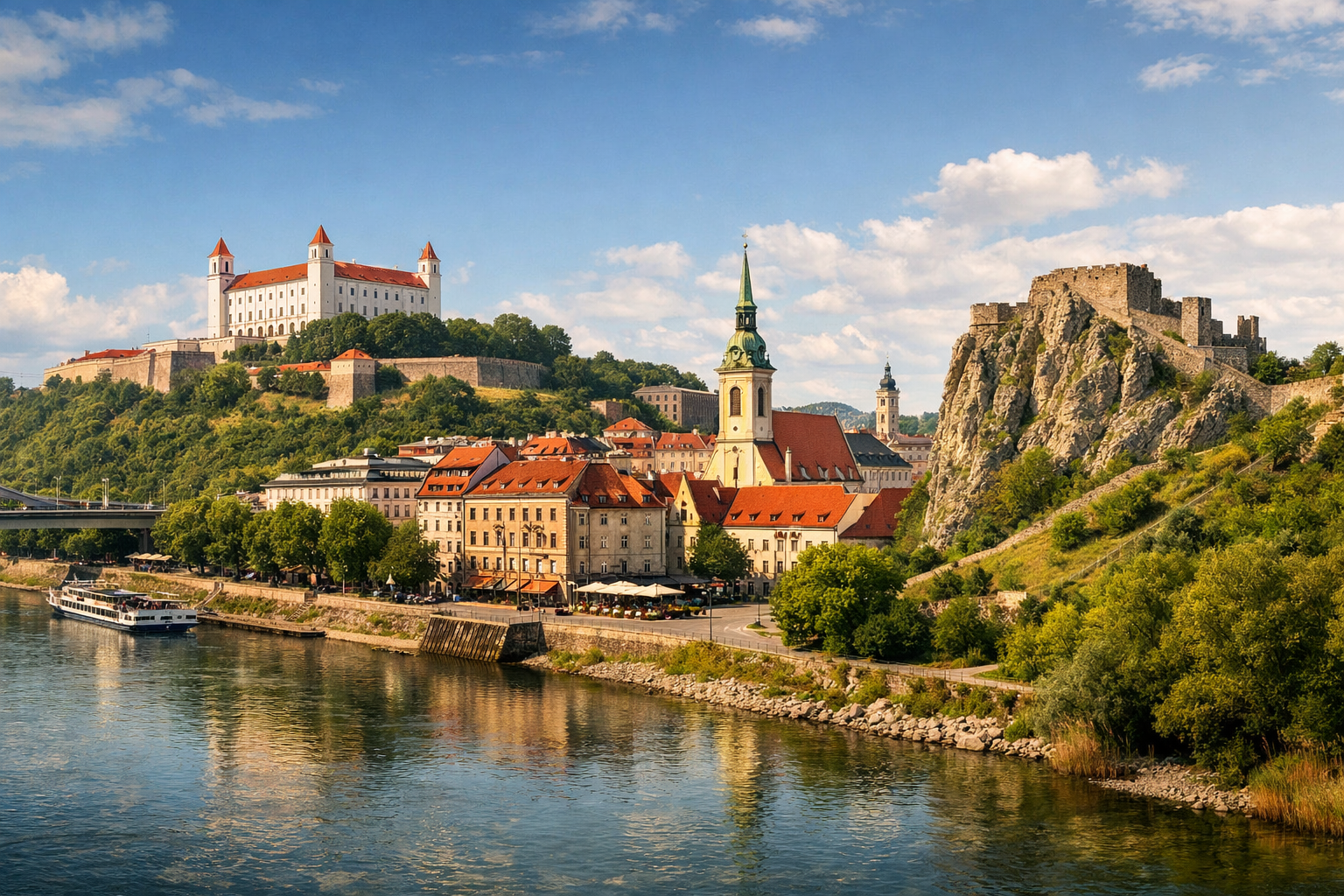
Day 1 — Bratislava: Old Town and Bratislava Castle
🚶 Start exploring Bratislava from the Old Town — a compact, very walkable historic core where almost all the main sights are located within a short distance of each other. It is especially pleasant to travel here on a budget: the center does not require complicated logistics, many experiences are free, and the atmosphere itself is built not on expensive entertainment but on a combination of narrow cobbled streets, bright squares, baroque facades, towers, courtyards, and the calm rhythm of a small Central European capital. Once you reach the Main Square and the Old Town Hall, you will immediately feel that Bratislava does not overwhelm with scale but instead invites a slow exploration: it is easy to turn into side streets, stop by old houses, admire city details, and notice the gentle mix of Hungarian, Austrian, and Slovak cultural heritage.
🚶 Then head up to Bratislava Castle — the city's main silhouette and a point without which it is hard to imagine the capital's panorama. The climb from the center usually takes about 15–20 minutes on foot, including stops for photos and a short rest. The snow-white four-towered castle stands high above the Danube and makes an especially strong impression in person: from its terraces there are wide views of the red roofs of the historic center, bridges, the left and right banks, and in clear weather your gaze stretches far beyond the city. The place itself has lived through a long history — from fortified height and royal residence to fire and later reconstruction — so a walk here offers not only beautiful photos but also a sense of a layered past. It is pleasant to spend at least 1.5–2 hours on the grounds: see the courtyards, viewpoints, and, if you wish, visit the exhibitions of the History Museum.
🏛️ If you still have energy left, after descending it is worth visiting the City History Museum in the Old Town Hall complex. It is a good way to connect the streets and squares you have seen with Bratislava's real past: the development of a trading town, the lives of its residents, and the change of eras and political influences. Thanks to the compact route, the day turns out rich but not tiring: there is not much pure walking time, and between key points it is easy to pause for coffee, an inexpensive lunch, and a short rest.