
Buy PDF guide

Buy PDF guide — 6.43 USD

PDF — 6.43 USD

Silistra - Srebarna Nature Reserve

Silistra - Srebarna Nature Reserve

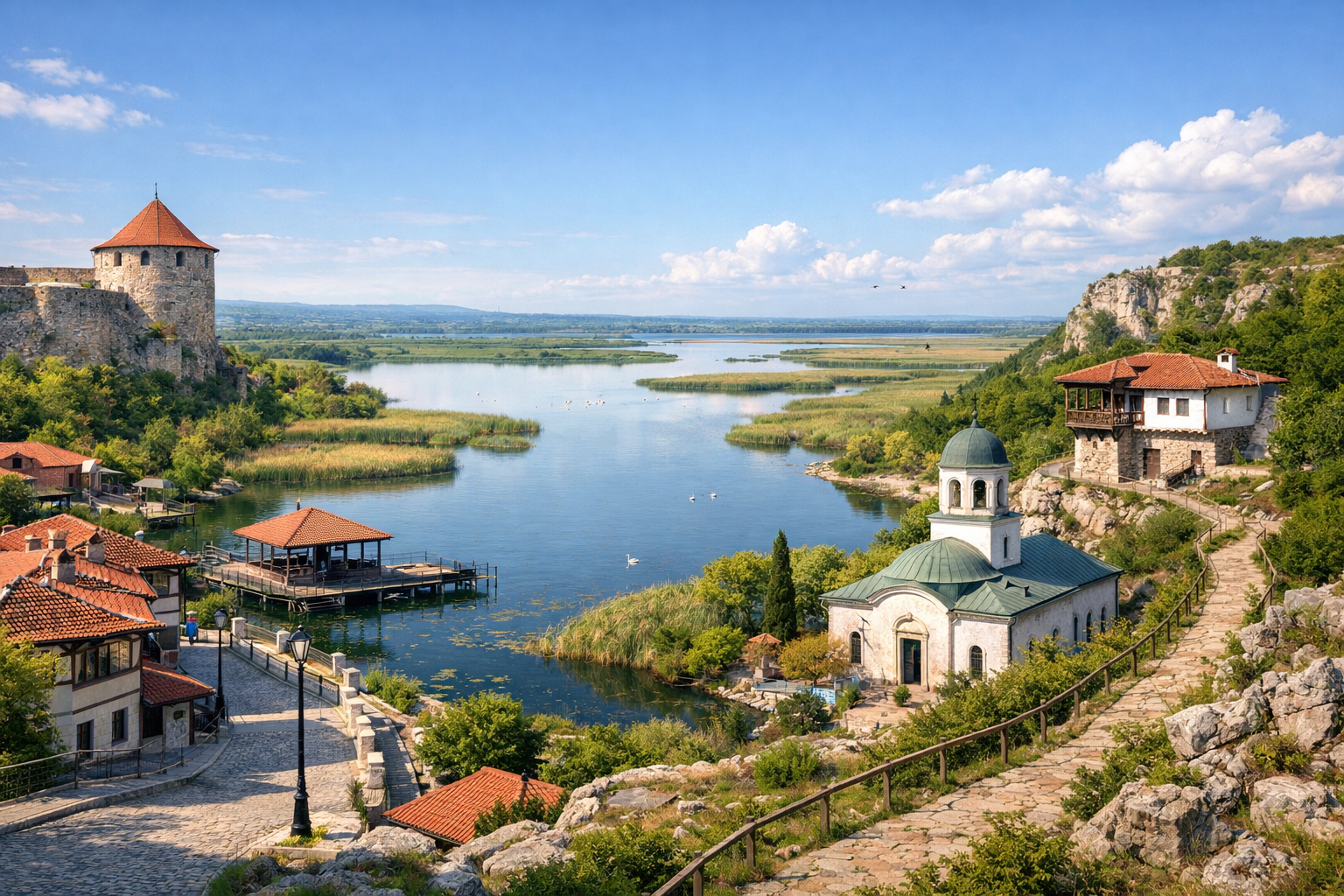
Discover a quieter side of Bulgaria in Silistra, where the reed-fringed lakes of Srebarna Nature Reserve shelter rare birds and peaceful wetland views. Then step into history at Medzhidi Tabia, a hilltop fortress overlooking the Danube and the plains beyond.

🧭 DAY-BY-DAY ITINERARY

Ready-made country and city routes with daily plans, sights, transport and accommodation. Buy PDF guides for independent travel.

🧭 DAY-BY-DAY ITINERARY


Day 1 — Silistra: the Danube promenade, ancient Durostorum, and the calm rhythm of a border town

  • 🚶 It is best to devote the first day to Silistra itself — a city that does not try to overwhelm with scale, but instead opens up through layers of history, the wide river, and the very distinctive atmosphere of northeastern Bulgaria. After checking in, start with a leisurely walk through the center and make your way to the Danube promenade: this is where the city’s character is felt especially well — a little borderland, a little river town, with soft light, a spacious horizon, and the sense that time moves more slowly. Then it makes sense to continue to the Archaeological Museum, where the history of ancient Durostorum comes together not as a dry chronology, but as a living line of Roman, early Christian, and medieval heritage. Set aside about 1–1.5 hours for the museum, and then leave time for coffee or a late lunch in the center. In the second half of the day, you can stroll through the old streets, look at the city without rushing, and, if you still have energy, add a short visit to the Ethnographic Museum from the outside or use it as a viewpoint for the neighborhood — even if the exhibition is temporarily unavailable, the historical context of the quarter itself works well as part of the walk. In the evening, return to the Danube: the sunset light, the broad water, and the quiet of the promenade create a very beautiful and “right” ending to a first acquaintance with Silistra.


Day 2 — Srebarna: biosphere reserve, pelicans, lake, and a day in the rhythm of nature

  • 🦢 The second day is worth dedicating to Srebarna — the region’s main natural highlight and the place people truly travel here for specifically. From Silistra to the village of Srebarna and the reserve’s visitor area, the drive takes about 15–20 minutes, so there is no need to leave too early: a convenient format is after breakfast, arriving at the lake in the first half of the day, when the light is still soft and birdwatching is especially pleasant. Srebarna is not an amusement park and not a place for ticking a box; its strength lies in silence, open space, the movement of water, and life in the reeds. The lake lies near the Danube and is known as one of Bulgaria’s most important ornithological sites: impressions are especially strong here for those who know how to slow down and look not only “at the object,” but at the environment — the lines of the reeds, the distant shimmer of water, bird colonies, the changing sound of the wind, and the almost meditative work of the landscape. Start with the nature museum and visitor point in the village of Srebarna, then move on to the viewpoints and a walk through the permitted parts of the buffer zone. For the main program, it is reasonable to allow 3–4 hours with breaks: without rushing, with rest, water, and time simply to stand by the lake panorama. After the nature-focused part, you can have lunch in Silistra or return to town to rest, and spend the evening as calmly as possible — this day is best not overloaded, because Srebarna works precisely as a space of observation, air, and inner quiet.

Day 3 — Medzhidi Tabia, the Roman tomb, and a final look at Silistra

  • 🏰 On the last day, bring together the military, Roman, and Ottoman layers of the region. In the morning, head to the Medzhidi Tabia fortress, located south of Silistra in the Kalipetrovo area: the drive from the city center takes about 15–20 minutes. This is one of the most expressive places in the surroundings — not only because of its fortification architecture, but also because of the sense of space around it. The earthen lines of the fortifications, the massiveness of the defensive logic, and the open views help you better understand why Silistra remained a strategic point on the Danube for centuries. It is comfortable to allow 1–1.5 hours for visiting the fortress. Then return to the city and, if visiting conditions allow and the visit is arranged in advance, add the Roman Tomb with frescoes — a rare monument of Late Antiquity that feels almost intimate and leaves a strong impression not through scale, but through its preserved artistic delicacy. After that, leave time for lunch and a final walk through the center: buy a few small souvenirs, go once more to the promenade, and look at the city with eyes that already feel like your own. This kind of ending rounds out a short journey well: first nature, then history, and in the end — a complete sense of Silistra as a quiet, multilayered, unexpectedly deep Danube destination.

Flight tickets

eSIM for travel

Buy PDF guide

Buy PDF guide — 6.43 USD

PDF — 6.43 USD