Buy PDF guide

Buy PDF guide — 29.99 USD

PDF — 29.99 USD

SWITZERLAND

SWITZERLAND

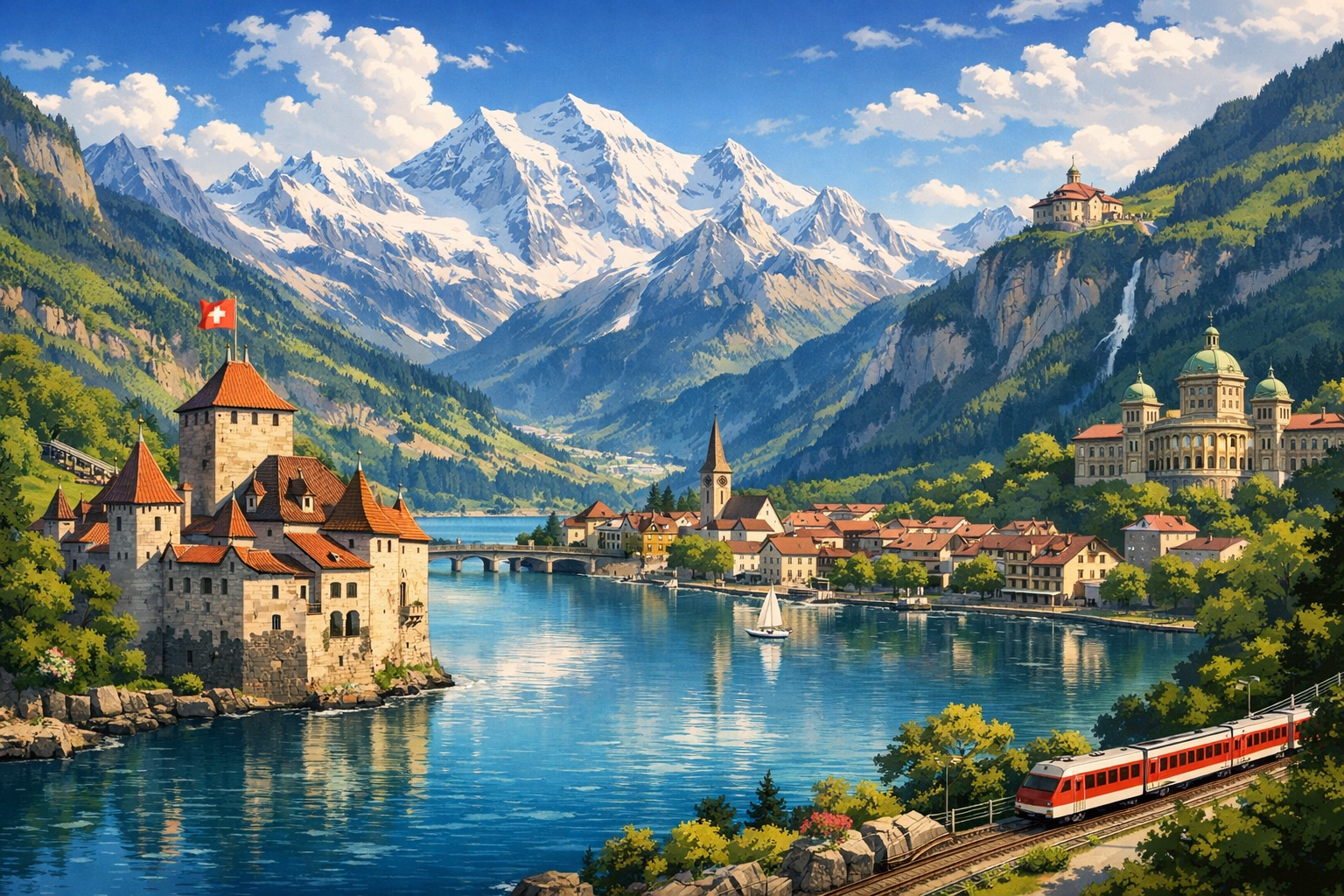
Start in sleek Zurich and storybook Lucerne, then ride into the Alps for Interlaken’s Jungfrau views and car-free Zermatt beneath the Matterhorn. Glide along Lake Geneva from Montreux to Vevey, savor culture in Lausanne and Geneva, and finish with Bern’s medieval arcades and Basel’s bold art scene.

🧭 DAY-BY-DAY ITINERARY

Ready-made country and city routes with daily plans, sights, transport and accommodation. Buy PDF guides for independent travel.

🧭 DAY-BY-DAY ITINERARY


Day 1 — Zurich: Old Town and the shores of Lake Zurich

  • 🚶 Start with the Old Town (Altstadt): the narrow lanes of Niederdorf, the legendary Bahnhofstrasse, tiny squares with fountains, and pastry-shop windows full of pralines. Be sure to stop by the Grossmünster and the Fraumünster (Chagall stained glass) — their towers and bells have shaped the city skyline for centuries. In the afternoon, head to the promenades along Lake Zurich: from Bürkliplatz stretches a scenic walkway with panoramas of the pre-Alpine ridges and the white hulls of sightseeing paddle steamers. In good weather — a swim at the city “badi” (baths) or a one-hour mini cruise.


Day 2 — Zurich: Kunsthaus + hike up Uetliberg

  • 🚶 Morning — at the Kunsthaus Zürich: collections from the Middle Ages to contemporary art, strong sections of Giacometti, the Impressionists, and the Swiss avant-garde. Next — the university’s botanical garden (sphere greenhouses) or the Succulent Collection on Lake Zurich if you love botany. Closer to sunset, go up Mount Uetliberg (Üetliberg) on the suburban S10 line: a short walk brings you to the Uto Kulm viewpoint. From here you get the city’s “postcard” view — the shimmer of the lake, the spires of the old town, and the jagged line of the Alps on the horizon.

Day 3 — Transfer to Lucerne and getting to know the city

  • 🚆 Transfer: Zurich HB → Lucerne (SBB IC/IR): ~45–55 minutes, trains frequent, non-reserved seating.

  • 🚶 Lucerne is the wooden Chapel Bridge (Kapellbrücke) with the Water Tower (Wasserturm), colorful half-timbered houses on Market Square, and reflections of peaks in the emerald Reuss. Stop by the Lion Monument and the “Glacier Garden” with polished boulders and fossilized shells — a rare window into the geological past of the Alps.

Day 4 — Lucerne: Transport Museum + Pilatus panorama

  • 🚶 Spend the morning at the Swiss Museum of Transport — the country’s most popular museum: halls devoted to railways, aviation, shipping, vintage cars, and the “media world.” Then head to Pilatus: the classic “Golden Round Trip” (boat across Lake Lucerne to Alpnachstad → the world’s steepest cogwheel railway up to Pilatus Kulm → cable cars down to Kriens → bus back to central Lucerne). The combination takes half a day, and the views — from lakes to Alpine ridges — stay with you for a long time.

Day 5 — Lucerne → Interlaken and an evening on Harder Kulm

  • 🚆 Transfer: Luzern → Interlaken Ost, Luzern–Interlaken Express (Zentralbahn): ~1h 50m, 1 direct train per hour, a panoramic route through passes and lakes.

  • 🚶 After checking in, go up to Harder Kulm in 10 minutes by funicular. From the “bridge between two lakes” you get a spectacular panorama of Interlaken between Lakes Thun and Brienz and the three giants — the Eiger, Mönch, and Jungfrau. Perfect for a sunset dinner.

Day 6 — Jungfraujoch: “Top of Europe”

  • 🚶 Day route: Interlaken Ost → (via Lauterbrunnen/Wengen or Grindelwald) → Kleine Scheidegg → Jungfraujoch. You’ll find ice tunnels, the “Sphinx” viewing platform at ~3454 m, the Aletsch Glacier (a UNESCO site), and a snowy panorama for dozens of kilometers. Plan an early start and budget 6–8 hours including travel. In clear weather — the best views; in overcast weather — Alpine-style dramatic clouds.

Day 7 — Lauterbrunnen and Mürren: trails above the valley of waterfalls

  • 🚶 The “Valley of 72 Waterfalls” is Lauterbrunnen, with the stream of Staubbach Falls and cascading flows dropping from stepped cliffs. Take the cable car up to Grütschalp and walk the panoramic trail to Mürren — a car-free Alpine village on a terrace above the abyss. Along the way — endless views of the Eiger’s North Face.

Day 8 — Interlaken → Zermatt: getting to know the car-free resort

  • 🚆 Transfer: Interlaken Ost → Spiez/Visp → Zermatt (SBB + Matterhorn Gotthard Bahn): ~2h 15–2h 30m. In Visp — a change to the narrow-gauge line to Zermatt.

  • 🚶 Zermatt is a pedestrian village at the foot of the Matterhorn. Streets lined with chalets, electric vehicles instead of cars, air that seems to ring with the closeness of glaciers. Stroll along Bahnhofstrasse, stop by the church next to the “underground” Zermatlantis museum, and, if you have the energy, climb up to the scenic meadows of Winkelmatten.

Day 9 — Gornergrat: the classic Matterhorn postcard view

  • 🚶 The Gornergrat Bahn cog railway will take you in 30–40 minutes to the Gornergrat ridge with views of the Matterhorn and an amphitheater of 4,000-meter peaks. Along the way — the Riffelalp/Riffelberg stations, mountain lakes, and short loop trails. At the top — viewing terraces, places to eat, and photo angles that draw visitors from all over the world.

Day 10 — Matterhorn Glacier Paradise and the Five Lakes Trail (seasonal)

  • 🚶 In the morning, go up to Matterhorn Glacier Paradise (Klein Matterhorn, 3883 m): cable cars lead to Europe’s highest viewing station, an ice palace with blue galleries, and a panorama of Monte Rosa. In the afternoon — the Five Lakes Trail (5-Seenweg) near Sunnegga: mirror-like waters where the Matterhorn reflects perfectly. In the shoulder season, swap it for walks to mountain restaurants and scenic balconies.

Day 11 — Zermatt → Montreux and Chillon Castle

  • 🚆 Transfer: Zermatt → Visp → Montreux (MGB + SBB IC): ~2 h 30–2 h 40 min, convenient and scenic.

  • 🚶 Montreux—palms, a mild climate, and a lakeside promenade where boats bob on the waves. In 15 minutes by train/bus—Chillon (Château de Chillon): an island-fortress above the azure of Lake Geneva, dark halls, a keep, and the legends of Bernard of Menthon. In the evening—sunset on the promenades with views of the Savoy Alps.

Day 12 — Vevey and the Lavaux terraces

  • 🚶 Morning—at Chaplin’s World (Corsier-sur-Vevey): Chaplin’s home and studios, where cinema comes alive in interactive sets. During the day—a walk through the Lavaux vineyard terraces (a UNESCO site) between Lutry and Saint-Saphorin: stone “balconies” above the lake, old wine shops and Chasselas tastings. On a clear day you can see the entire arc of mountains outlining the lake.

Day 13 — Geneva: Old Town, watch museum, and the Palace of Nations

  • 🚆 Short transfer: Montreux/Lausanne → Geneva (SBB IC/IR/RE): ~35–60 minutes depending on departure.

  • 🚶 Walk: the Anglo-Swiss Jardin Anglais with the Flower Clock, the quays with the Jet d’Eau fountain, a network of old lanes up to St. Peter’s Cathedral and cozy bistros. For watch lovers—Patek Philippe Museum (a 500-year collection). In the afternoon—a visit to the Palais des Nations (tour of the League of Nations/UN halls, entry via the Pregny Gate with advance registration). In the evening—train to Bern (~1 h 45–1 h 55) for the night.

Day 14 — Bern: Old Town and the Rose Garden → Basel: art and the Rhine

  • 🚶 Morning in Bern: arcades of medieval streets, the Zytglogge tower, Einstein’s house, the cathedral with views over the bend of the Aare. Head up to the Rosengarten—the best panorama of terracotta rooftops. Have lunch at the market on Münsterplatz or in a cozy beer hall under the arcades.

  • 🚆 Transfer: Bern → Basel (SBB IC/IR): ~56–70 minutes, trains at least once an hour.

  • 🚶 Final chord—Basel: neighborhoods by the Rhine, old bridges, and the museum “mile.” Visit the Kunstmuseum Basel (one of Europe’s most important collections), drop by the Tinguely Museum (kinetic sculptures, a play of light and mechanics), or the viewing terraces by the Münster. In the evening—dinner on the Kleinbasel riverside.

Flight tickets

eSIM for travel

Buy PDF guide

Buy PDF guide — 29.99 USD

PDF — 29.99 USD