
Buy PDF guide

Buy PDF guide — 29.99 USD

PDF — 29.99 USD

Sri Lanka

Sri Lanka

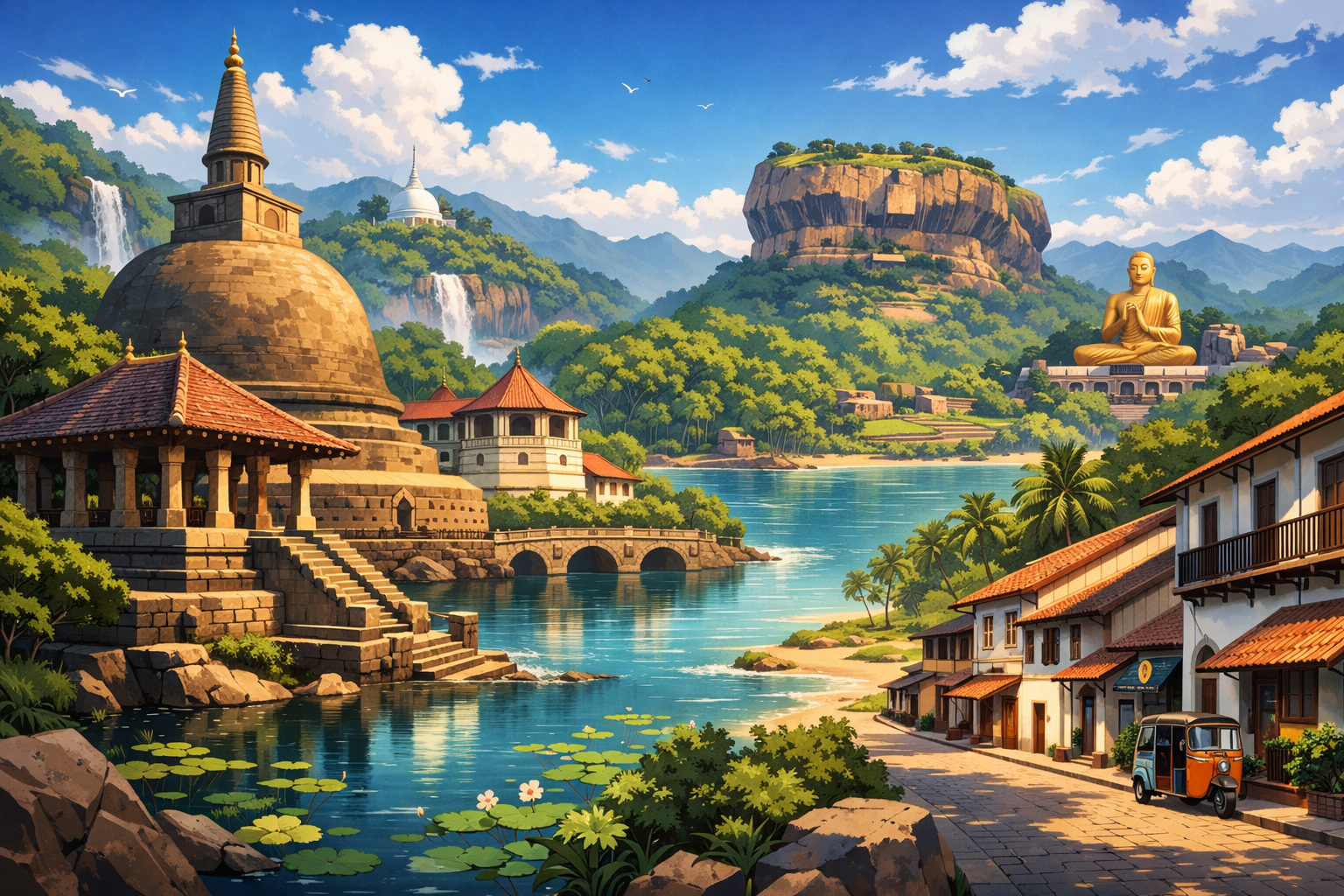
Sri Lanka packs a lot into one unforgettable island journey, from Colombo’s buzz and Kandy’s temple charm to the rock fortress of Sigiriya and the misty hills of Ella. Finish with leopard safaris in Yala and slow coastal days around Galle and Weligama, where golden beaches and surf-perfect waves steal the show.

🧭 DAY-BY-DAY ITINERARY

Ready-made country and city routes with daily plans, sights, transport and accommodation. Buy PDF guides for independent travel.

🧭 DAY-BY-DAY ITINERARY


Day 1 — Colombo: Galle Face, Fort, and an evening by the ocean

  • 🚶 Colombo is not just a “tick-the-box city before your flight,” but a noisy, humid, layered introduction to Sri Lanka, where colonial history, business districts, Buddhist shrines, tea shops, and the salty wind of the Indian Ocean come together in a vivid and cinematic picture. For the first day, a gentle acclimatization route without overload is ideal: start in the Galle Face Green area — a long coastal strip where families, street food vendors, couples, and kite lovers gather by evening. This place is not about the “perfect beach,” but about atmosphere: the ocean here is powerful, the wind is strong, and the sunsets often paint the sky in pink and gold. Then take an unhurried walk toward the old business district of Fort, where the British geometry of the streets, old façades, and modern signs create a strangely compelling contrast. In Colombo, you should not try to see everything at once: the city reveals itself better in short, dense fragments, with an essential pause for tea, fruit juice, or lunch in the cool.


Day 2 — Colombo: National Museum and Viharamahadevi Park

  • 🚶 The second day in Colombo is best devoted to the calmer, more cultural side of the capital. The National Museum of Sri Lanka is a place where the journey suddenly gains depth: ancient statues, royal artifacts, carvings, ritual objects, and historical collections help you understand that the island is not only about beaches and palm trees, but also about a very long and complex civilizational history. After the museum, it is especially pleasant to step into Viharamahadevi Park — Colombo’s oldest and largest city park, where tall trees, wide paths, tropical greenery, and open lawns provide a rare breathing space for an Asian capital. Here the route can be intentionally slow: coffee, a bench in the shade, a short walk without a goal, and then a return to the hotel to rest. Such a day is important before the onward journey into the hill country: it does not exhaust you, but gently prepares you for the more intense part of the itinerary.

Day 3 — Travel to Kandy and an evening by the lake

  • 🚆 Transfer: Colombo → Kandy by Sri Lanka Railways train or by car/private transfer. The trip usually takes about 2h 30m–3h 30m depending on the specific service; by car, people usually allow 3h 30m–4h 30m considering traffic when leaving the capital.

  • 🚶 Kandy feels completely different from Colombo: the air becomes a little fresher, the rhythm calmer, and the landscape more dimensional thanks to the hills and greenery. This is the last royal capital of Sri Lanka and one of the country’s most important spiritual centers, so it amazingly combines the bustle of an ordinary city, a pilgrim atmosphere, and the almost theatrical beauty of the landscape. After checking in, it is better not to load the day with museums and long drives, but simply to go out to Kandy Lake and walk along its curve. The city is especially beautiful in the soft evening light: the white walls of the temple complex, reflections in the water, the mountains along the edges of the valley bowl, and the slowly deepening twilight create the feeling that you have not just arrived in a new city, but stepped into an important scene in the whole journey. An evening in Kandy is about resting after the road and tuning yourself to a deeper encounter with the country.

Day 4 — Kandy: Temple of the Tooth and the royal complex

  • 🚶 The Temple of the Tooth, or Sri Dalada Maligawa, is not just Kandy’s main sight, but one of the most revered places in the entire Buddhist world. A sacred relic is kept here, and that is why the atmosphere of the complex differs from an “ordinary tourist attraction”: it does not feel like a detached museum, but like a living, dense, emotional religious life. The space itself is incredibly expressive — white walls, golden details, drums during services, streams of pilgrims carrying lotus flowers, the flicker of lamps, and the scent of incense. It is important not to rush: give yourself time to walk through the grounds of the royal complex, see the inner courtyards and historic buildings beside the temple, and, if you wish, add the museums around the complex to your day. Kandy is at its best in exactly this rhythm — not at a gallop, but with pauses, attention to detail, and respect for the fact that for locals this is first and foremost a shrine, not a tourist backdrop.

Day 5 — Kandy: Peradeniya and a gentle day of rest

  • 🚕 Short outing: central Kandy → Royal Botanic Gardens, Peradeniya. By taxi or tuk-tuk, it is usually about 20–30 minutes one way, depending on traffic.

  • 🚶 After the spiritual and historical intensity of the previous day, a “green breather” day in the Royal Botanic Gardens of Peradeniya works especially well. This is one of the most beautiful landscape pauses on the route: palm avenues, giant trees, manicured lawns, orchids, shady sections, and the slow rhythm of walking make the garden feel almost meditative. Here there is no need to try to walk everything in order — it is better simply to wander, choose beautiful sections, stop in the shade, and let your body recover before the next transfer. In the evening, you can return to Kandy early, have a calm dinner, and go to bed without late activities. Such a day is especially important on a 14-day itinerary: without it, the island easily turns into an endless race between transfers, but with it, the trip begins to breathe.

Day 6 — Travel to Sigiriya and sunset at Lion Rock

  • 🚆 Transfer: Kandy → Sigiriya/Dambulla. By car or private transfer, it is usually about 2h 30m–3h 30m. Direct public transport is possible with transfers, but for this segment it is more convenient to plan a private transfer so as not to lose half the day.

  • 🚶 The central part of the island changes gradually, but noticeably: Kandy’s hills give way to drier plains, the light becomes harsher, the colors more ochre, and the air carries a sense of an ancient landscape. Sigiriya is a place where nature and history literally crash into each other. The best strategy on a transfer day is not to storm the rock right away in the midday heat, but to arrange an adaptation evening: check in, rest by the pool or in the garden shade, and closer to sunset head to a viewpoint opposite Lion Rock, or simply spend the evening watching the giant monolith slowly darken against the sky. This is one of those rare landscapes that looks almost unreal: a solitary rock rising above the jungle seems at once a fortress, a mirage, and a set piece from an ancient epic.

Day 7 — Sigiriya: Lion Rock and the ancient landscape

  • 🚶 Sigiriya, the famous Lion Rock, is one of the most impressive archaeological sites in South Asia and, without exaggeration, one of Sri Lanka’s visual wonders. It is not just a rock to climb, but the remains of a grand 5th-century royal complex with gardens, hydraulic engineering, terraces, frescoes, and monumental symbols of power. It is best to start the climb early in the morning, while the air is not yet scorching and the steps have not turned into a test of endurance. As you ascend, the route becomes increasingly dramatic: the Mirror Wall, the frescoes, the gigantic lion paws at the entrance to the upper platform, and finally the summit itself, from where a powerful panorama opens over forests, reservoirs, and the ancient cultural landscape. This place makes a strong impression not only because of its beauty, but also because of the sense of human ambition: when you stand at the top, it becomes especially clear that before you are not just ruins, but an attempt to turn a solitary rock into a capital, a symbol, a fortress, and a stage for royal power all at once.

Day 8 — Long transfer to Ella and an evening view over Ella Gap

  • 🚆 Transfer: Sigiriya → Ella. This is one of the longest logistical days of the itinerary. It is best to go by car/private transfer via the Kandy or Nuwara Eliya area; usually you should allow about 5h 30m–7h 30m with a lunch stop and a short rest. If you specifically want the railway beauty, it is more practical to drive to the hill-country line and only then take the train onward, but within 14 days a direct transfer is usually more reliable.

  • 🚶 Ella is a completely different Sri Lanka: cooler, greener, softer in both light and relief. After the dry drama of Sigiriya, the mountainous south feels almost like a separate country. The best thing to do on arrival is not to try to cover all the iconic points at once, but to arrange a beautiful evening of calm: check into a hotel with a view, open the balcony, listen to the rain or the sound of cicadas, watch the mist slowly fill the valleys, and go for a short walk along Ella’s main street. The atmosphere here is more relaxed, almost resort-backpacker-like, with cafés, viewing terraces, and the feeling that for the first time on the trip, time has truly slowed down. After a long road, this is the perfect place to recover.

Day 9 — Ella: Nine Arch Bridge and Little Adam’s Peak

  • 🚶 Ella has a rare ability to give a packed itinerary a sense of lightness. Here the main emphasis is not on museum sightseeing, but on the landscape, the air, and the beauty of moving on foot. In the morning, it makes sense to head to Nine Arch Bridge — the most photogenic bridge in the country, hidden among dense tropical greenery and tea-covered slopes. If you are lucky enough to catch a train, the shot will look almost postcard-perfect, but even without a train the place works beautifully: the old stone viaduct, humid mountain air, birds, leaves, mist, and the unhurried flow of travelers create a very cinematic scene. Then you can continue the day with an ascent of Little Adam’s Peak — a relatively easy trek with an incredibly rewarding panorama. Along the way, terraced hills, tea plantations, cliffs, and the famous Ella Gap open up, and at the top it becomes especially clear why Ella is so loved: there is no single “site” here — the main attraction is the space itself.

Day 10 — Transfer to Yala and sunset safari

  • 🚆 Transfer: Ella → Yala / Tissamaharama area. By car it is usually about 2h 30m–3h 30m. The road descends from the mountains into the drier and hotter southern landscapes.

  • 🚶 Yala is no longer about cities or colonial façades, but about the feeling of a boundary between humans and wild nature. After the mountain panoramas of Ella, the landscape changes again: it becomes hotter, drier, thornier, and around you appears that special light, African in mood, which makes the southeast of the island feel like part of another continent. If logistics allow, it is good to take an evening safari on the day of arrival: it is not as demanding in terms of early rising as the morning one, and gives beautiful golden light over shrubs, dusty roads, waterholes, and animal silhouettes. In Yala, the main thing to remember is that this is not a zoo and not a “guaranteed leopard encounter,” but a real national park, where all the magic is built on waiting, attention, and luck. Sometimes the strongest impression comes not from a rare beast, but from a herd of deer in the sunset dust, a peacock on a branch, or sudden silence in the middle of the scorching savanna.

Day 11 — Yala: morning safari and transfer to Galle

  • 🚕 It is best to plan the early safari departure before sunrise or immediately after dawn: the morning hours are usually the most pleasant temperature-wise and the most active for wildlife watching.

  • 🚶 A morning safari in Yala is one of the strongest impressions of the entire trip. At dawn, the park wakes up in a special way: soft light falls across the scrub and red earth, birds become noticeably more active, and the ride itself along dirt roads takes on an almost expedition-like mood. It is at this time that you especially feel the scale of the territory and the diversity of ecosystems — from dry forest and scrubland to lagoons and water bodies. After returning, breakfast, and a short rest, it is worth heading further southwest, toward the ocean and colonial heritage.

  • 🚆 Transfer: Yala / Tissamaharama → Galle. By car it is usually about 3h 30m–4h 30m without long stops.

  • 🌆 It is best to dedicate the evening in Galle to the simplest pleasure of all — a walk along the walls of the old fort. After the wild nature of Yala, this city feels almost therapeutic: the wind from the ocean, stone bastions, old streets, lanterns, white façades, church towers, cafés, and soft maritime light create the atmosphere of a noble, slightly faded, but very beautiful southern port.

Day 12 — Galle: Fort, lighthouse, and old streets

  • 🚶 Galle Fort is one of the most complete and charming historical spaces on the island. Literally everything here is pleasant: the shape of the streets, the texture of the walls, the old shutters, arches, courtyards, salty air, the view of the ocean from the bastions, and the way a European street plan has grown for centuries into a South Asian climate and everyday life. The morning is best started with a walk along the fort ramparts, when the sun is not yet too high, then see the famous white lighthouse and simply dissolve into the grid of streets — Church Street, Pedlar Street, and the neighboring lanes. In Galle there is no need to be constantly “sightseeing” in the strict sense: the city itself is the attraction. It is best read with your feet — stepping into galleries and small shops, drinking coffee in the shade of inner courtyards, peeking into museums, making long stops, and allowing the fort to gradually reveal its character. This place is amazingly photogenic, but its main quality is not the outward picture, but the rare feeling of calm and completeness of space.

Day 13 — Weligama and Mirissa: ocean, surfing, and the south coast

  • 🚆 Transfer: Galle → Weligama. By car it is usually about 45–60 minutes. There is also service on the southern railway line, but with luggage and for flexibility with stops, a transfer is more convenient.

  • 🚶 Weligama and neighboring Mirissa give the journey a soft, almost vacation-like exhale before the finale. Weligama is famous for its wide bay and surf-town atmosphere: there is a lot of light here, a long beach arc, a lazy rhythm, and that feeling when shoes finally cease to be necessary. Even if you do not surf, watching the lessons is very pleasant: the bay is lively, friendly, and visually beautiful. Nearby Mirissa adds the open-ocean picture, palm trees, viewpoints, and an even stronger resort mood. This day is best kept intentionally free — without a strict list of must-do activities. Swimming, a late breakfast, a beach walk, seafood for dinner, and a long sunset — this is exactly how the south coast reveals itself best. After packed transfers and ancient cities, this day is needed no less than all the “main” highlights.

Day 14 — Return to Colombo and a final urban chord

  • 🚆 Transfer: Weligama → Colombo. By train along the coastal line it is usually about 2h 30m–3h 15m, by car via the Southern Expressway more often about 2h 30m–3h 30m depending on traffic and your arrival point in the city.

  • 🚶 Returning to Colombo on the final day works as a beautiful closing of the entire arc of the itinerary. After temples, rocks, tea mountains, safari, and the southern coast, the capital is perceived differently: not as a noisy arrival point, but as the complex and energetic finale of the island. The last evening can be spent without rushing — choose a good dinner, take a short walk through already familiar neighborhoods, buy tea and small gifts, go out to the ocean one more time, and let the trip settle calmly in your memory. Sri Lanka is rarely remembered for just one thing: it remains a combination of very different textures — a humid metropolis, a sacred city, an ancient rock, mountain mist, red safari dust, and the warm southern sea. That is exactly why such an itinerary is especially good: in 14 days it gives not one image of the country, but a whole collection of its moods.

Flight tickets

eSIM for travel

Buy PDF guide

Buy PDF guide — 29.99 USD

PDF — 29.99 USD