
Buy PDF guide

Buy PDF guide — 10.71 USD

PDF — 10.71 USD

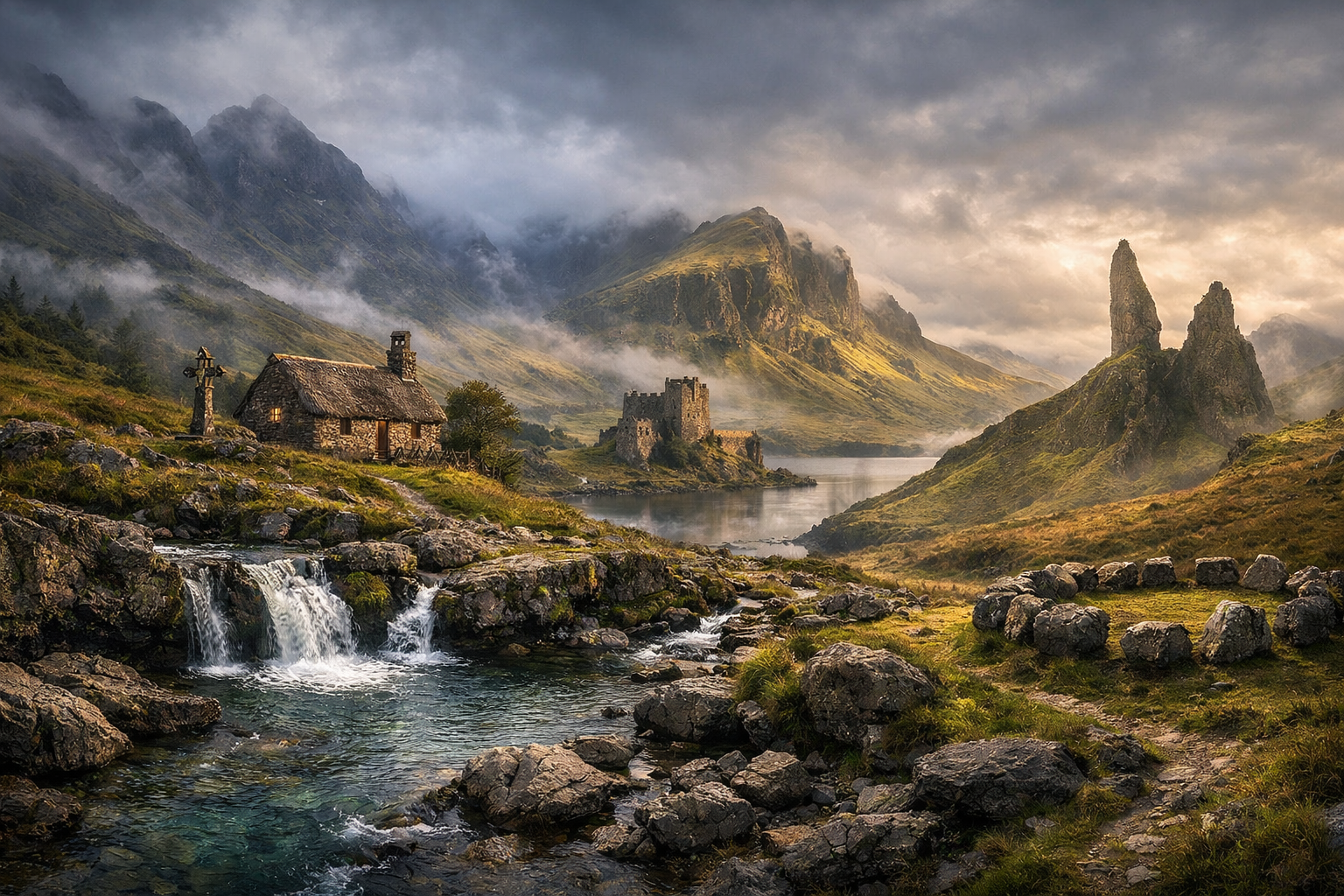
Scotland, Isle of Skye. Celtic legends and misty mountains. Fairy Pools, Quiraing, Old Man of Storr and the island’s secluded landscapes for fans of Celtic mythology, meditation, and mystical photography.

Scotland, Isle of Skye. Celtic legends and misty mountains. Fairy Pools, Quiraing, Old Man of Storr and the island’s secluded landscapes for fans of Celtic mythology, meditation, and mystical photography.

Discover the Isle of Skye, where Celtic legends drift through misty mountains and wild, secluded landscapes. From the colorful harbor of Portree to the dramatic Quiraing, the Old Man of Storr, and the crystal-clear Fairy Pools near Glenbrittle, Skye feels made for quiet reflection, myth-soaked wanderings, and unforgettable photography.

🧭 DAY-BY-DAY ITINERARY

Ready-made country and city routes with daily plans, sights, transport and accommodation. Buy PDF guides for independent travel.

🧭 DAY-BY-DAY ITINERARY


Day 1 — Inverness → Isle of Skye → Portree: a gentle entry into a sacred landscape

  • 🚗 The recommended start of the route is arrival in Inverness and a drive in a rental car to Portree via the Skye Bridge. Travel time without long stops is usually about 3.5–4 hours, but for the first day it is better to allow 5–6 hours with breaks for rest, coffee, and viewpoints. On the Isle of Skye, a car is almost essential if you want to fit in Trotternish, Fairy Pools, and the south of Sleat without exhausting transfers: the bus network exists, but service is limited, and public transport does not take you directly to the trailhead for some natural sites.

  • 🚶 After checking in at Portree, devote the evening not to chasing “top spots,” but to tuning in to the rhythm of the island. Walk along the harbor and head up to the viewpoints above the bay. Portree is not a mystical site in itself, but a convenient base from which the island reveals itself gradually: through the wind, damp light, changing skies, and restrained northern palette. For an esoteric route, this is an important psychological transition—not so much “sightseeing in town” as adapting to a space where solitude, mist, and silence become part of the experience.

  • 🌫️ In the evening you can add a short stop at Sligachan Old Bridge on the way from Broadford to Portree if you are driving during the day and still have energy to spare. This is a real historic bridge at the foot of the Cuillins, known in local folklore for the legend of water that grants beauty to anyone who can hold their face under the flow without touching it with their hands. It is important to clearly separate folklore from fact: this is a local legend, not a proven property of the water. Even so, the place is genuinely impressive—the noise of the river, the mountain silhouettes, and the severe geometry of the stone create an almost ritual atmosphere, especially at dusk and after rain.

  • 🕯️ For your first night on Skye, it is better to avoid overloading yourself with impressions. Dinner, an early night, and preparing your clothes in layers are more important than “one more location.” Even in summer, the weather on the island changes abruptly: wind, rain, and low cloud can make tomorrow’s dawn photography either incredible or exhausting. The esoteric travel format works better here not through haste, but through disciplined attention, silence, and respect for the landscape.


Day 2 — Trotternish: Old Man of Storr, Kilmuir, and traces of northern mythology

  • 🌄 Get up very early and head to The Old Man of Storr. From Portree the drive takes about 15–20 minutes, but for the climb to the classic viewpoint and the descent it is sensible to allow 2.5–4 hours depending on the weather, your pace, and the number of photography stops. This is one of the island’s most iconic natural sites: a giant rock pinnacle rises above the cliffs of Trotternish, and when the mist breaks you can see the sea below, heather slopes, and distant outlines of the mainland. The historical fact here is geological: it is part of a vast ancient landslip. Everything else—“stone guardian,” “gateway to another world,” “place of power”—belongs to poetic and folkloric interpretations that may be experienced aesthetically, but not as scientifically confirmed reality.

  • ⚠️ A practical note: Storr has an official paid car park, and the area is very popular. It is best to arrive early in the morning, when there are fewer cars and people and the light is softer for photography. The trail has been improved, but in rain and wind it still requires good waterproof footwear. Do not leave the route for the sake of a “secret shot”: this is an erosion-vulnerable slope, and safety matters more here than dramatic pictures.

  • 🏚️ After the hike, continue north to Kilmuir and the Skye Museum of Island Life. From the Storr area to the museum it is about 25–30 minutes by car. This museum is not esoteric in a direct sense, but it is essential to the route as an anthropological layer: it shows the everyday life of a Gaelic island community in which stories of fairies, the other side of the world, weather signs, and boundaries between the “ordinary” and the “subtle” were born and preserved. Here it becomes especially clear that Skye’s mythology grew not out of abstract mysticism, but out of a specific rural culture, harsh climate, oral tradition, and a very close connection between people and the land, sea, and seasons.

  • 🪦 If you still have the energy and the weather holds, add a stop at Kilmuir Cemetery, where Flora MacDonald is buried. This is first and foremost a historic site of remembrance, not an occult location. However, for a journey in the Celtic spirit it creates an important emotional tone: the northern landscape, stone gravestones, sea wind, and a sense of deep time. It is especially important to behave quietly and respectfully here: this is not a backdrop for content, but an active memorial space.

  • 🌙 Return to Portree in the second half of the day. The evening is best left for rest, dry clothes, and calmly processing your photos. A Trotternish day often turns out to be the most emotionally intense: do not try to cram in too many extra stops. On an esoteric tour, richness is created not by the number of places, but by the depth of perception.

Day 3 — Quiraing and Fairy Glen: geology, folklore, and a careful approach to the image of “magical Skye”

  • 🚗 Start the morning with Quiraing. From Portree the drive takes about 35–40 minutes. Allow 3–4.5 hours for the circular route and viewpoints, and more in difficult weather. Quiraing is one of the most dramatic landscapes not only on Skye but in all of Scotland: huge folds of earth, sheer drops, grassy terraces, and rock forms that look almost unreal in the mist. A verifiable fact: this is an active geological landslip landscape on the Trotternish Peninsula. The legendary interpretations—“stone thrones,” “sleeping giants,” “portals”—belong to the sphere of tourist imagery, local folklore, and personal symbolic interpretation.

  • 📷 For mystical photography, this is perhaps one of the best spots on the route: clouds do not get in the way here, and often create exactly the right theatrical mood. But this is also where safety is especially important. Cliff edges are dangerous in rain and wind, the ground can be slippery, and visibility can change within minutes. If the clouds sit too low, do not try to complete the full loop at all costs—better to do a shortened route from the viewpoint area and save your strength.

  • 🧚 After lunch, head to Fairy Glen near Uig; the drive from Quiraing takes about 20–25 minutes. This is one of the island’s best-known “fairy-tale” places: hills of unusual shapes, small cones, winding paths, and intimate relief create the feeling of a miniature world. At the same time, it is important not to over-romanticize it: the name and its modern popularity are largely tied to a visual association with a fairy-tale landscape, not because it is a recognized ancient sanctuary. Talk of fairies, “subtle energy,” and mystical beings is appropriate here only as part of Skye’s cultural image, not as verifiable fact.

  • 🙏 At Fairy Glen, visiting ethics are especially important. Do not build stone spirals or cairns, do not rearrange stones for “ritual” photos, and do not stray onto private or eroded ground. On Skye, it is increasingly emphasized that respect for the landscape matters more than fashionable esoteric gestures. The best way to experience this place is a slow walk, watching the light, taking a breathing pause on a safe dry patch, and photographing attentively without interfering with the environment.

  • 🌌 In the evening, you can end the day in Uig or return to Portree. If the sky clears, the north of the island is excellent for twilight photography; if rain blows in, use the evening for a quiet travel journal. Quiraing and Fairy Glen together offer a rare combination: powerful scale and intimate “fairy-tale” quality, where geology and myth are almost inseparable at the level of experience, even though on the level of facts they must always be kept apart.

Day 4 — Fairy Pools and Sligachan: water, reflections, and the meditative rhythm of the Cuillins

  • 💧 In the morning, head to Fairy Pools in Glenbrittle. From Portree the drive usually takes about 45–55 minutes, less from the Sligachan area. Fairy Pools is a series of clear bluish basins and cascades on the River Allt Coir’ a’ Mhadaidh at the foot of the Black Cuillins. This is a real natural site, freely accessible to visitors, but extremely popular. The fairy-tale name is linked to local imaginative imagery and tourism culture, not to any proven supernatural nature of the place.

  • 🥾 Allow about 1.5–3 hours for the walk to the main pools and back, plus time for photography and quiet stops. The path can be wet, the stones slippery, and fords and crossings after rain require caution. Even if you practice meditation or contemplative walks, do not sit too close to the edge of wet rocks and do not attempt to enter the water without experience and suitable equipment: the water is cold year-round, and beautiful shots are not worth hypothermia.

  • 🌀 In an esoteric context, Fairy Pools is often described as a place of “cleansing” and “subtle attunement.” It is important to phrase this correctly: such descriptions belong to the language of personal experience, water symbolism, and folkloric perception, not to scientifically confirmed effects. What is really verifiable here is something else—the strong sensory impact of the landscape: the sound of the current, changing light, the rhythm of the cascades, reflections of clouds and rocks. These are exactly the qualities that make the place so powerful for photography, non-fanatical breathing practices, and inner quiet.

  • 🌉 On the way back, stop in Sligachan. It is a good idea to take a long break here for tea, warm food, and an unhurried walk to the old bridge and river. Combined with the silhouette of the Cuillins, this place brings the route’s “water day” to a satisfying close. If Fairy Pools in the morning was about moving water and the nearness of stone, then Sligachan is about distance, open space, and the mountain line on the horizon. The legend of the “water of beauty” is well known and loved here, but it should be treated as part of the local narrative, not as a promise of results.

  • 🔥 It is best to make this evening as calm as possible. After nature hikes on Skye, fatigue accumulates unnoticed because of the wind and dampness. A good dinner, the soundscape of rain outside the window, selecting the best shots, and an early night will prepare you for the final day, when the focus shifts from wild nature to the cultural memory of clans and a museum context.

Day 5 — Sleat and Armadale: clan memory, museum context, and return

  • 🏰 Dedicate the final day to the south of the island—the Sleat Peninsula. From Portree to Armadale Castle, Gardens & Museum of the Isles, the drive usually takes about 1 hour 15 minutes to 1 hour 30 minutes. This is one of the best closing accents for an esoteric route because it translates the impressions of “wild mystical Skye” into a cultural and historical dimension. What matters here is not supernatural claims, but the memory of Clan Donald, the museum interpretation of the Gaelic world, the landscape garden, and the sense of continuity of tradition.

  • 📚 Museum of the Isles is especially valuable because it provides context for Celtic and Gaelic history, sea routes, clan culture, and the world of ideas from which the legends of the islands grew. If in previous days you encountered myth through cliffs, mist, and names like Fairy Pools, here myth returns to a human scale: through objects, the history of power, migration, memory, and language. This helps avoid turning Scotland into a set of romantic clichés about “magical lands,” and instead reveals the real depth of the culture.

  • 🌿 The gardens and ruins of Armadale Castle are well suited to a quiet walk and a concluding meditation without any claim to “initiation” or a mystical finale. The place itself is beautiful and emotionally rich, but its impact is aesthetic, historical, and personal—not demonstrably supernatural. In good weather, it is especially pleasant to end the route here by rereading notes, sorting the visual motifs of the trip, and drawing for yourself the line between what was fact and what was symbolic experience.

  • ⛴️ From here, there are two realistic ways to end the tour. First: return to the mainland via the Skye Bridge and drive toward Inverness. Second: use the CalMac Armadale–Mallaig ferry if your onward route goes along the west coast and toward Fort William. The ferry takes about 30 minutes, but you need to arrive at the terminal with time to spare, and the schedule should definitely be checked in advance, especially in bad weather and during high season.

  • 🕯️ The finale of this five-day route is built not on ticking off the maximum number of sights, but on a coherent arc: from the first entry into island space—through cliffs, mist, water, and folklore—to a more mature understanding that the “mysticism of Skye” lives on the boundary between geography, memory, language, weather, and human imagination. In this form, the journey remains honest, beautiful, and deep.

Flight tickets

eSIM for travel

Buy PDF guide

Buy PDF guide — 10.71 USD

PDF — 10.71 USD