
Buy PDF guide

Buy PDF guide — 10.71 USD

PDF — 10.71 USD

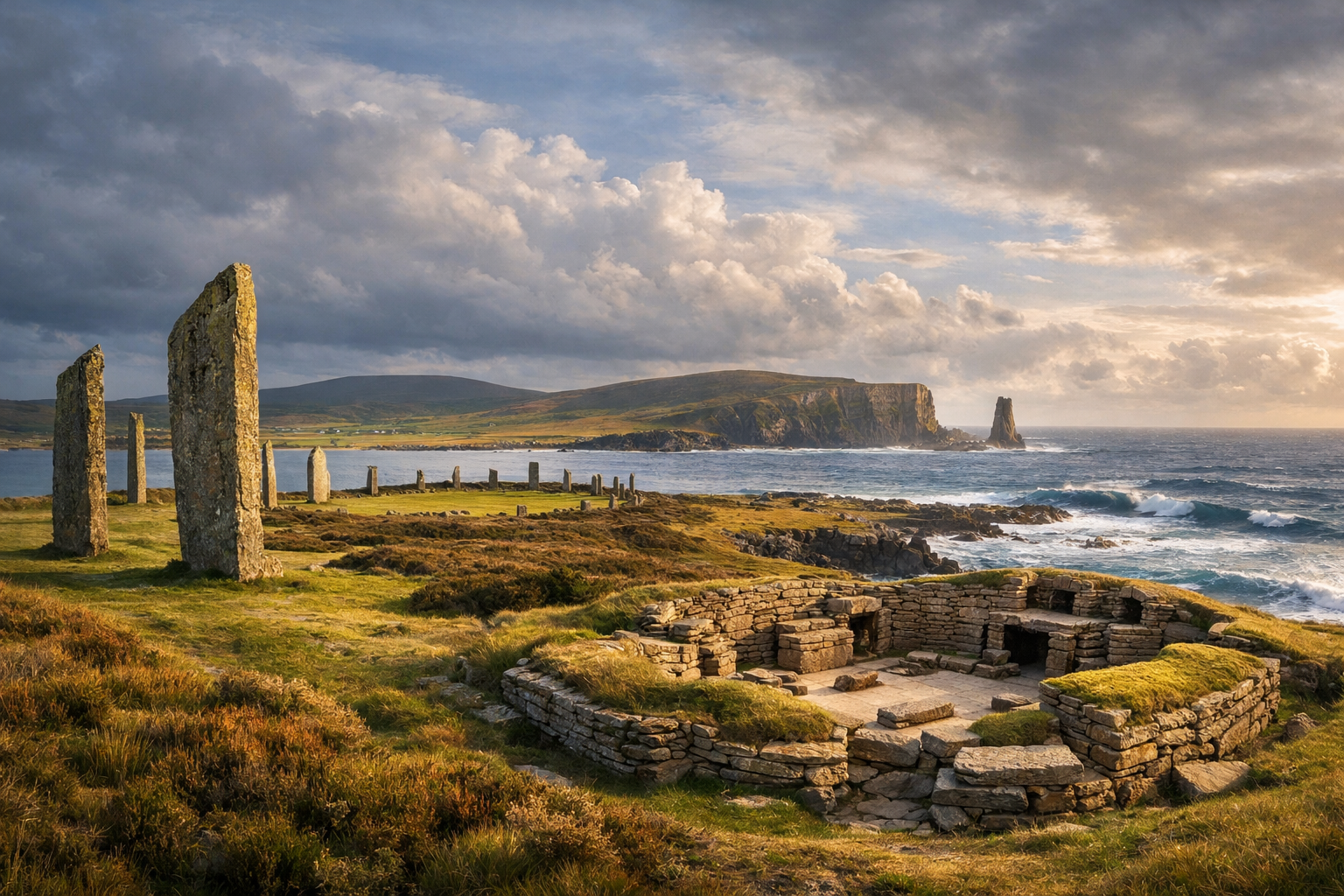
Scotland, Orkney Islands. Stones of the ancient North. Standing stones, Neolithic monuments, and harsh seascapes of the Orkney Islands in a journey for lovers of megaliths and ancient cultures.

Scotland, Orkney Islands. Stones of the ancient North. Standing stones, Neolithic monuments, and harsh seascapes of the Orkney Islands in a journey for lovers of megaliths and ancient cultures.

Journey through the Orkney Islands, where standing stones rise from windswept fields and the sea frames one of the richest prehistoric landscapes in Europe. From Kirkwall to Skara Brae, this is Scotland at its most ancient and elemental, shaped by Neolithic monuments, harsh beauty, and the lingering presence of the distant North.

🧭 DAY-BY-DAY ITINERARY

Ready-made country and city routes with daily plans, sights, transport and accommodation. Buy PDF guides for independent travel.

🧭 DAY-BY-DAY ITINERARY


Day 1 — Kirkwall: tuning into the archipelago, cathedral, museum, and northern historical memory

  • ✈️ The optimistic arrival scenario is via Kirkwall Airport, from which it is usually about 10 minutes to central Kirkwall by taxi or transfer. If you arrive by sea, keep in mind that ferry connections to Orkney are tied either to Kirkwall or Stromness, and the final trip to the hotel requires additional time. It is better not to plan long outings on the first day: island logistics are sensitive to wind, weather, and seasonal demand.

  • 🚶 Kirkwall is the best introduction to Orkney’s esoteric theme not because it is a “city of magic,” but because this is where it is easiest to gather cultural context before immersing yourself in the megalithic landscape. Start with St Magnus Cathedral on Broad Street — a grand 12th-century cathedral of red and yellow sandstone associated with the cult of Saint Magnus. Historically, it is the archipelago’s most important Norse-Scottish monument, a testament to medieval Christian power and the memory of martyrdom. In popular perception, the place is often described as especially “strong” and atmospheric, but that belongs to personal experience of the space, not to verifiable scientific fact. Inside, it is important to behave quietly: this is an active sacred space, not just a tourist attraction.

  • 🏛️ Then go to The Orkney Museum, located in Tankerness House. This is a key point for understanding what you will see over the next few days: Stone Age artifacts and materials on the Picts, Vikings, and later island history help separate archaeologically confirmed information from later legends. For an esoteric route, the museum is especially useful because it shows how real burial monuments, ritual spaces, and ancient settlements gradually give rise to modern stories about “places of power,” astronomical alignments, and sacred lines.

  • 🌆 After the museum, it is worth taking a leisurely walk through the old streets of Kirkwall and leaving the evening free. For a gentle “entry” into the theme, you can discuss the upcoming route through the Heart of Neolithic Orkney — a UNESCO World Heritage Site that includes Skara Brae, Maeshowe, the Ring of Brodgar, and the Standing Stones of Stenness. Today’s task is not to take in everything at once, but to let the body rest after the journey and tune in to the northern rhythm: an early dinner, warm clothes at hand, and sleep without overload. In Orkney, the weather and the light shape the impression no less than the stones themselves.


Day 2 — Stenness and Brodgar: stone circles, Watch Stone, and Maeshowe

  • 🚆 Transfer: Kirkwall → Stenness / Maeshowe Visitor Centre, by bus or car: usually about 15–25 minutes to the start of the visit area, depending on the chosen point. If you go by bus, it is more convenient to ориентироваться on routes through West Mainland and check the timetable in advance; in Orkney, service intervals are not “urban,” but island-style.

  • 🪨 Today is the main day for megalith lovers. Start with Maeshowe Chambered Cairn. This is one of the most outstanding Neolithic burial-ritual monuments in northwestern Europe, accessible only through an organized visit via the Visitor Centre in Stenness. Historical fact: the structure dates back to deep prehistory and is also known for the famous runic inscriptions preserved in its chamber, left by Norsemen in a later period. Another important fact is the winter solar alignment: for several weeks around the winter solstice, the ray of the setting sun really does reach the inner chamber. This is not a “mystical legend,” but an observable archaeoastronomical feature of the monument. It is from such real alignments that esoteric interpretations about calendars, initiations, and “solar gates” arise; these can be discussed as cultural versions, but not as proven purpose in every detail.

  • 🚶 After Maeshowe, move on to the Standing Stones of Stenness — one of the oldest henges and stone circles in Britain. Even though it has not survived in full, this place makes a strong impression with its austerity: the stones stand not as a decorative ensemble, but as hard verticals in an open space between water, grass, and sky. A verifiable fact is that this is part of Orkney’s Neolithic sacred landscape. Legends and modern esoteric interpretations speak of transition rituals, “gateways between worlds,” and a special sonic or energetic quality of the place, but such claims belong to the realm of folklore, spiritual practices, and subjective experience.

  • 🚶 Then walk to the Watch Stone and onward to the Ring of Brodgar. The Ring of Brodgar itself is a great stone circle about 130 meters in diameter, set in a dramatic landscape between the loch of Harray and the loch of Stenness. It is not just a separate monument, but part of an entire ritual territory. For lovers of esotericism, what is especially valuable here is the very way of perceiving it: a slow walk around the perimeter, watching the changing light, wind, and distances between the stones. In local culture, the circle has long been surrounded by stories of fairies, ancient ceremonies, and a “place of power”; but the correct way to put it is this: the atmosphere truly is exceptional, while supernatural explanations are part of folk and modern spiritual interpretation, not established fact.

  • ⚠️ Practically, it is important to remember: do not climb over fences, do not stand on the stones, do not touch vulnerable surfaces, and do not step onto wet ground off the paths if this could damage the monument. Strong wind, rain, and slippery grass are common here even in summer, so waterproof footwear and a jacket are essential. It is best to spend the evening quietly in Kirkwall: after several hours outdoors and powerful sites, overload is felt more strongly than it seems.

Day 3 — Skara Brae, the Bay of Skaill, and the Yesnaby cliffs: an ancient settlement and the northern edge of the world

  • 🚆 Transfer: Kirkwall → Skara Brae / Bay of Skaill: usually about 30–40 minutes by car; bus options are also possible, but they need to be matched to the daytime schedule and the return journey. If you are planning the day around public transport, it is better to leave earlier.

  • 🏛️ Skara Brae is one of the most famous Neolithic monuments in Europe and perhaps the clearest place in Orkney for understanding the everyday side of ancient culture. Unlike monumental circles, here you can see not only ritual, but life: stone houses, passages, built-in furniture, the logic of a small community on the edge of the sea. It is precisely because of this preservation that the site is often perceived almost as if it has “fallen out of time.” For an esoteric route, it is important not to romanticize it too simply: this is not a proven “temple of the Atlanteans” or a confirmed “school of priests,” as popular mystical texts sometimes like to claim, but a real Neolithic settlement of exceptional preservation. But the fact that the entire sacred landscape of western Mainland Orkney lies nearby makes the discussion of links between daily life, cosmology, death, and ritual especially meaningful here.

  • 🌊 After visiting the settlement, be sure to stay at the Bay of Skaill. Here the theme of the journey changes: antiquity begins to be read through the elements. The northern wind, the long line of surf, and the low sky create exactly that harsh background against which Neolithic monuments cease to be museum objects and are perceived as part of a living island world. Local stories that the sea “reveals” and “takes away” history are metaphorical, but in a sense they are rooted in reality: it was storms that once helped reveal Skara Brae to the modern world.

  • 🌬️ In the second half of the day, head to Yesnaby — one of the most impressive stretches of coast in Orkney. This is no longer archaeology in the direct sense, but a natural counterpoint to it: Old Red Sandstone, jagged cliffs, sea stacks, and an almost cosmic feeling of an open edge. In esoteric trips, such landscapes are often called “threshold” or “liminal” spaces. Scientifically, this is simply an outstanding coastal landform and a valuable natural route; culturally, however, it is a place where a person feels especially sharply the scale of the elements and their own smallness. This is a good place to end the day in silence, without haste and without any obligation to “feel” something.

  • ⚠️ Safety at Yesnaby is critical: approach cliff edges very carefully, do not stand on overhanging sections, do not walk too close to the edge in strong winds, and do not trust grass that looks dry, as there may be loose ground underneath. There is no need to take risks for beautiful shots. Plan your return to Kirkwall before dusk if you do not have your own driver.

Day 4 — Stromness, Pier Arts Centre, and the spiritual layer of interpretation

  • 🚆 Transfer: Kirkwall → Stromness, usually about 25–30 minutes by car or bus westward. This day is intentionally made gentler in pace so that after two intense field days, your body and attention can shift into a different rhythm.

  • 🚶 Stromness is a port town with a long, narrow urban fabric, almost theatrically turned toward the sea. In the context of an esoteric route, it is interesting not as a “place of occult practices” in the direct sense, but as a space of northern memory, maritime stories, liminality, and cultural interpretation. Here the ancient archipelago is read no longer through the megalith, but through the human gaze upon it — through collections, art, stories, and personal mythologies.

  • 🏛️ Start with Stromness Museum. Its collections help you see Orkney not only as a set of famous iconic monuments, but as a complex cultural environment where archaeology, seafaring, local legends, and everyday life have intertwined for centuries. For a traveler interested in mysticism and ancient cultures, the museum is especially useful as a tool of sober focus: it returns us to objects, finds, context, and dating. After it, it becomes easier to distinguish where archaeology ends and poetic or spiritual projection begins.

  • 🖼️ Then visit the Pier Arts Centre. At first glance, contemporary art may seem like a departure from the megalith theme, but in Orkney it surprisingly organically continues the conversation about stone, wind, light, memory, and the perception of landscape. This is a good day for contemplation and inner work without a direct “esoteric” declaration: when the journey not only shows ancient objects, but also gives space for thinking about them. If you want, you can create your own practice of observation — without mystification, simply 20–30 minutes of silence by the water or in the lanes of Stromness, noticing how your inner state changes after the previous days among the stone circles.

  • 🌫️ In the evening, walk along the waterfront and the old streets. Stromness is especially beautiful in changing light, when the houses, sea, and hills become almost monochrome. This is a fitting place to talk about how a “place of power,” in the cultural sense, is often born not from any proven special property of a point, but from the convergence of history, landscape form, community memory, and the depth of personal experience. Such a conversation is more honest than any promises of miracles and better matches the spirit of Orkney.

Day 5 — Lamb Holm and the Italian Chapel: prayer, war, sea, and return

  • 🚆 Transfer: Kirkwall → Lamb Holm / Italian Chapel, usually about 20–25 minutes in the direction of the Churchill Barriers. This final day takes the route out of the Neolithic and into the 20th century, while preserving the main thread of the journey: the sacredness of space created by humans on the edge of the harsh northern sea.

  • ⛪ The Italian Chapel on Lamb Holm is a real and deeply moving place, built by Italian prisoners of war who worked on the construction of the Churchill Barriers. The historical fact is that two simple prefabricated structures were transformed into an astonishingly delicate sacred space through the efforts of Domenico Chiocchetti and his companions. It is not an ancient megalith, not a “place of power” in the neopagan sense, but one of the strongest spiritual places in Orkney in human terms: a place of prayer, hope, memory, and the transformation of rough military matter into beauty.

  • 🕯️ For an esoteric route, this point is important as a counterweight: after paganly interpreted stones and Neolithic circles, you encounter a Christian, personal, and historically documented sacred gesture. Legends do not dominate the facts here; the space itself works more strongly. Many travelers describe the chapel as a place of special peace and inner silence. This is subjective, but entirely understandable. The correct way to put it is this: the effect of the place is linked to its history, artistic expressiveness, and the contrast between origin and result, not to proven supernatural properties.

  • 🌉 After the chapel, drive along the Churchill Barriers and take time for views over Scapa Flow. This marine horizon brings the whole tour to a logical conclusion: here Orkney shows itself as an archipelago of transitions — between land and water, prehistory and modernity, ritual and everyday life, legend and document. If your departure time allows, return to Kirkwall in advance, leaving at least 2–3 hours before heading to the airport or ferry terminal. On islands, it is better to end a trip calmly rather than on the edge of the schedule.

  • 📌 The result of this route is not a promise of “secret revelations,” but a rare opportunity to experience Orkney as a multilayered spiritual and cultural landscape. Standing stones, burial chambers, sea cliffs, and a quiet chapel come together here in an honest esoteric journey, where myth and folklore are respected as part of local culture, but do not replace history and archaeology.

Flight tickets

eSIM for travel

Buy PDF guide

Buy PDF guide — 10.71 USD

PDF — 10.71 USD