
Buy PDF guide

Buy PDF guide — 10.71 USD

PDF — 10.71 USD

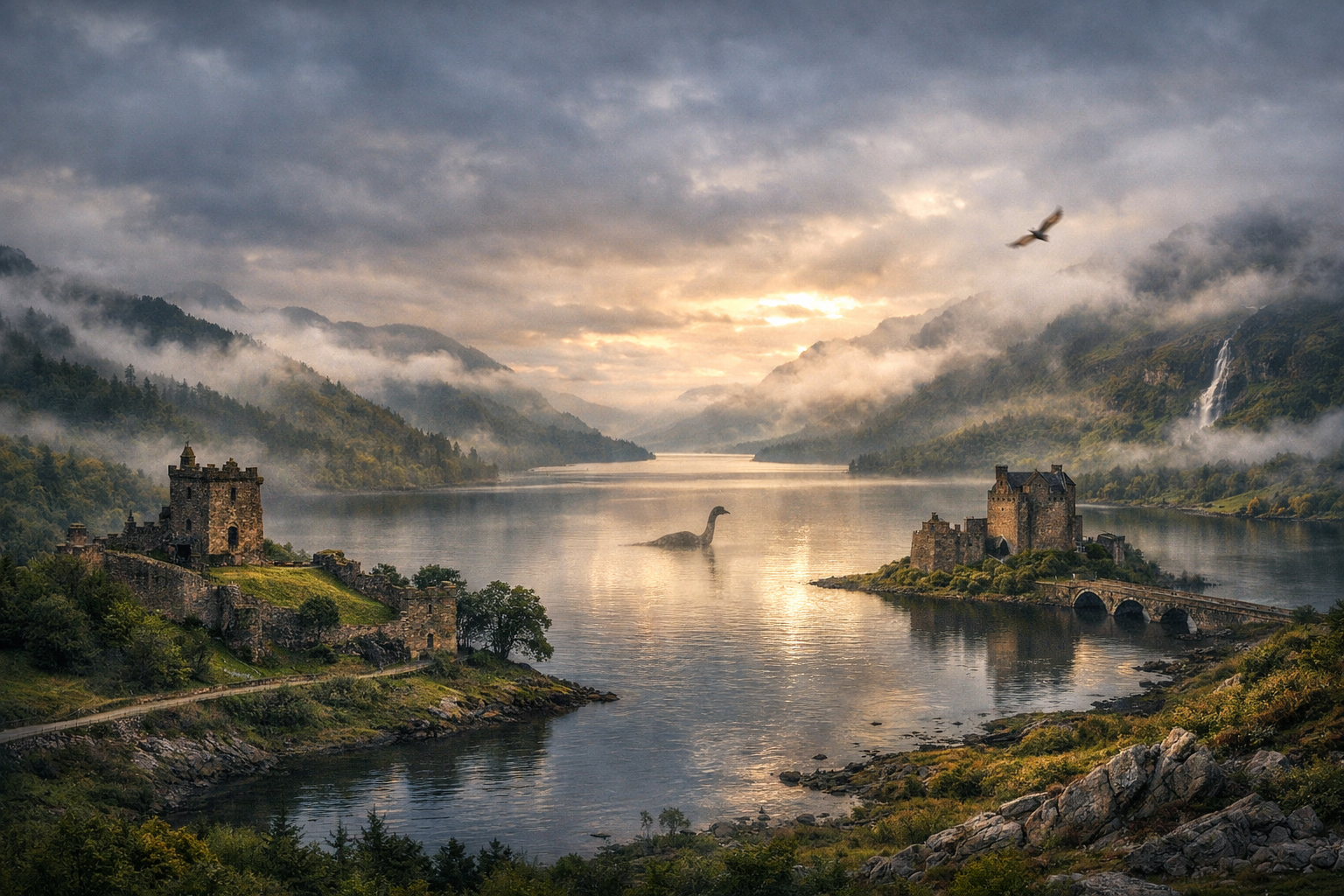
Scotland, Highland. Loch Ness and the legends of the Highlands. Castles, misty valleys, Loch Ness, and ancient Scottish legends in an atmospheric journey

Scotland, Highland. Loch Ness and the legends of the Highlands. Castles, misty valleys, Loch Ness, and ancient Scottish legends in an atmospheric journey

Discover the Highlands of Scotland, where ruined castles rise from misty glens and every loch seems to hold an old legend. From Inverness and the ancient stones of Clava Cairns to the haunting shores of Loch Ness and Fort Augustus, this is a journey through wild beauty, history, and myth.

🧭 DAY-BY-DAY ITINERARY

Ready-made country and city routes with daily plans, sights, transport and accommodation. Buy PDF guides for independent travel.

🧭 DAY-BY-DAY ITINERARY


Day 1 — Inverness: a gentle introduction to the mystical Highlands

  • 🚆/✈️ The base of the route is Inverness, the compact capital of the Scottish Highlands, from which it is easy to make day trips to Loch Ness, ancient stone circles, and places surrounded by a strong folkloric aura. From Inverness Airport to the center, people usually travel by Stagecoach bus or taxi; the journey takes around 20–30 minutes depending on traffic and drop-off point. After check-in, it is best not to overload the first day and to leave time to rest after the flight.

  • 🚶 Start with a walk along River Ness and through the Ness Walk area: this is one of the most beautiful and meditative urban routes in Inverness, especially in overcast weather, when the gray light, water, and tree canopies create an almost cinematic atmosphere. In the evening, the river, small islands, and old bridges create exactly that sense of a northern “threshold territory” for which the Highlands are so often perceived as a space between history, memory, and legend.

  • ⛪ Then visit Inverness Cathedral, known as St Andrew’s Cathedral, on the riverbank. This is a real active 19th-century cathedral, not an “esoteric site” in the strict sense, but for this kind of route it matters as a place of quiet contemplation and acquaintance with the living spiritual culture of the region. Here it is more appropriate to speak of Christian tradition, architectural symbolism, memory, and ritual, rather than of a “place of power” as a proven phenomenon. If a service is taking place inside, keep quiet, do not photograph people without permission, and do not disturb worshippers.

  • 🏛️ Next, it makes sense to visit Inverness Museum and Art Gallery to gain context before trips into the Highlands: archaeology, everyday life, clan history, regional beliefs, and cultural memory allow you to perceive the following stops not as a set of beautiful views, but as a complex historical landscape. For an esoteric route this is especially important: local legends about second sight, ghosts, water creatures, and “thin” places are better understood as part of folklore and social memory, not as scientifically confirmed reality.

  • 🌆 Dedicate the evening to a calm walk around the old center and an early dinner. If you want to add a folkloric note, you can discuss with local guides or in the museum shop the themes of Highland second sight, tales of water spirits, and the image of Nessie in popular culture. It is important to remember: stories of miracles, energy, prophecies, and mystical phenomena belong to the sphere of legends, beliefs, and cultural interpretations and are not scientifically confirmed facts.


Day 2 — Clava Cairns and Culloden: megaliths, memory of the dead, and the field of history

  • 🚗 In the morning, head from Inverness to Clava Cairns — by car the drive usually takes about 15–20 minutes, by taxi roughly the same; if using a bus and then walking in, allow extra time. This is one of the most expressive prehistoric monuments in northern Scotland: a Bronze Age burial complex around 4,000 years old, located on a terrace above the River Nairn. Stone circles, passage cairns, and standing stones create an exceptional sense of antiquity and ritual geometry.

  • 🪨 For an esoteric route, Clava Cairns is a key stop. The verifiable fact is that this is a real archaeological monument and an ancient burial and ceremonial landscape. Everything else — stories about “portals,” special energy, altered perception of time, or contact with other worlds — belongs to modern mystical interpretation, not confirmed by science. This distinction makes the visit deeper: you can honestly admire how ancient societies shaped sacred space without replacing archaeology with fantasy.

  • ⚠️ On site, it is important to behave delicately: do not climb on the stones unless necessary, do not leave coins, ribbons, or “offerings,” do not trample the grass around the monument, and do not treat the site as a backdrop for a noisy photoshoot. This is not a theme park, but a vulnerable heritage site and a former burial place. Allow 45–75 minutes for a calm visit.

  • 🚗 After a short drive of about 5 minutes, head to Culloden Battlefield Visitor Centre. Culloden is not a “mystical” place in the narrow sense, but a powerful space of historical memory: it was here on 16 April 1746 that the Jacobite uprising came to an end. The visit is especially important on an esoteric route because many modern ideas about the “heavy atmosphere” of Highland places arise not only from nature and folklore, but also from genuinely experienced collective trauma.

  • 🛡️ It is best to spend at least 2 hours on the battlefield and in the interpretation center. The exhibition helps separate fact from romantic myth: Jacobite history is often presented through a beautiful legend of a heroic past, but on site the cost of defeat, the collapse of the clan world, and cultural losses are felt especially clearly. If in local stories you hear about ghostly sounds, visions of warriors, or “unsettled land,” treat this as part of memorial folklore, not as an established fact.

  • 🌙 Returning to Inverness in the evening, leave time to rest. After a full day of megaliths and a battlefield, it is better not to add many new stops: the Highlands reveal themselves not through rushing, but through pauses, silence, and the gradual layering of historical images.

Day 3 — Loch Ness and Urquhart: the monster legend, ruins, and a museum interpretation of the mystery

  • 🚗 Today is devoted to the region’s most famous mythological landscape. From Inverness, drive toward Drumnadrochit — the journey usually takes about 30–40 minutes. Here you will find The Loch Ness Centre, a modern interpretation venue that tells the story of the lake’s geology, historical reports of sightings, scientific expeditions, and how exactly the global phenomenon of Nessie was formed.

  • 🐉 For an esoteric journey, this is an exemplary stop because it helps avoid mixing legend and fact. The verifiable facts are these: Loch Ness is a large, deep tectonic lake in the Great Glen system, and stories about a mysterious creature have been recorded in various forms for a long time, especially intensifying in the 20th century. But the existence of the “monster” has not been proven, and the museum presentation is valuable precisely because it shows the evolution of the myth — from a local tale to a global cultural brand.

  • 🏰 After that, head to Urquhart Castle on the shore of the lake. From Drumnadrochit, it is only a very short drive. Urquhart is one of the most dramatically situated castles in Scotland, with a history of more than a thousand years. The ruins, the water, the gusty wind, and the long dark line of the lake create that very “Highland Scottish” atmosphere in which history and legend seem almost inseparable. But here too it is important to distinguish the layers: the walls, wars, sieges, and political history are fact; stories of ghostly figures, curses, and the hidden powers of the lake are part of local folklore.

  • ⛴️ If the weather allows, add a daytime cruise on Loch Ness departing from Clansman Harbour or Dochgarroch via Loch Ness by Jacobite. From the water, the lake is perceived very differently: it seems even darker, longer, and harsher. It is precisely this visual experience that helps explain why the legend of an elusive creature took root here so naturally. However, any stories of “unexplained signals,” mysterious waves, or unusual sensations on the water should be treated as interpretations, personal experience, and tourist narrative.

  • 📷 Allow plenty of time for scenic stops and photos: Loch Ness reveals itself best not in haste, but in changing light. Bring a windproof jacket, rain gear, and comfortable waterproof shoes even in summer. The weather on the lake changes quickly, and in damp wind the open areas by the castle and piers feel much colder than in the city.

  • 🌌 In the evening, return to Inverness. If you still have energy, spend a quiet evening talking in the hotel or a pub, dedicating it to the topic of how powerful cultural myths are born: not from “proven supernatural events,” but from a combination of landscape, repeated stories, media, and the human attraction to mystery.

Day 4 — Fort Augustus and southern Loch Ness: abbey, canal, and the quiet sacredness of transitional places

  • 🚗 The drive from Inverness to Fort Augustus via the A82 along Loch Ness usually takes about 1 hour. This is one of the most beautiful road sections of the route: the lake gradually unfolds as a long dark ribbon, and the road itself seems to lead into an old northern legend. It is better not to leave too early, so the day does not turn into a marathon and there is time for stops.

  • ⛪ The main point of the day is the former St Benedict’s Abbey in Fort Augustus, now known as The Highland Club complex. Historically, this is a real monastic space connected with the Benedictine tradition, the rhythm of prayer, and secluded life at the southern end of Loch Ness. For an esoteric route, the place is interesting not as a “magical object,” but as a space of Western spiritual discipline, where silence, architecture, water, and mountain scale create a very strong inner impression. At the same time, keep in mind that this is partly a residential and hotel complex: respect privacy, do not enter closed areas, and check access rules in advance.

  • 🌊 Then walk to the locks of the Caledonian Canal. Here the theme of “transition” is felt especially well — not in a mystical, but in a symbolic and landscape sense. Water, engineering, monastic history, and the surrounding hills combine in one frame practical Scotland and the Scotland that people love to describe as a land of mists, thresholds, and ancient tales. Such places are often called “places of power,” but it is more accurate to say that they make a strong aesthetic and emotional impression on many people.

  • 🚶 During the day, leave time for an unhurried walk around the village and the waterfront points. If you want a quieter experience, you can spend part of the day in silent contemplation by the water, journal writing, or a slow walk without music or your phone. This is a safe and respectful way to experience the “esoteric” aspect of the route without appropriating other people’s religious traditions and without pseudoscientific claims about the miraculous properties of the place.

  • 🍽️ Allow a proper pause for lunch and rest. After lunch, either return to Inverness or, if you want a more atmospheric night by the lake, choose an overnight stay in Fort Augustus. In that case, the day becomes even more cohesive: the evening silence by the water feels especially strong here, and the tourist flow usually decreases noticeably after the middle of the day.

Day 5 — Newtonmore and Highland Folk Museum: memory of the old Highlands, folk beliefs, and the route’s finale

  • 🚗 On the final day, head to Newtonmore. From Inverness the drive usually takes about 1 hour 15 minutes, from Fort Augustus about the same or slightly longer depending on the route. Here you will find Highland Folk Museum — a large open-air museum that is especially valuable for understanding the everyday culture of the Highlands, including religious practices, folk ideas, daily life, fears, and ways of explaining the world before the era of mass modernity.

  • 🏘️ This is not a “museum of magic,” but a living environment of historical reconstruction, where through houses, crafts, settlements, and rural landscape you can better understand how those very stories of signs, premonitions, water creatures, witches, blessings, and curses were born. For an esoteric route, this is an extremely important conclusion: here it becomes clear that most mystical ideas do not hang in a vacuum, but grow from a real environment — climate, isolation, religiosity, kinship structures, and closeness to death and nature.

  • 🌲 Allow at least 2.5–4 hours for visiting the museum. Much of the impression comes not only from the exhibits, but also from the transitions between zones, the paths, the smell of wood and damp earth, the reconstructed interiors, and the sense that before you is not a “picture of the past,” but a space where people with a completely different perception of time, fate, and nature could have lived until quite recently.

  • 📚 In the second half of the day, summarize the meaning of the journey. In five days, you will have seen several different layers of Highland mysticism: prehistoric sacred architecture at Clava Cairns, memory of death and trauma at Culloden, myth-making around Loch Ness, the monastic silence of Fort Augustus, and the folk world of Highland Folk Museum. All this forms not proof of the supernatural, but a dense cultural fabric in which legend, religion, history, and landscape constantly interact.

  • 🛫 After returning to Inverness, leave a sufficient time buffer for your flight or an overnight stay before the journey home. For an evening departure to the airport, it is sensible to allow not only for the transfer itself, but also for possible delays due to weather, roadworks, and seasonal traffic. The Highlands do not like haste — and it is precisely this feeling of unhurried depth that becomes, perhaps, the main “aftertaste” of such a route.

Flight tickets

eSIM for travel

Buy PDF guide

Buy PDF guide — 10.71 USD

PDF — 10.71 USD