
Buy PDF guide

Buy PDF guide — 8.57 USD

PDF — 8.57 USD

SCHLESWIG-HOLSTEIN - Sylt Island: beaches, dunes and the North Sea

SCHLESWIG-HOLSTEIN - Sylt Island: beaches, dunes and the North Sea

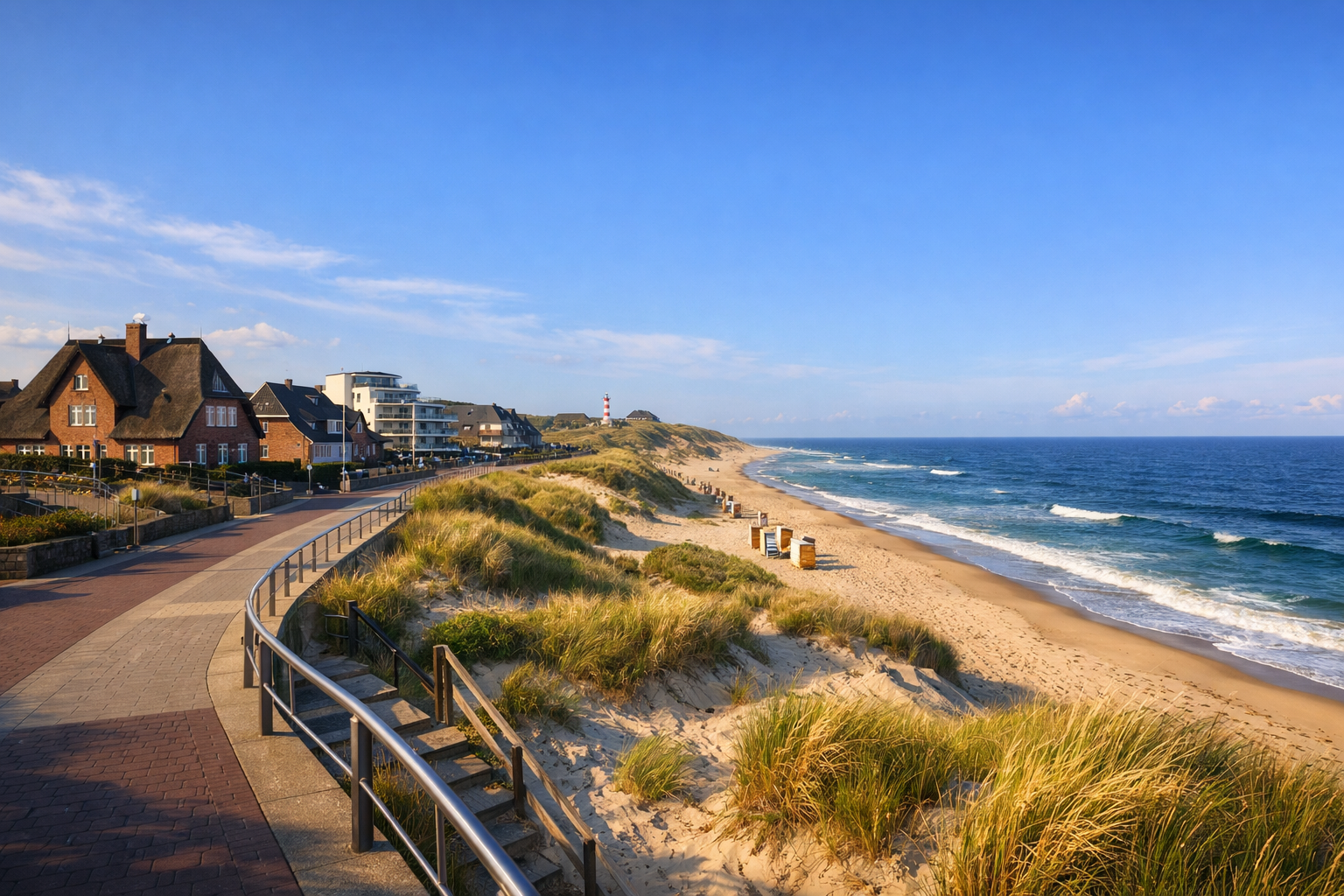
Sylt blends wide North Sea beaches, shifting dunes and that unmistakable island calm into one of northern Germany’s most iconic escapes. From lively Westerland and the charm of Keitum to the cliffs near Kampen, the northern tip at List and the long sands of Hörnum, every part of the island feels shaped by wind, sea and light.

🧭 DAY-BY-DAY ROUTE

Ready-made country and city routes with daily plans, sights, transport and accommodation. Buy PDF guides for independent travel.

🧭 DAY-BY-DAY ROUTE


Day 1 — Travel to Sylt, Westerland and the first evening by the sea

  • 🚆 Transfer: Hamburg → Westerland (Sylt). The fastest practical rail connection takes about 3 hours 1 minute on a direct train; some services run without changes, others with one transfer. It is a comfortable and very logical start to the route: instead of a tiring drive, you almost immediately find yourself inside the North Sea landscape, and the arrival on the island via the Hindenburgdamm causeway already feels like part of the journey.

  • 🚶 Westerland is Sylt’s main resort center and an ideal base for a short 4-day trip. This is the best place to feel the contrast people return to the island for again and again: on one side, a neat German seaside resort with a promenade, shops, cafés and convenient transport infrastructure; on the other, a completely un-urban sense of open space, wind, salty air and an endless beach stretching to the horizon. After check-in, do not overload the day: the best scenario is to head out to the promenade, walk along the Strandpromenade, give yourself time to adjust to the island’s rhythm, and simply watch how the light changes over the North Sea. This is a place where that rare holiday feeling works especially well, when you do not need to “fit everything in”: the sound of the surf, wooden boardwalks over the dunes, Strandkorb beach chairs and the cool wind already become a complete program on their own.

  • 🌅 At sunset, head to the beach in Westerland. In the evening, this part of the island is especially beautiful: the sea looks more steel-gray and dramatic, the dunes cast soft long shadows, and the sky over the western shore often turns into a true northern spectacle with fast-moving clouds, pink-gold breaks in the light and a feeling of vast open space. For the first day, it is the perfect rhythm: minimum logistics, maximum air and a slow northern mood.


Day 2 — Keitum: island history, Frisian character and a museum day

  • 🚌 Transfer: Westerland → Keitum. On the island, it is convenient to use SVG buses: Keitum is connected to Westerland by regular routes, and the ride itself usually takes about 10–15 minutes depending on the stop. It is a very short and easy outing, so the day feels full but not tiring.

  • 🚶 Keitum is a completely different side of Sylt, not about the resort façade but about the depth of the place. If Westerland presents the island as a modern seaside resort, Keitum reveals its historical and cultural memory: quiet streets, old Frisian houses with thatched roofs, tidy gardens, stone walls, small gates and a feeling of almost rural unhurriedness. Here you understand especially clearly that Sylt is not only about beach holidays, but also an island with a strong local identity, maritime history and a distinct Frisian culture. The main stops of the day are Sylt Museum and Altfriesisches Haus seit 1640, located very close to each other, so the route is very convenient on foot.

  • 🏛️ Sylt Museum tells the story of the island not as a set of postcards, but as a living world of people who for centuries adapted to harsh nature, the sea, wind and a changing shoreline. The exhibitions help you see Sylt more broadly: as a place of seafaring, crafts, archaeology, local language and everyday life. After it, it is especially interesting to continue to Altfriesisches Haus seit 1640, one of the most atmospheric museums on the route. It is not just an old house, but almost a physical immersion into island life: low ceilings, antique furniture, interior details, the tightness and thoughtfulness of the space all remind you that life on a windy island has always required practicality, endurance and a very precise view of the home as shelter.

  • 🌿 After the museums, be sure to leave time for a quiet walk around Keitum itself without a strict goal. This village is best exactly when you are not in a hurry: you walk between old houses, glance into quiet lanes, notice flowering hedges, listen to the silence and realize that northern beauty is often built not on splendor, but on restraint. It is best to finish the day in Keitum with an early return to Westerland and an unhurried dinner, because the next day the route moves toward the dunes and the more “landscape-focused” side of Sylt.

Day 3 — Wenningstedt, Kampen and the red cliffs: dunes, megaliths and northern chic

  • 🚌 Transfer: Westerland → Wenningstedt, then short moves toward Kampen. Bus connections between these villages and Westerland are regular, and the rides themselves usually take 10–20 minutes. This makes the day very comfortable: lots of impressions, but no long travel time.

  • 🚶 Start in Wenningstedt with Steinzeitgrab Denghoog, one of the island’s most striking prehistoric monuments. Against the backdrop of beaches, wind and resort lightness, such a place is especially impressive: it literally reminds you that people lived on this land thousands of years ago, long before modern hotels and holiday rhythms. Then devote time to the Wenningstedt coast and dunes. This part of Sylt is very photogenic: a wide beach, high shore, sandy slopes and an open horizon create an almost meditative landscape where you simply want to walk along the sea and never stop.

  • 🚶 In the second half of the day, head to Kampen, a village where island nature unexpectedly combines with the reputation of one of the most stylish and expensive places on Sylt. But it is worth coming here not for the shopfronts, but for the landscape. The main walk of the day is the Rotes Kliff area, the Red Cliff, and the wooden boardwalks along the dunes. Here the coast looks especially dramatic: dark reddish cliffs, pale sand, silvery-green beach grass and a wide northern sky create a landscape that feels both harsh and very elegant. In clear weather, the walk along the cliff is one of the most beautiful on the whole island.

  • 🌾 If you still have energy, add Naturpfad Vogelkoje in Kampen — a quiet green part of the island that contrasts with the open coast. It is a good way to see that Sylt is not only sea and beaches, but also a subtle system of inner landscapes, where birds, marshy areas, ponds and wind-sheltered vegetation all matter. The day becomes very complete: from the megalithic past through dunes and cliffs to the island’s more intimate natural side.

Day 4 — List and Hörnum: two ends of the island, the North Sea and farewell to Sylt

  • 🚌 Transfers: Westerland → List on the line to the northern part of the island usually takes about 35–45 minutes; Westerland → Hörnum to the southern part also takes about 35–45 minutes. Visiting both points in one day is realistic if you start early and do not overload the plan with extra stops. For a short route, this is a beautiful finale: you see Sylt as a long narrow island stretched between two edges with very different characters.

  • 🌊 It is best to devote the morning to List. This is the north of Sylt, where you feel space, wind and the closeness of big nature especially sharply. Be sure to include Erlebniszentrum Naturgewalten: it is one of the best introductory points for understanding the island, its climate, marine environment, storms, tides, the Wadden Sea and the vulnerability of the shoreline. After the exhibition, the landscape itself reads very differently: dunes stop being just a beautiful backdrop and become part of a complex living system. If the weather allows, continue with a walk along the northern beaches and toward Ellenbogen — here Sylt looks especially pristine, almost like the edge of the world, where land gradually gives way to wind, sand and water.

  • 🚶 After the northern part of the island, head to Hörnum, the southern tip of Sylt. Here the landscape changes again: you feel the open sea, the marina, the lighthouse and that southern “nose” of the island that people love for its panoramic views and calmer rhythm. Hörnum Odde is a magnificent place for a final walk. Here it is especially easy to see how the island is constantly shaped by sea and wind: the coast feels mobile, the lines of the dunes and sand spits keep changing, and all around there is lots of light and air. This place is not about a packed sightseeing program, but about a farewell and very pure visual final chord.

  • 💨 End the journey without rushing: coffee or an early dinner in Westerland, one last walk on the beach, and a little time just to sit by the sea. Sylt rarely feels like a “place you need to tick off a list.” Quite the opposite: in 4 days it manages to show how varied one small island can be — resort-like and wild, elegant and severe, historical and very alive.

Flight tickets

eSIM for travel

Buy PDF guide

Buy PDF guide — 8.57 USD

PDF — 8.57 USD