
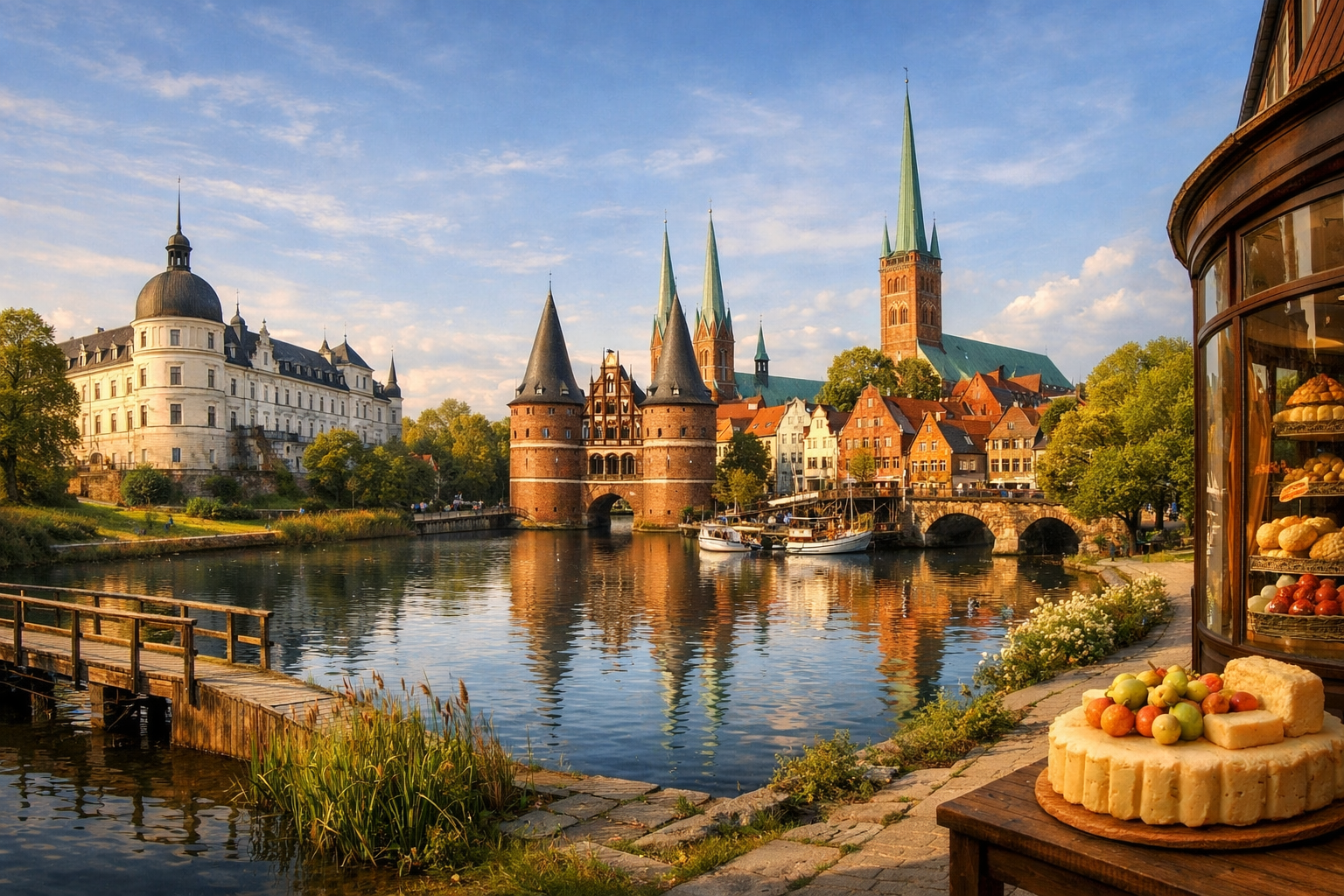
Day 1 — Lübeck: Holstentor, the old Hanseatic axis, and marzipan
🚆 The trip from Hamburg to Lübeck by regional train usually takes about 40–50 minutes to Lübeck Hbf, after which it’s an easy 10–15 minute walk to the Holstentor and the edge of the old town. If you’re arriving at Hamburg Airport, allow around 1 h 40 min–2 h 10 min for the S-Bahn connection to Hamburg Hbf and then the train to Lübeck; if you’re arriving at Flughafen Lübeck, the trip to the center is usually shorter and takes about 15–25 minutes by train/bus or taxi.
🚶 The best place to begin discovering Lübeck is at the Holstentor — that powerful city gate façade with two round towers that has long become not just a symbol of the city, but practically an emblem of all North German brick Gothic. Built in the second half of the 15th century, it demonstrated both defensive strength and the wealth of the free Hanseatic city. This is where Lübeck’s character is felt especially well: austere, merchant-like, proud, and remarkably photogenic. Take a closer look at the slightly leaning towers — this unevenness doesn’t spoil the monument, but makes it feel alive and almost human. Inside there is a museum dedicated to trade, the sea, power, and the wealth of the Hanse, so even a short stop here becomes a vivid introduction to the whole trip.
🚶 From the Holstentor, it makes sense to walk toward the market square and St. Mary’s Church. This stretch of the old town is very convenient for the first day: distances are short, the streets are atmospheric, and pauses for coffee, photos, and shop windows don’t disrupt the rhythm of the route. Along the way, you get that classic “postcard” Lübeck — gables, red brick, narrow passageways, old merchant houses, and the feeling that the city was shaped over centuries not for speed, but for dignity. For this walk with relaxed stops, it’s reasonable to allow 1.5–2 hours.
🚶 St. Mary’s Church is the climax of medieval Lübeck and one of the most important churches of North European brick Gothic. Its enormous mass rises above the city like a stone-and-brick proof that a merchant republic could think on an almost cathedral-like scale. What impresses here is not only the architecture, but also the dramatic historical memory: inside, you feel the connection of eras, and the entire old town ensemble is read through St. Mary’s towers as through a vertical axis. Even for those who are usually indifferent to church architecture, this place offers a rare sense of scale, silence, and inner dignity. Give yourself at least 40–60 minutes to explore inside and around it.
🍰 After the first historical part of the route, it’s ideal to take a break at Café Niederegger on Breite Straße — this is exactly where the theme of “Lübeck and marzipan” stops being a souvenir cliché and turns into a full-fledged city story. Lübeck marzipan is part of the local identity, and since the 19th century Niederegger has cemented the city’s reputation as a sweet capital. The café is a convenient place to plan a late breakfast or an early dessert break for 45–60 minutes: cake, coffee, and signature marzipan sweets provide a very welcome pause after walking in the wind and over cobblestones.
🏛️ On the second floor of Café Niederegger is the Marzipan Museum — a small but very distinctive place that unexpectedly complements the serious Hanseatic theme of the first day very well. The exhibition tells the story of the origins of marzipan, the path of this delicacy to Northern Europe, and the history of the Niederegger house itself. Particularly memorable are the life-size figures made of marzipan: there is something at once slightly theatrical, slightly nostalgic, and very much in the spirit of Lübeck about them. Usually 20–30 minutes are enough for the museum, and it fits perfectly between the walk and lunch.
🚶 After lunch, it’s worth continuing the route toward the Trave waterfront and, if you like, adding an hour-long boat ride from the pier near the Holstentor. Lübeck reveals itself especially well from the water: the old island center, towers, gables, bridges, and former port spaces come together into a single silhouette that makes it easy to understand why this city was considered the “Queen of the Hanse” for centuries. Formally, this is no longer a museum experience but a spatial one — the city begins to be perceived not as separate façades, but as a whole historical organism. If you skip the boat ride, you can leave this time for wandering freely along the Obertrave and the quiet side streets.
🌆 The evening of the first day is best spent without rushing: return to the market square, stroll along Breite Straße, look into the illuminated passageways and courtyards, and end the day with dinner by the water or within the old town. Lübeck is especially beautiful at dusk, when the brick darkens, the towers become more graphic, and the city sheds its daytime tourist bustle and again feels like an old northern capital. This is a good day without overload: on foot, with real breaks for rest, dessert, and, if desired, a short boat trip.