
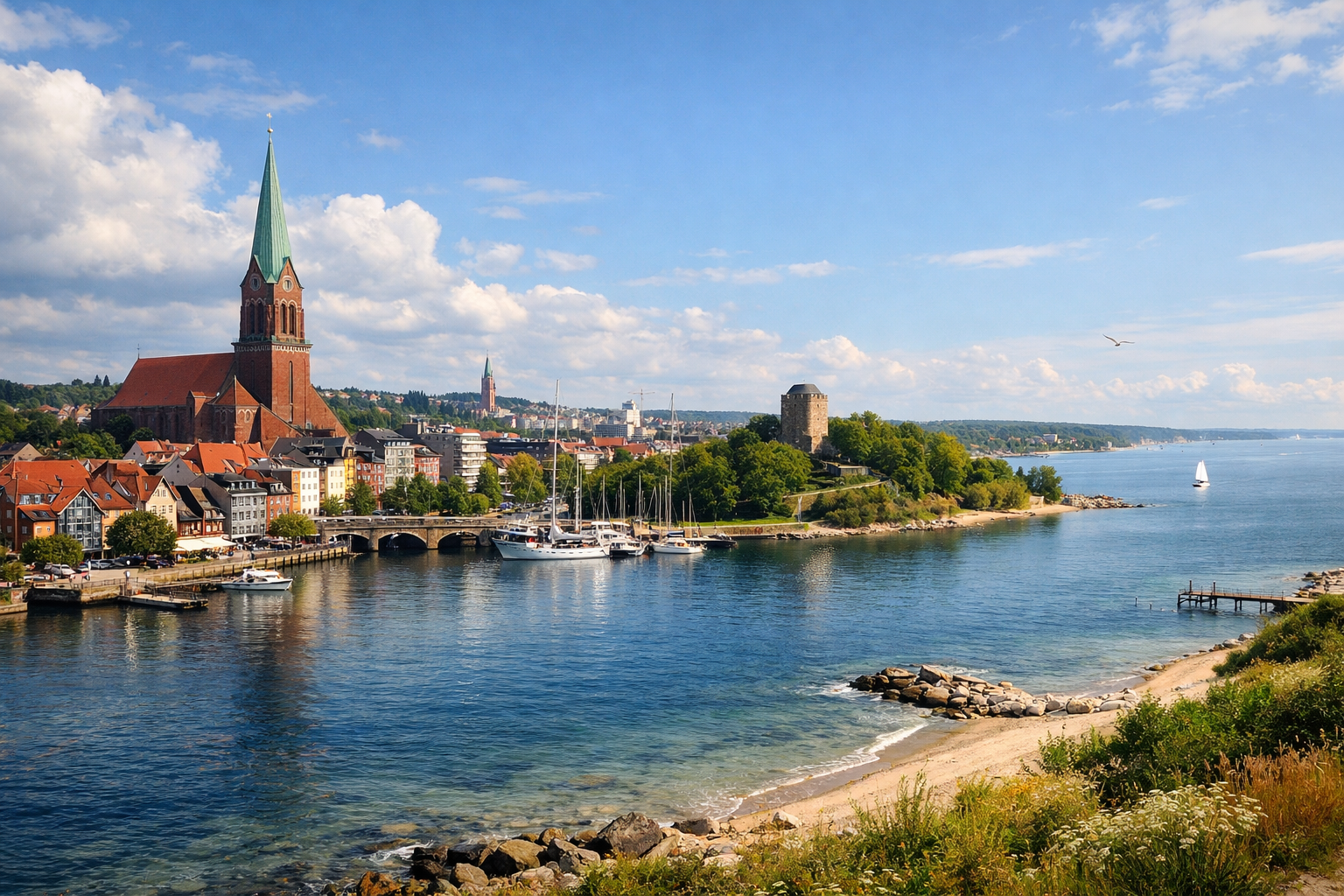
Day 1 — Kiel: old town, museums, and Kiellinie
🚶 Kiel is the capital of Schleswig-Holstein and one of Germany’s most maritime cities, where everyday life is quite literally shaped by the water. You do not need to search long for a postcard view here: the harbor, ferries, yachts, university buildings, old shopping streets, and wide promenades come together in a complete northern landscape with salty air and a feeling of openness. Kiel is especially convenient for a short two-day route: the historic center, museum stops, and main walking areas are compact enough, and the city itself feels not like an overloaded metropolis but like a lively North German capital on a fjord, where you want to slow down, look at the water, and take long pauses for coffee, fish, and walks along the piers.
🚶 Start the day in the old town area and the quarters around Dänische Straße. Here Kiel reveals itself not only as a port, but also as a city with a deep biography: the war destroyed a significant part of its historic buildings, so everything that survived and still helps you feel the former scale and character of the city is especially valuable. One of the best stops is Stadtmuseum Warleberger Hof, a museum in one of Kiel’s oldest civic buildings. Its atmosphere is not grand but intimate and intelligent: an old house, vaulted rooms, objects from the city’s history, changing exhibitions, and a calm, almost homelike introduction to how Kiel grew from a trading-port settlement into one of the region’s most important maritime centers. It is a good first stop because it sets the context for the rest of the route.
🏛️ Then it makes sense to continue to Schifffahrtsmuseum Fischhalle, located by the water. This maritime museum is especially fitting in Kiel: here the city’s history is inseparable from shipbuilding, trade, the harbor, sailors, and both naval and civilian fleets. The former fish auction hall building on the waterfront is itself part of the experience — the architecture reminds you that the sea here was not a backdrop but the foundation of the city’s economy and identity. The exhibitions help you see Kiel not only as a beautiful northern city, but as a place where maritime history is felt in a literal, material sense. It is convenient to allow about 1.5–2 hours for the museum, including a pause by the water and an unhurried walk around it.
🍽️ After the museum part, have a proper lunch and rest in the center without trying to cram too much into the day. This matters for a two-day route: Kiel is at its best when you leave room for air, a long gaze over the harbor, and a slow transition from one location to another. It is reasonable to allow about 1–1.5 hours for lunch and a short break.
🚶 Dedicate the second half of the day to Kiellinie — the famous waterfront promenade that locals see almost as the city’s maritime heart. This is a long walking line along Kiel Bay where you can feel the character of northern Germany especially clearly: wind, open space, passing ships, sports clubs, research institutes, green areas, an open horizon, and constantly changing water. Kiellinie is wonderful because it does not look like an artificial tourist set — people walk here, run, cycle, sit on benches, watch the sunset, and observe yachts and large ferries. On a clear day, a walk here becomes an almost meditative experience.
🚶 If you still have energy, add the area around Kunsthalle zu Kiel and the university museums. Kunsthalle stands in a beautiful position above the fjord and is important in itself as the region’s major art institution: it is especially strong in 19th-century art, Expressionism, and contemporary art. Even if you are not planning a long museum visit, this part of the city is pleasant for an evening walk thanks to its mix of cultural atmosphere, greenery, and water views. Nearby is also the Zoologisches Museum der Christian-Albrechts-Universität — a good option for those who like smaller academic museums and want to diversify their maritime day with something more scholarly.
🚕 In the evening, it is easy to plan your return to the hotel without rushing: from Kiellinie, central hotels are usually easy to reach by bus or taxi, and within the center many parts of the route can realistically be done on foot. Altogether, the day is full but realistic: historic Kiel, the city museum, the maritime museum, lunch, a long waterfront walk, and a gentle evening by the water without exhausting transfers.