
Buy PDF guide

Buy PDF guide — 4.28 USD

PDF — 4.28 USD

SCHLESWIG-HOLSTEIN - Flensburg and northern Germany

SCHLESWIG-HOLSTEIN - Flensburg and northern Germany

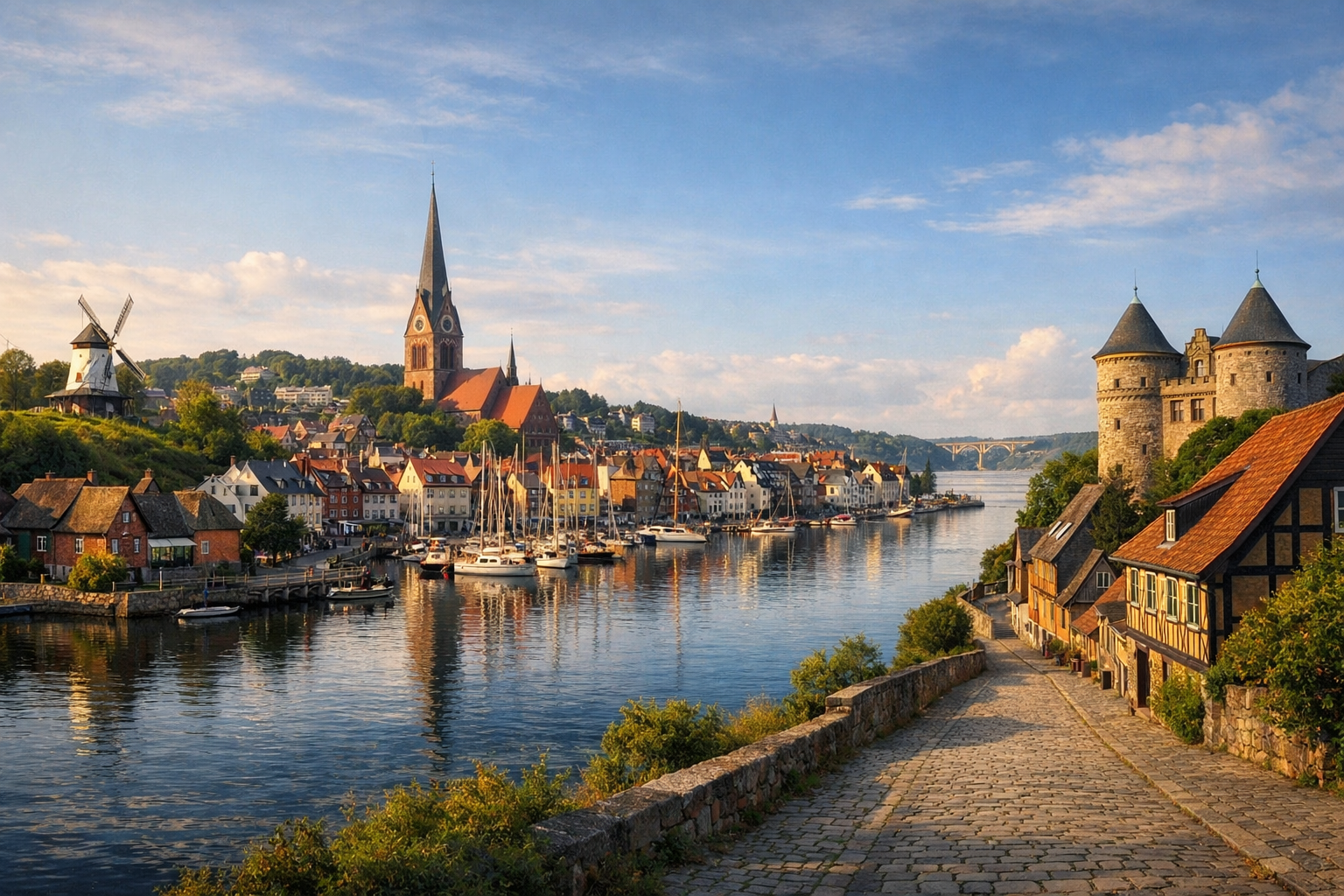
Discover Schleswig-Holstein at its northernmost edge, where Flensburg’s harbor charm meets the quiet elegance of Glücksburg. Along the Flensburg Fjord, sea air, sandy shores and Danish-German flair create a relaxed coastal escape with a distinctly northern character.

🧭 DAY-BY-DAY ROUTE

Ready-made country and city routes with daily plans, sights, transport and accommodation. Buy PDF guides for independent travel.

🧭 DAY-BY-DAY ROUTE


Day 1 — Flensburg: old harbor, Rote Straße, and the museum waterfront

  • 🚶 Flensburg is one of the most atmospheric cities in northern Germany, where you can feel a rare blend of German and Danish cultures, maritime trade, old merchant quarters, and calm northern beauty. The city lies at the very end of Flensburg Fjord, almost on the border with Denmark, and water has shaped much of its character: the promenades, old warehouses, piers, former rum trading houses, and narrow streets here do not look like museum scenery, but form a living urban fabric. It is best to start the route in the Schiffbrücke area and the harbor: in the morning, the light falls softly on the masts of historic ships, seagulls circle above the water, and the facades of brick houses reflect in the calm surface of the fjord. This place is not about rushing — it is pleasant to walk slowly here, look closely at the details, notice old doors, signs, stairs down to the water, and feel how port severity and almost postcard-like neatness coexist in one city.

  • 🏛️ Next, it makes sense to head to the Flensburg Maritime Museum, located right by the water and perfect for revealing the port biography of the city. What is especially interesting here is that the history is presented not abstractly, but through real stories: shipping, rum trade, connections with the Baltic and the North, crafts, maritime professions, and the everyday life of the port. The area around the museum itself adds to the impression — the exhibition seems to be continued by the city itself, where the harbor, old ships, and museum landscape work as one unified space. After the museum, it is worth leaving time for a short rest by the water or a coffee break: this is an important stop, because Flensburg is best experienced not in a "rushing from point to point" mode, but as a slow northern walk with pauses for the view, the wind, and the waterfront.

  • 🚶 In the second half of the day, head toward the old center and the famous Rote Straße, one of the most charming streets in the city. It differs noticeably from the harbor line: there is less open maritime space here and more intimacy, inner courtyards, old trading houses, workshops, and quiet urban elegance. This street seems to concentrate the Flensburg that people love for its coziness: neat cobblestones, reddish facades, arches into courtyards, small shop windows, and the feeling that the city knows how to be not only maritime, but also almost intimate. It is especially nice to simply stroll without a strict goal, peeking into passageways and courtyards, because that is often where the most beautiful North German rhythm hides — calm, understated, and incredibly photogenic.

  • 🏛️ In the evening, go up to Museumsberg — this is a different Flensburg, more cultural, contemplative, and panoramic. The museum hill is important not only as a collection of art and the cultural history of the Schleswig region, but also as a point from which the city’s many layers are best felt: the port below, the old center, the closeness of Denmark, the memory of the Duchy of Schleswig, and a special borderland identity. Inside the museum, the interiors and collections connected with regional culture are especially good, and outside — the very relief of the place, which gives a rare sense of height and perspective for a northern city. It is worth ending the day calmly: dinner in the center, then 10–15 minutes of an unhurried walk back to the harbor or to the hotel. If your base is chosen in the historic port, evening Flensburg with the reflections of lights in the water will become an almost perfect finale to the first day.


Day 2 — Glücksburg and the north of the fjord: a castle on the water, sea air, and return to Flensburg

  • 🚌 Transfer: Flensburg → Glücksburg by regional bus line 21 or 22 takes about 25–35 minutes depending on the stop and time of day. This is a realistic and convenient trip without a tiring transfer: the route is well suited for a short two-day journey when you want to see not only the city, but also the more aristocratic and scenic side of the fjord.

  • 🏰 Glücksburg offers a completely different mood compared to port-side Flensburg. If the first day was about the mercantile north, the harbor, and urban textures, then the second reveals the ceremonial and almost fairy-tale side of the region. The main point here is Schloss Glücksburg, one of the most famous water castles in Northern Europe. It stands on the water so naturally and beautifully that it seems less like a fortified residence and more like a carefully composed set for a historical novel: a light-colored facade, reflections in the pond, trees at the edges, calmness, and noble symmetry. Inside, the aristocratic scale of northern history is especially tangible — not excessively lavish, but restrained, Protestant in its severity, yet very expressive. This place is best experienced slowly, leaving time not only to see the halls, but also to walk around the castle outside, where the perspective changes and the best angles open onto the water and facades.

  • 🌿 After the castle, it is worth devoting a few hours to a walk around the surroundings of Flensburg Fjord. Northern Germany here reveals itself through air, light, and space: not with loud Alpine landscapes, but with the subtle beauty of the coast, parks, roads between water and greenery, yacht views, and the feeling of an open horizon. If you do not overload the day, you can combine the castle with a short walk to the shore or toward the resort part of Glücksburg, where the mood becomes almost Baltic: a light wind, even light, silence, a beach line, and a very calm rhythm. This is the perfect contrast after the urban part of the route — less architectural density, more breathing room and space.

  • 🔬 Upon returning to Flensburg in the second half of the day, you can finish the trip with a more modern and interactive point — PHÄNOMENTA Flensburg near Nordertor. This is a successful choice for the finale: after historical interiors, port memory, and palace aesthetics, there is a lively, playful, almost laboratory-like energy here. The museum does not require an academic mindset — on the contrary, it is built on curiosity, movement, and personal experience. Even adults can easily get involved in the process here, and the area by the city’s northern gate adds the feeling that you have seen Flensburg from different sides: from the harbor and old center to the scientific, family-friendly, and modern urban layer. After the museum, there is still time for an early dinner and a calm departure or one more night in the city without rushing.

Flight tickets

eSIM for travel

Buy PDF guide

Buy PDF guide — 4.28 USD

PDF — 4.28 USD