
Buy PDF guide

Buy PDF guide — 6.43 USD

PDF — 6.43 USD

NORTH RHINE-WESTPHALIA - Castles of Westphalia

NORTH RHINE-WESTPHALIA - Castles of Westphalia

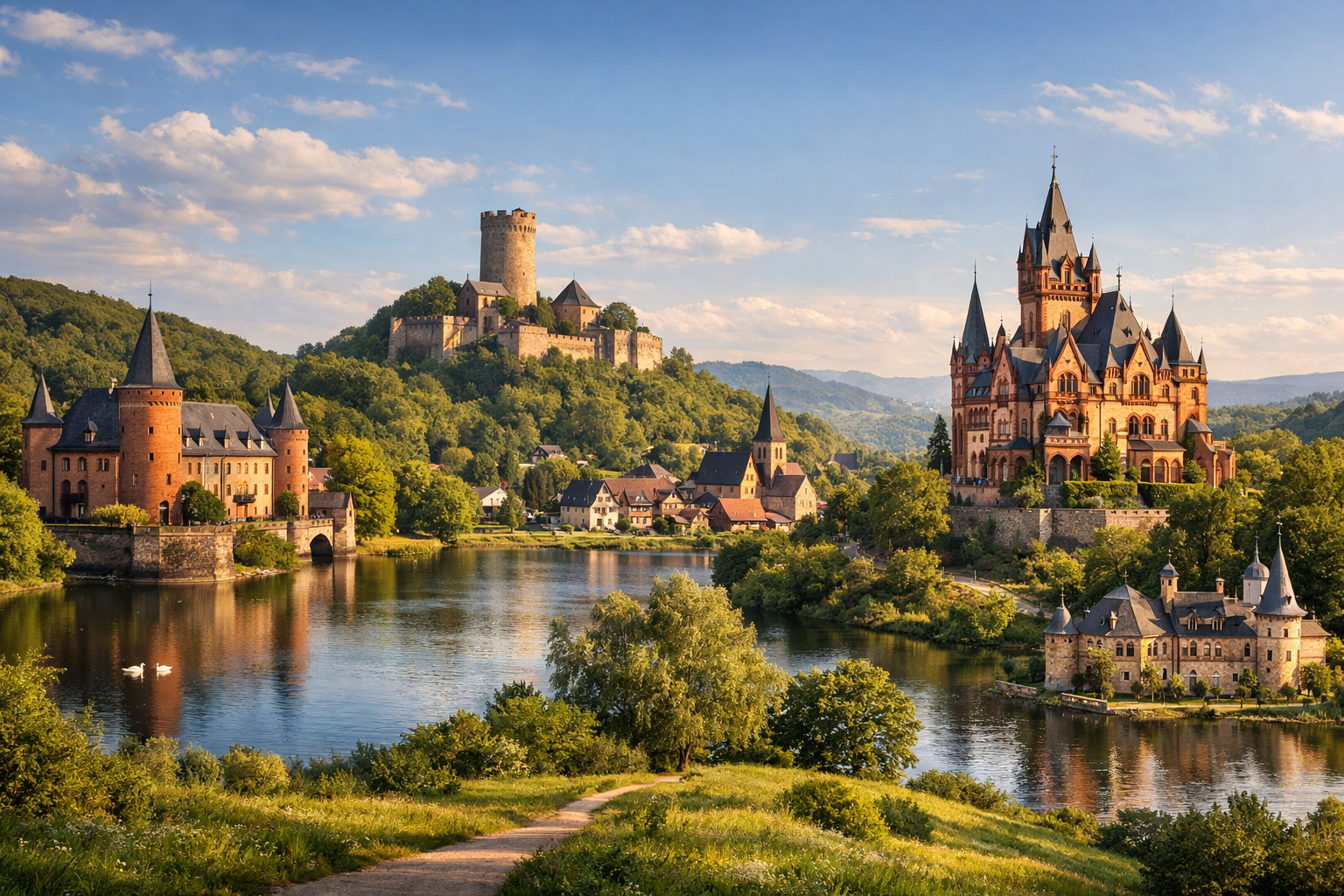
Discover the storybook side of North Rhine-Westphalia on a journey through Westphalia’s castle country. From Münster to the moated castles of Lüdinghausen, the grand baroque elegance of Nordkirchen, and the romantic fortress at Dorsten-Lembeck, this route unfolds through stately estates, quiet parkland, and timeless charm.

🧭 DAY-BY-DAY ROUTE

Ready-made country and city routes with daily plans, sights, transport and accommodation. Buy PDF guides for independent travel.

🧭 DAY-BY-DAY ROUTE


Day 1 — Münster: a gentle start and immersion in Westphalia

  • 🚶 Münster is an ideal base for a short castle route through Westphalia: it is an elegant university city with very convenient logistics, an old center, a long green promenade on the site of former fortifications, and a calm, almost aristocratic atmosphere. There is no sense of a rushed metropolis here: historic facades, the arcades of Prinzipalmarkt, the cathedral square, and the cycling culture create a backdrop that perfectly sets the tone for the theme of western German palaces, moated castles, and historic estates. It is best not to overload the first day with long excursions: after arrival, it makes sense to check into the hotel, give yourself 1–1.5 hours to rest, and only then head out for a walk through the center to get into the rhythm of the region without fatigue.

  • 🏛️ Start with the Domplatz area and the LWL-Museum für Kunst und Kultur, where the cultural depth of Westphalia is especially tangible: medieval heritage stands side by side with a modern museum space, and the museum itself is conveniently located right by the old center. Even if you do not go inside for long, simply walking around Domplatz, St. Paul's Cathedral, and the historic streets gives that very feeling of old northern European culture—restrained, noble, and very "stone-like" in character. Then it is worth heading to Prinzipalmarkt, where the gabled house fronts and arcaded galleries create an almost theatrical perspective. This is one of those urban landscapes that does not shout about itself, but reveals itself gradually: in the details of the signs, in the rhythm of the cobbled streets, in the subtle play of light on the pale sandstone.

  • 🌿 In the second half of the day, it is good to add a more relaxed location—Aasee and Mühlenhof. Lake Aasee works as the perfect “pause” between the journey and the busy castle days: the embankments, greenery, boats, and wide horizon help the body recover from the road. Nearby is the Mühlenhof-Freilichtmuseum, an open-air museum where you can see the region’s traditional rural architecture and better understand the cultural and economic world from which Westphalian manor houses and castles emerged. This is important context: castles here are not just beautiful facades, but part of a historic landscape in which water, fields, forests, church lands, and noble residences existed in close connection for centuries.

  • 💤 It is best to keep the evening as gentle as possible: dinner in the center of Münster, a leisurely walk along the Promenade, and an early return to the hotel. This matters because the next two days will revolve around trips to castles, and a comfortable rhythm on the first day strongly affects the overall impression of the journey.


Day 2 — Lüdinghausen and Nordkirchen: Burg Vischering + Schloss Nordkirchen

  • 🚆 Transfer: Münster → Lüdinghausen, by regional train and then a short connection/local transfer or taxi to the castle; on average, allow about 45–60 minutes from central Münster to Burg Vischering including waiting time and the last few kilometers.

  • 🚶 Burg Vischering in Lüdinghausen is one of the most striking moated fortresses in Westphalia and perhaps the best choice for getting acquainted with the region’s “castle” theme in a concentrated form. This is not a palace for ceremonial balls, but a true fortified aristocratic complex surrounded by water and built with that Westphalian practicality where beauty is never separated from defense. The silhouette makes an immediate impression: the ring moat, bridge, towers, brick and stone reflected in the water—all of it looks almost like the perfect illustration of the word Wasserburg. Inside there is a museum, so the visit is not only visual but also substantial: it is easy to imagine how people lived here, defended themselves, managed the estate, and built their position in the local hierarchy. For the grounds and museum section, it is reasonable to allow about 2–2.5 hours without rushing.

  • ☕ After Burg Vischering, it is worth taking a break for lunch and rest in Lüdinghausen or near the castle. This is an important point for a realistic itinerary: two major castle sites in one day are best separated not only by a transfer, but also by a proper pause of at least 60 minutes, otherwise you will arrive at Nordkirchen already tired and lose the main thing—the ability to look around calmly, walk, and notice details.

  • 🚕 Transfer: Lüdinghausen → Nordkirchen, by car or taxi about 15–20 minutes; public transport is usually slower and less convenient, so for this segment it is better to plan for a taxi or car sharing.

  • 🏰 Schloss Nordkirchen has a completely different tone. If Burg Vischering speaks the language of medieval defense, Nordkirchen speaks the language of Baroque representation, symmetry, and power. It is no coincidence that it is called the “Westphalian Versailles”: the palace is dramatically set amid a broad water system and a formal park, and the approach is designed so that the visitor gradually enters a ceremonial space where architecture, avenue axes, canal mirrors, and open perspectives are all subordinated to one idea—to impress. It is especially pleasant to walk here not in bursts but slowly: changing angles, circling the ponds, watching the facades reflected in the water, and catching that calm Baroque luxury that reveals itself not in decorative excess, but in scale and perfectly measured composition.

  • 🌳 You should allow at least 2.5–3 hours for Schloss Nordkirchen, especially if you want to walk through the park and not limit yourself to just one viewing point. This place is very photogenic, but its real strength lies in the space itself: the longer you stay in it, the more strongly you feel the carefully planned drama of approaches, bridges, water lines, and park axes. Toward evening, the light becomes softer and the palace looks especially noble.

  • 🚆 Return: Nordkirchen → Münster, including the local transfer to the station and the regional train, allow about 60–80 minutes. After such a day, it is better not to plan evening museums: at most, a calm dinner in Münster and rest.

Day 3 — Dorsten-Lembeck: Schloss Lembeck and the route’s final note

  • 🚗 Transfer: Münster → Schloss Lembeck (Dorsten-Lembeck), by car about 1–1.5 hours depending on your starting point and traffic; the trip is possible by public transport, but noticeably more complicated and longer, so for the third day car sharing or a pre-booked transfer is especially sensible.

  • 🚶 Schloss Lembeck is a beautiful finale to a three-day route because it combines the features of a noble residence, a moated castle, and a landscaped country estate. Unlike the more “ceremonial” Nordkirchen and the more “defensive” Burg Vischering, Lembeck is perceived as a place where the castle theme is softened by parkland, forest, and an almost manor-like sense of space. Even the approach sets the mood: water, greenery, elongated perspectives, and a calm, balanced architectural silhouette. It is a wonderful place to walk slowly, with a feeling of completing the journey rather than “checking off one more stop.”

  • 🏛️ The grounds of Schloss Lembeck include museum spaces, and the ensemble is valuable not only for its interiors or collections, but also for the overall atmosphere of a historic estate connected to its natural surroundings. What is especially pleasant is that Lembeck does not overwhelm the visitor with monumentality, but rather draws you into contemplation: the paths, water, old trees, and facades work together. It is an excellent site for the last day, when you do not want to rush, but want to let the route come to a beautiful close.

  • 🌲 After visiting the castle and park area, it is worth leaving time for a leisurely lunch or coffee break and a short rest. For Schloss Lembeck, it is reasonable to allow 3–4 hours including a walk around the grounds, because this is not a location to see “on the run.” If you still have energy, you can devote some time simply to walking through the surrounding natural landscape: it is precisely this combination of architecture and rural scenery that makes western Westphalian residences so memorable.

  • 🚗 Return: Schloss Lembeck → Münster, approximately 1–1.5 hours. If you are departing the same day, it is better not to schedule your return flight too early: ideally, have at least 3–4 hours between leaving the castle and departing from the airport or boarding a long-distance train.

Flight tickets

eSIM for travel

Buy PDF guide

Buy PDF guide — 6.43 USD

PDF — 6.43 USD