
Day 1 — Essen: Zollverein, Ruhr Museum, and an evening in the city center
🚆 If you are flying into Dortmund, it makes sense to head straight to Essen as the first base of the route: from the airport, AirportExpress is a convenient way to reach Dortmund Hbf in about 25 minutes nonstop, then take a regional train to Essen Hbf — roughly another 35–45 minutes. Including the transfer and getting out into the city, the whole journey usually takes about 1.5 hours. This is a realistic start that does not overload the day: after the trip, there is still plenty of time left for your first major industrial site.
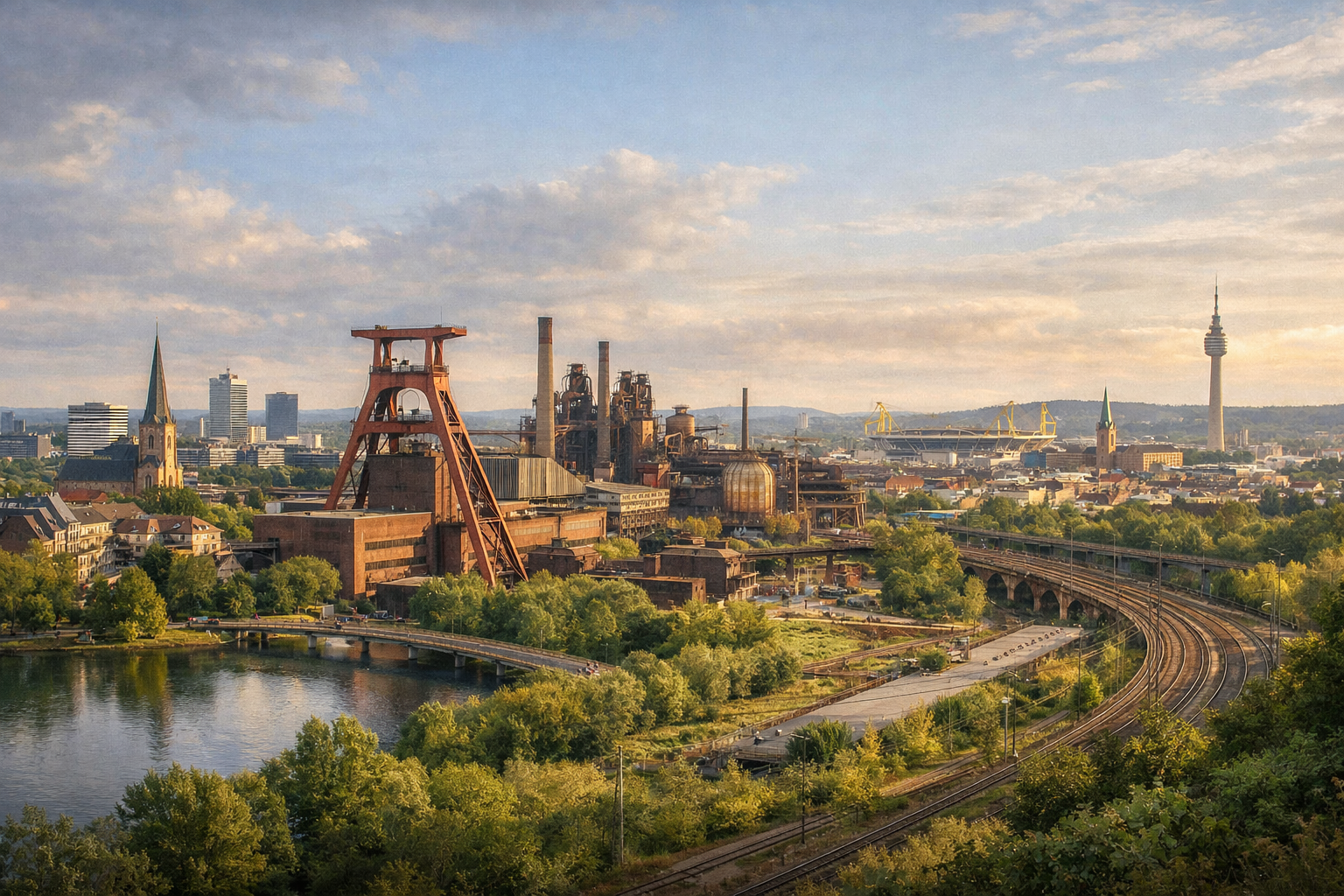
🚶 Begin your introduction to the Ruhr with UNESCO-Welterbe Zollverein — a place where the region’s industrial history does not look like a museum behind glass, but like a real architectural landscape of steel, brick, conveyors, towers, and gigantic structures, where the scale of the coal era can still be felt. It is here that you especially clearly understand why the Ruhr was the engine of German industrialization: the former coal mine and coking plant site is not just huge, it is almost theatrical in its visual impact. Bauhaus straight lines, the rhythm of pipes, stairways, and walkways, the rusty patina of metal, and the spaciousness of former production grounds create the rare feeling that you have entered the past, an architectural manifesto of the 20th century, and a very modern cultural space all at once. Allow at least 3–4 hours for walking and exploring with breaks to rest: distances within the complex are noticeable, and this is the kind of place you do not want to rush through but to take in slowly, stopping for photos and viewpoints.
🏛️ Then head up to the Ruhr Museum, located right on the Zollverein site in the former coal washing plant. This is one of the best museums for a first immersion into the context of the region: it tells not only about mines and factories, but also about nature, culture, migration, everyday working life, and the transformation of the Ruhr from a smoky industrial belt into a modern urban agglomeration. What is especially interesting inside is how the exhibition does not compete with the industrial shell, but lives within it: you literally move through a space that is itself an exhibit. It makes sense to allow 2–2.5 hours for the museum, and afterwards take a relaxed break for coffee or a late lunch on the grounds of the complex.
🚆 Zollverein is usually reached from central Essen by public transport in about 25–35 minutes, depending on the exact route and transfer wait times. The return trip to the center in the evening takes about the same amount of time.
🌆 Dedicate the evening to a softer, more urban side of Essen: a walk through the city center, Kennedyplatz, and the area around Limbecker Platz. After the strict industrial geometry of Zollverein, central Essen feels unexpectedly light and comfortable: broad pedestrian zones, shops, cafés, and the modern rhythm of the city show well how the former coal capital has learned to live a new life. It is an ideal end to the day without extra transfers — just stroll at an easy pace, have dinner, and return to the hotel a bit earlier so as not to overload your impressions.