
Buy PDF guide

Buy PDF guide — 4.28 USD

PDF — 4.28 USD

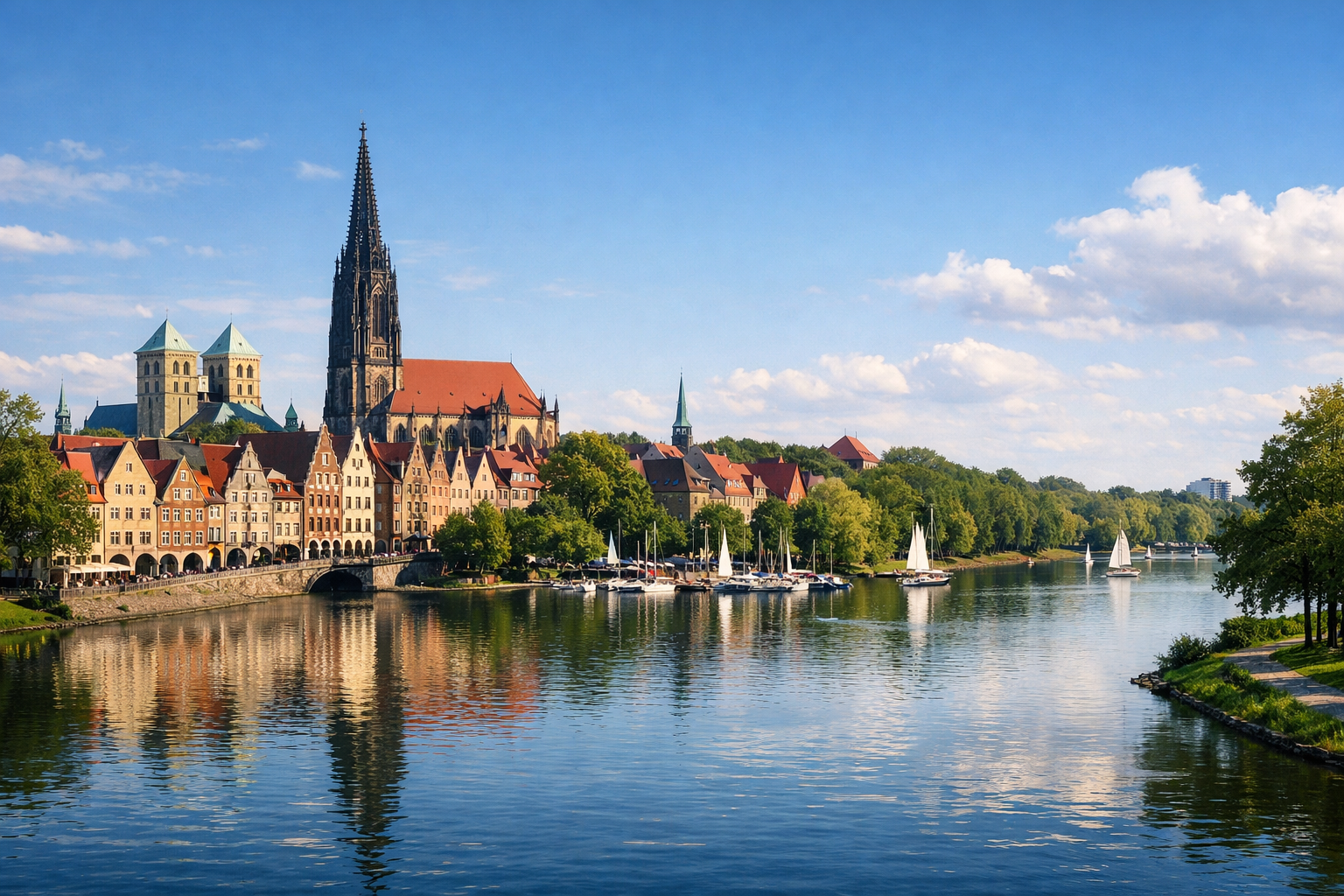
NORTH RHINE-WESTPHALIA - Münster: old town and Lake Aasee

NORTH RHINE-WESTPHALIA - Münster: old town and Lake Aasee

Münster blends historic charm with easygoing lakeside life in the heart of North Rhine-Westphalia. Stroll through its beautifully preserved old town, then unwind by Lake Aasee, where green spaces and calm waters give the city its relaxed rhythm.

🧭 DAY-BY-DAY ROUTE

Ready-made country and city routes with daily plans, sights, transport and accommodation. Buy PDF guides for independent travel.

🧭 DAY-BY-DAY ROUTE


Day 1 — Münster: old town, Prinzipalmarkt, Cathedral and Town Hall

  • 🚶 Begin your introduction to Münster with its old town — one of the most charming historic centers in North Rhine-Westphalia. This is not a city of just one landmark, but a rare case where the very fabric of the place becomes the main impression: arcades, brick-and-stone facades, pointed gables, calm squares, and the city’s famous cycling energy come together to create the atmosphere of an old, intelligent, and very lively Westphalia. The heart of the route is Prinzipalmarkt, Münster’s ceremonial main street with its long line of arched galleries, where history is not locked behind museum glass but continues to live among cafés, shops, and leisurely strolls. It is especially pleasant to walk here without rushing, studying the facade details and catching that rare European rhythm in which the city feels both grand and cozy at once.

  • 🚶 From Prinzipalmarkt, it makes perfect sense to continue to the Historic Town Hall and Friedenssaal — the Hall of Peace, connected with the Peace of Westphalia of 1648. This is where Münster feels not only beautiful but truly significant: behind the elegant facade lies a place where one of the most difficult chapters of European history came to an end. Inside, a solemn, almost contemplative atmosphere has been preserved, and the visit complements a walk through the center very well because it shifts your impression of the city from the aesthetic to the historical. After the town hall, walk a few minutes toward Domplatz: the transition between the squares is very short, but it is exactly what shows how compact and pedestrian-friendly Münster is.

  • 🚶 St.-Paulus-Dom is another essential highlight of the first day. Münster Cathedral impresses not so much through outward grandeur as through its combination of spiritual silence, medieval solidity, and very noble architectural restraint. Inside, it is easy to feel the pace of the trip change: the noise of the shopping streets remains outside, while the cathedral space brings your attention back to stone, light, and the scale of centuries. If you are not in a hurry, it is worth allowing time not only for the visit itself but also for a calm pause on the square in front of the cathedral. Domplatz works very well as a natural resting point in the middle of the day.

  • 🚶 After the cathedral, it is convenient to visit the LWL-Museum für Kunst und Kultur at Domplatz 10 — one of the city’s strongest museums. Around a thousand years of art are represented here, and the visit is especially rewarding in the context of Münster: after the old town, the museum does not feel detached from the route, but rather continues it through painting, sculpture, and the cultural history of the region. Even if you are not planning a deep museum day, 1.5–2 hours here provide a rich but not exhausting immersion. Afterward, you can take a long coffee break under the arcades in the center or return to Prinzipalmarkt in the early evening, when the facades glow softly and the city looks especially photogenic.

  • 🚶 In practical terms, this day is very comfortable: from Münster’s main station to the Domplatz/Prinzipalmarkt area it is about a 15-minute walk, to the Stadtmuseum about 5 minutes, and between the key points of the old town, transfers usually take 3–10 minutes. So the route is not overloaded with transport and leaves room for spontaneous stops, dinner, and rest without any sense of rushing.


Day 2 — Münster: Lake Aasee, waterfronts, nature, and museums by the water

  • 🚶 Dedicate the second day to Aasee — the most important urban leisure space in Münster. It is not just a lake, but a large, vibrant recreational zone that begins almost at the center and very naturally shifts the trip from “historic city” mode into “air, water, and a long walk” mode. From Prinzipalmarkt to Aasee it is about a 15-minute walk, and this short transition is especially pleasant because it requires no complicated logistics: after a few blocks, the city unexpectedly opens up, with avenues, sculptures, water, boats, and a sense of wide open space.

  • 🚶 A walk along Aasee is especially enjoyable because of its flexibility. Here you can choose a calm route without rushing: stroll along the waterfront, stop at a café, watch the sailboats and urban sculptures, and then continue toward the museum area. In Münster, the lake is not separated from cultural life — on the contrary, it is very subtly woven into the landscape around it. Because of this, a day by the water does not turn into just a “park day”: it remains meaningful and full, but without overload.

  • 🚶 One of the best options near Aasee is the LWL-Museum für Naturkunde with planetarium at Sentruper Straße 285. It is an excellent stop for the second half of the day: the museum is located by the leisure area, so it combines easily with a walk, and the exhibition format makes it a good choice even for those who do not usually build trips around natural history museums. If you want more fresh air and fewer indoor spaces, you can choose a shorter museum visit instead and continue along the lakeshores toward Mühlenhof-Freilichtmuseum or simply follow the green walking paths.

  • 🚶 Mühlenhof-Freilichtmuseum at Theo-Breider-Weg 1 is a wonderful addition for those interested not only in urban history but also in everyday old Westphalia. It is an open-air space with historic buildings and a very soft, almost pastoral atmosphere. After the ceremonial facades of the center, it feels like another layer of the region: more grounded, rural, domestic, and therefore very alive. This contrast makes the two-day route more three-dimensional — in a short time, Münster manages to reveal itself both as a city of peace and trade and as a city of nature, unhurriedness, and local cultural memory.

  • 🚶 In terms of timing, the day is also realistic and comfortable. From the center to Aasee is about 15 minutes on foot; from the main station to Domplatz by bus is about 7 minutes, and the Zoo/Naturkundemuseum area can be reached by public transport without complicated transfers. If you want a more relaxed pace, allow 4–5 hours for Aasee itself with stops and rest, and finish the evening by returning to the old town for dinner. This is one of those routes where you do not need to “see everything”: Münster is especially good when you let it move at its own pace.

Flight tickets

eSIM for travel

Buy PDF guide

Buy PDF guide — 4.28 USD

PDF — 4.28 USD