
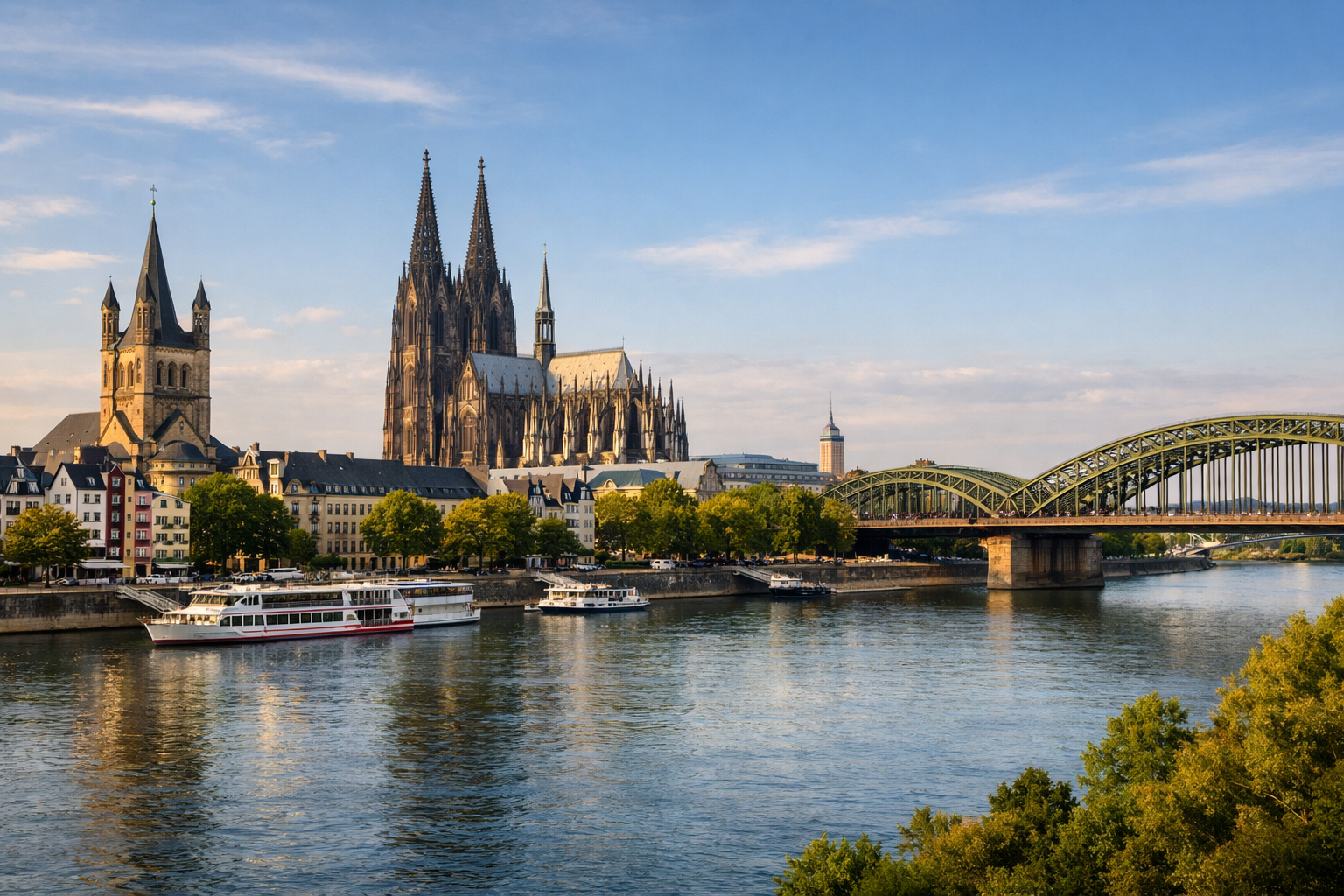
Day 1 — Cologne: Cologne Cathedral, Hohenzollern Bridge, and the Rhine embankment
🚆 If you arrive at Cologne/Bonn Airport, allow about 15–20 minutes to get to the center by S19 or a regional train to Köln Hbf, plus another 10–15 minutes to exit the station and check into your hotel. For a short two-day itinerary, this is one of the most convenient airport transfers in Germany: the train literally brings you into the heart of the city, right by the cathedral.
🚶 Start your introduction to Cologne with Cologne Cathedral — that very Gothic giant that not only dominates the skyline, but seems to gather the entire rhythm of the city around itself. Its two towers rising above the central station and squares create an almost theatrical effect: you step off the train and immediately find yourself in front of one of Europe’s most recognizable churches. Inside, the cathedral feels different than it does from the outside: instead of a noisy tourist snapshot, you enter a vertical world of stone, light, and silence, where the high vaults, stained glass, and depth of space automatically make you slow down. For a tourist visit, it is important to keep the opening hours in mind: from Monday to Saturday, visits are usually possible roughly from 10:00 to 17:45; on Sundays and church holidays, roughly from 13:30 to 16:30; and from July 1, 2026, tourist entry to the cathedral interior became ticketed. If you want not only to see the church but to physically experience its scale, you can climb the south tower: it is 533 steps and a real workout, but at the top you get one of the best views of Cologne, the Rhine, the railway arches, the old town, and the chain of bridges.
☕ After the cathedral, do not try to pack the day immediately with the maximum number of locations: it is wiser to take a 40–60 minute break for coffee or a late breakfast near Dom/Hbf, because the first day in Cologne is best built around walking and the right pace, not endless dashes. The most pleasant rhythm here is a short visit, then an unhurried walk to the river, then architecture and panoramas again.
🚶 From the cathedral, walk 8–12 minutes to Hohenzollern Bridge. It is not just a crossing over the Rhine, but one of those places where the cityscape suddenly comes together like a perfect postcard: the river on the left, steel arches ahead, the constant flow of trains under your feet, and behind you the Gothic cathedral, which from this angle looks especially cinematic. The pedestrian part of the bridge is famous for its “love locks,” but the real point of the walk here is the panorama. It is best to walk at least to the middle of the bridge, slowly, for 15–20 minutes, to see how the cathedral gradually recedes and becomes part of the silhouette of the old town. If the weather is clear, photos from here are especially good closer to evening, when the stone of the cathedral and the water of the Rhine take on softer light.
🚶 Then head down to the Rhine embankment and give yourself 1.5–2 hours for an unhurried walk. In Cologne, the Rhine is not a background river but the true axis of the city. You feel the scale here: broad water, the smooth movement of boats, promenade decks, steps down to the shore, the low hum of the city fading into an almost resort-like mood by the water itself. It is convenient to build the route from the cathedral area toward Rheingarten and farther along the old town. Along the way, it is worth making short stops on benches, because the feeling of Cologne is made up of exactly these pauses: the city is at once large, historic, and very “alive,” without museum-like sterility.
🚶 In the evening, move into a calmer part of the day — a walk to the viewpoints on the right bank or a return to the left bank for dinner. If you still have energy, you can walk or ride to Deutz and look at the evening cathedral from the opposite side of the Rhine: from there, it is especially easy to see how the old center seems to rise out of the water and bridges. It is convenient to allow 1–1.5 hours for dinner, and after that, a short final walk along the river. At dusk, Cologne becomes especially cozy: the lights of the bridges reflect in the water, the facades of the old town grow warmer, and the cathedral turns into an almost unreal silhouette above the night station.