
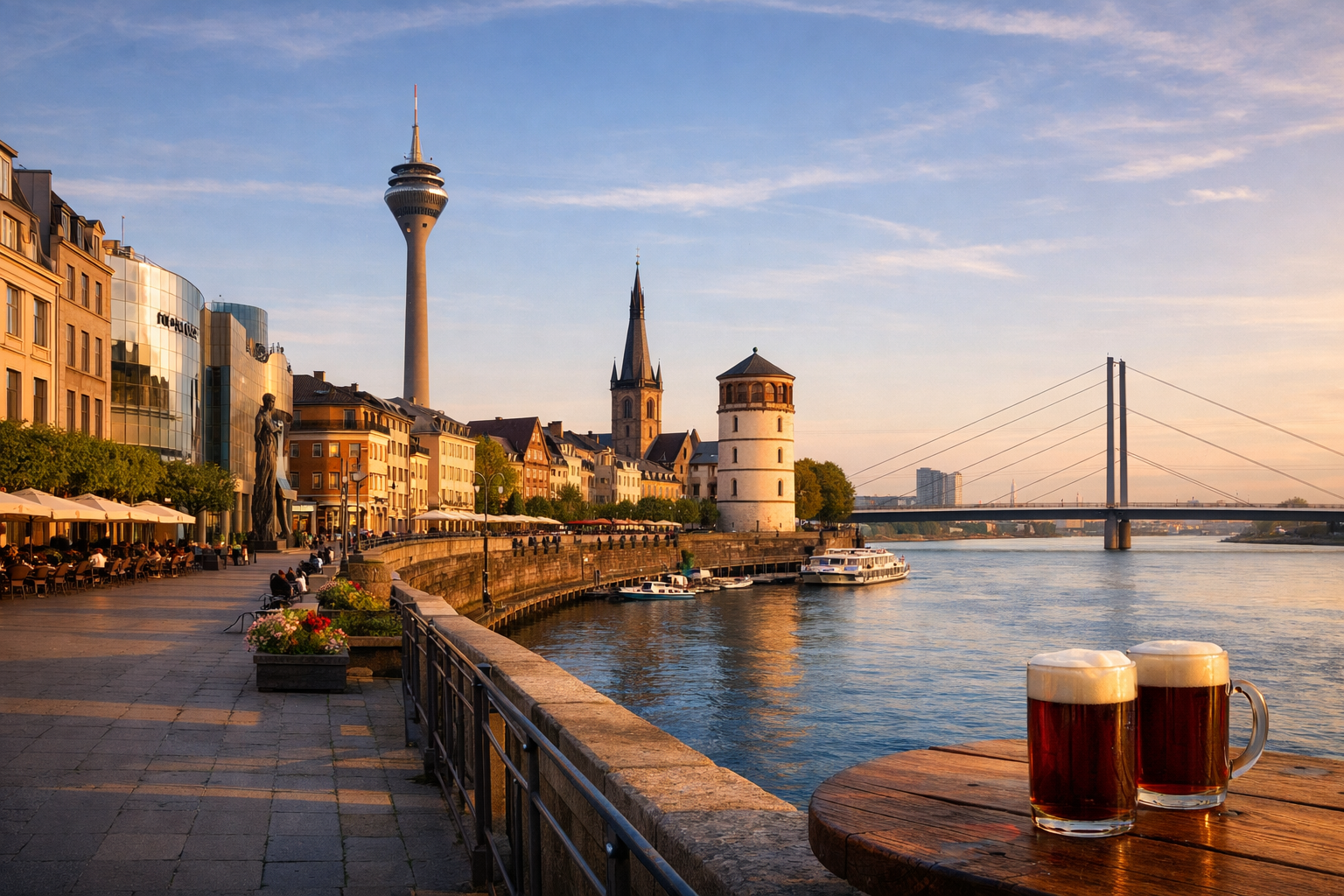
Day 1 — Düsseldorf: Königsallee, Hofgarten, K20, and Altstadt
🚆 If you are arriving at Düsseldorf Airport, the most logical and least tiring way to start the route is by train into the center. The airport has two rail points: Düsseldorf Flughafen Terminal station, served directly by the S11, and the longer-distance Düsseldorf Flughafen station, from which the automated SkyTrain runs to and from the terminal in about 7 minutes. Getting to Düsseldorf Hauptbahnhof by S-Bahn usually takes around 12–15 minutes, and then reaching your hotel in Little Tokyo, around Kö, or in the center often takes just another 10–15 minutes on foot or one short tram/metro ride. This way, you do not lose half a day to logistics and can step into the city at a normal pace already in the first half of the day.
🏨 After check-in, begin your introduction to Düsseldorf with Königsallee — the legendary “Kö,” one of Europe’s best-known fashion streets. It is not just a shopping artery, but a carefully staged urban scene where luxurious facades, a neat canal with little bridges, chestnut trees, and the windows of global brands create an almost cinematic impression. Here Düsseldorf presents itself as the style capital of North Rhine-Westphalia: confident, expensive-looking, but never loud. Even if you do not plan to buy anything, a walk along Kö works as an aesthetic tune-up for the whole trip: you immediately understand why fashion became one of the city’s main calling cards.
🌿 From Königsallee it is very easy to head into Hofgarten — Germany’s oldest public park and a rare chance to switch from shop windows and traffic to a calm green setting in just a few minutes. This is not a “tick-the-box park,” but the true breathing space of the center: lawns, winding paths, stretches of water, old trees, and a very gentle urban rhythm. It is a lovely place to pause after the journey, get a takeaway coffee, and simply give yourself an hour to adjust. Hofgarten is especially good as a space between route points: it links the city’s elegance, museums, and historic center, so resting here does not interrupt the route — it actually makes the day steadier and less overloaded.
🏛️ After lunch, head to K20, Kunstsammlung Nordrhein-Westfalen, at Grabbeplatz 5, 40213 Düsseldorf. This is one of the city’s main art destinations and essentially a must-stop on any route built around art and modern urban style. K20 is especially strong in 20th-century art and classical modernism, and the space itself makes the collection easy to experience without museum fatigue: it is clear, airy, and well integrated into a central city walk. It is sensible to allow 1.5–2 hours for your visit, so you do not rush through the galleries in “seen it, forgotten it” mode, but instead really give yourself time for a few powerful works, a change of pace, and that concentration that is rarely easy to maintain in large capital-city museums.
🚶 Then walk toward Altstadt — the old town, which in Düsseldorf does not feel like a museum set at all. It is a dense, lively, food-filled urban fabric of streets between Heinrich-Heine-Allee, Hofgarten, the Rhine promenade, and Carlstadt, where history is felt not through plaques but through the scale of the space, the turns of the lanes, church silhouettes, squares, and endless bars. This is where the city’s character becomes especially visible: it does not try to be “postcard-old,” but remains real, talkative, and deeply urban. A walk through Altstadt is not about a checklist of sights, but about the atmosphere of a dense European center where every street naturally leads either to a tower, a square, or another cozy place.
🍺 Dedicate the evening to Altbier — the dark top-fermented beer that is almost a cultural marker for Düsseldorf. In the old town, this tradition is best enjoyed not as a “drink tasting,” but as part of city life: small glasses, fast service, noisy tables, hearty food, conversation, and the feeling that beer culture here is not staged for tourists. It is better not to try to cover too many places at once: choose 1–2 classic beer halls in Altstadt, order an Altbier and something filling, then finish the evening with a short walk to Burgplatz. It is the perfect balance for an ending — historic center, local food culture, and a gentle transition into the night city.