
Day 1 — Bonn: old center, Beethoven, and an evening by the Rhine
🚶 Start your route in Bonn’s historic center — compact, cozy, and surprisingly “human-scaled” for a city with such a major cultural biography. This is where old Rhenish Europe is especially tangible: narrow streets, calm squares, 18th–19th century facades, bell towers, cafés, and a gentle urban rhythm that doesn’t overwhelm but instead invites you to wander without rushing. For a long time Bonn remained in the shadow of louder German cities, but that is exactly part of its charm: it does not try to stun with scale, instead revealing itself gradually — through music, a university atmosphere, views of the Rhine, and the feeling of an intelligent, almost intimate city.
🚶 The main point for the first half of the day is Beethoven-Haus, the house where Ludwig van Beethoven was born. This is not just a memorial address, but one of the most important musical places in Germany, where the story of the great composer is read not from dry plaques but almost literally through the space of the house, courtyard, rooms, and museum collection. Inside are manuscripts, instruments, portraits, household items, and keepsakes that help you see Beethoven not as a bronze genius, but as a living person — a boy from Bonn who grew up in a musical environment and became a figure of global significance. The area around Bonngasse is also very atmospheric: it is right in the center near the pedestrian streets, and after the museum it is especially pleasant to simply melt into the urban fabric, where Beethoven’s name appears almost everywhere.
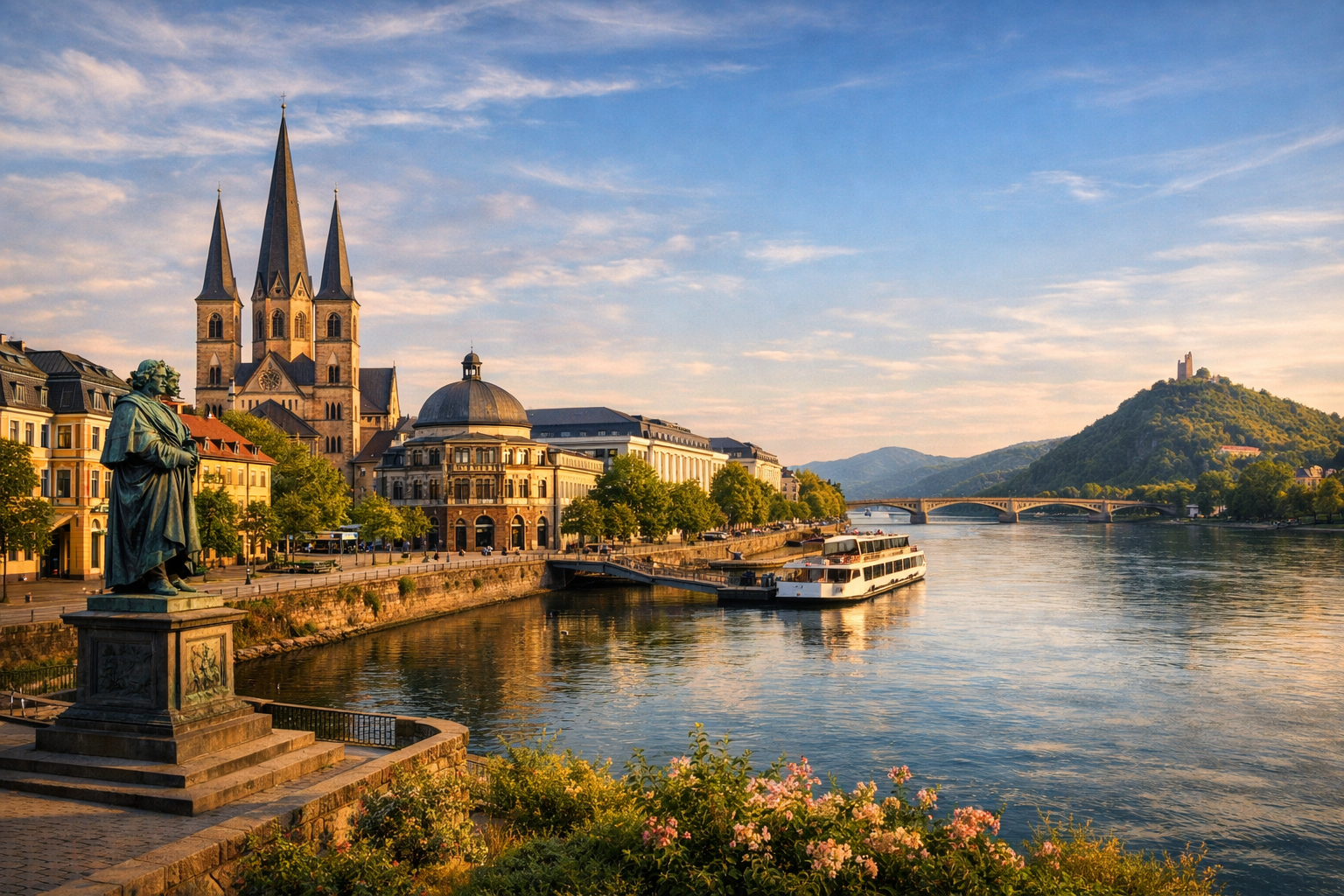
🚶 From Beethoven-Haus it is easy to walk about 5–10 minutes to Münsterplatz and the Beethoven monument. This square is one of the best places to feel how the city speaks with its most famous native son. The monumental statue does not feel like random tourist decoration: it truly sets the tone for the whole square and seems to gather Bonn’s musical and historical memory around itself. Nearby rises Bonn Minster, one of the oldest churches in the region, and the contrast between the strict church architecture, the city noise, and the composer’s statue makes the scene feel highly cinematic. This is a great place to pause for coffee, rest a little after the museum, and simply watch life on the square.
🚶 After lunch, head to Museumsmeile — Bonn’s “museum mile.” From the center you can get here by Stadtbahn in about 10–15 minutes or by taxi in about 10 minutes without heavy traffic. For the first day, it is best to choose Haus der Geschichte and then enjoy a calm walk around the museum district. Haus der Geschichte is especially good because it gives a full-bodied sense of recent German history: it is not a dusty museum “about dates,” but a modern space where objects, interior scenes, documents, transport, design, and media build an entire story of the Federal Republic. Even if you are not a fan of political history, the museum works on an emotional level: it shows how everyday life changed, what freedom, division, and reunification meant, what life in postwar Germany looked like, and what path the country took to modernity.
🚶 By evening, it is worth returning closer to the Rhine. If you still have energy, walk along the promenade toward Kennedybrücke or choose a quieter stretch along the water south of the center. In Bonn, the Rhine is not just a geographical line, but the city’s true stage designer: broad water, long perspectives, soft wind, excursion boats, bridges, and golden evening light turn an ordinary walk into something almost meditative. It is especially pleasant to end the day here: without rushing, with dinner in one of the restaurants by the river or in the center, leaving room not only for “checkmarks” but also for a feeling of the city itself.
💤 The day’s rhythm is realistic: the main part of the route is on foot through the center, then one short transfer to Museumsmeile and a calm evening without unnecessary connections. It is reasonable to allow 1.5–2 hours for Beethoven-Haus, 45–60 minutes for the square and a break, 2–3 hours for Haus der Geschichte, and another 2–3 hours for travel and an evening walk by the Rhine at a relaxed pace.