
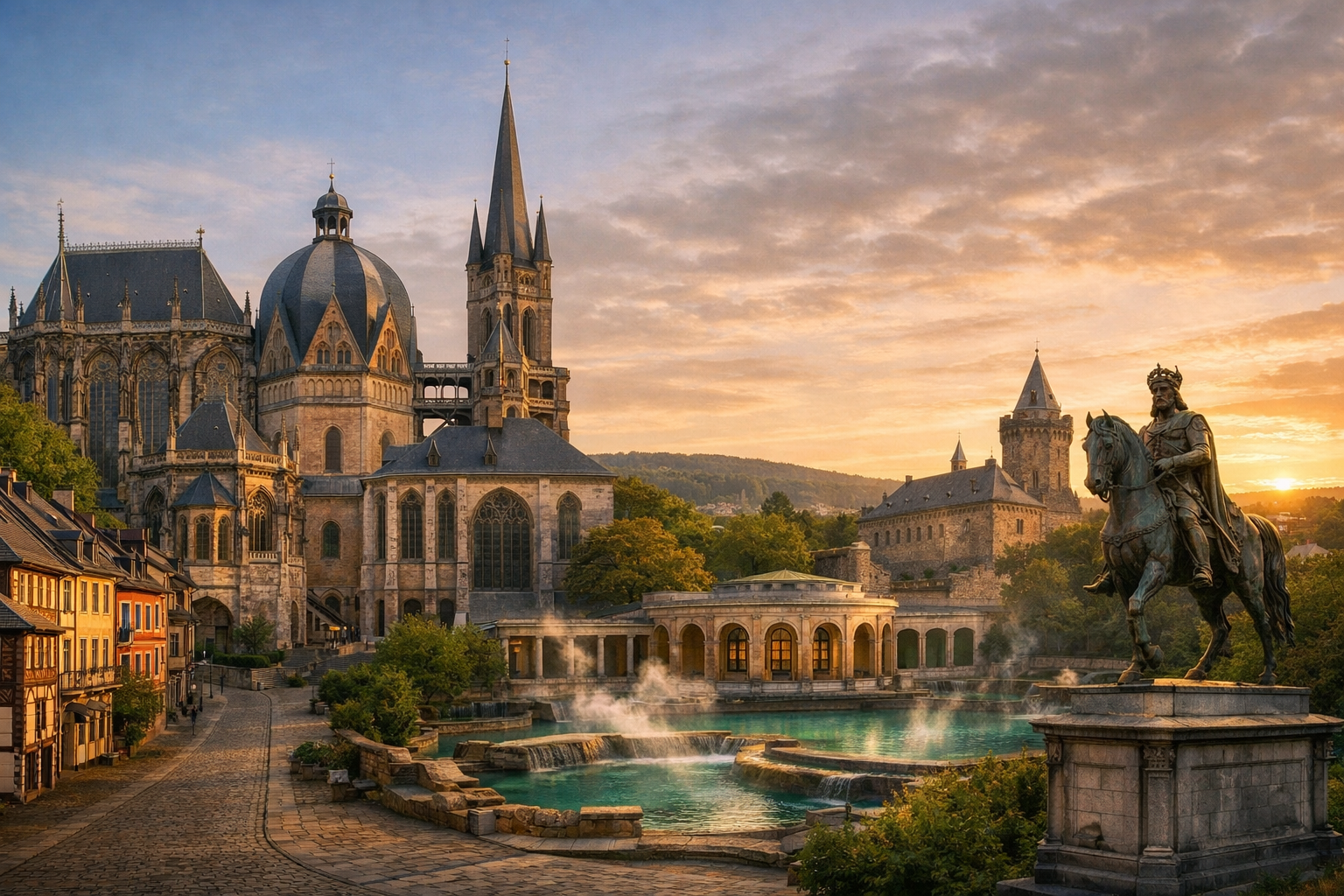
Day 1 — Aachen: cathedral, town hall, and the history of Charlemagne
🚆 It is convenient to plan your arrival in Aachen via Cologne/Bonn or Cologne. The nearest major airport is Cologne Bonn Airport, located about 85 km from Aachen. A realistic scenario without a car: airport → train to Köln Hbf, then a regional or express train to Aachen Hbf; in total, the journey usually takes around 1 hr 30 min–2 hr 10 min depending on the connection. From Aachen Hbf to the historic center it is about a 15–20 minute walk or 5–10 minutes by city bus. For a two-day itinerary, it is best to check into a hotel in the center and then get around mostly on foot: Aachen’s old town is compact, and the main points on the route are located close to one another.
🚶 Start your trip with Aachen Cathedral — a place where the history of Europe is felt almost physically. It is not just the city’s main symbol, but one of the continent’s most important churches, associated with Charlemagne, who made Aachen his favorite residence and the political center of his empire. The octagonal Palatine Chapel at the heart of the cathedral impresses not with outward pomp, but with inner power: marble, bronze, the gold of the mosaics, and the strict geometry of the space create a sense of solemn, almost Byzantine eternity. It was here that the coronations of German kings took place for centuries, and the cathedral itself became Germany’s first UNESCO World Heritage Site. If possible, plan not only a самостоятельный visit but also an official interior tour: this makes Charlemagne’s throne, imperial symbolism, reliquaries, and the layered history of the church—grown from a palace chapel into one of Europe’s great spiritual monuments—come alive much more vividly.
🚶 From the cathedral, take a short walk across Katschhof to Centre Charlemagne — the city museum, which works perfectly as a “key” to all of Aachen. Here, the ancient Roman spa town, imperial residence, pilgrimage site, university city, and borderland center come together into a single story. The exhibition is especially valuable because it does not stop at dry dates: it explains why the hot springs made this place important already in antiquity, how Charlemagne turned Aachen into the political heart of his realm, and why the memory of him still shapes the city’s image today. After the cathedral, the museum provides essential context: the stones and facades you have seen stop being just a beautiful old town and begin to read as fragments of a great European biography.
🚶 Then move on to Aachen Town Hall — one of the city’s most striking civic buildings, built on the foundations of Charlemagne’s palace. Its tall towers and solemn Gothic appearance look like theatrical scenery for a medieval chronicle, but behind this beauty lies the political memory of several eras. Inside, the halls connected with coronations and imperial representation are especially interesting; outside, it is worth lingering on Markt square to feel how the cathedral, town hall, and surrounding houses form an almost perfect scene of old Aachen. This is the part of the route where there is no need to hurry: have a coffee, watch city life, walk over to the Charlemagne Fountain, and you will understand why Aachen is perceived not as an open-air museum, but as a living city with an astonishingly dense historical fabric.
🍰 After lunch, devote some time to a leisurely walk through the old center: Elisenbrunnen, the square scented with mineral water, the little streets around Hühnermarkt, shop windows with Aachen Printen gingerbread, and cozy urban facades create a very special atmosphere of a spa, imperial, and border city all at once. Elisenbrunnen is a reminder that Aachen is not only about Charlemagne and coronations, but also about the centuries-old history of thermal springs. It was thanks to the water that the city lived, healed, welcomed travelers and aristocracy, and today this motif beautifully links the first day of the route with the second.
🏛️ If you still have energy and time, add a short visit to the Couven Museum. It is located in a historic house and shows the world of bourgeois Aachen in the 18th–19th centuries: interiors, furniture, decorative arts, and what everyday urban elegance looked like beyond the great imperial narratives. It is a very pleasant contrast to the monumentality of the cathedral and town hall — a more intimate, warm, and almost homely view of the city’s past.
💤 It is best to end the evening without overload: dinner in the center, an early rest, and a slow walk through the illuminated old town. Distances here are short: between the cathedral, Centre Charlemagne, town hall, Elisenbrunnen, and the Couven Museum, transfers usually take from 3 to 12 minutes on foot, so the day feels full but not exhausting.