
Buy PDF guide

Buy PDF guide — 21.42 USD

PDF — 21.42 USD

North Coast - Inverness Torridon Gairloch Assynt Durness Caithness Black Isle

North Coast - Inverness Torridon Gairloch Assynt Durness Caithness Black Isle

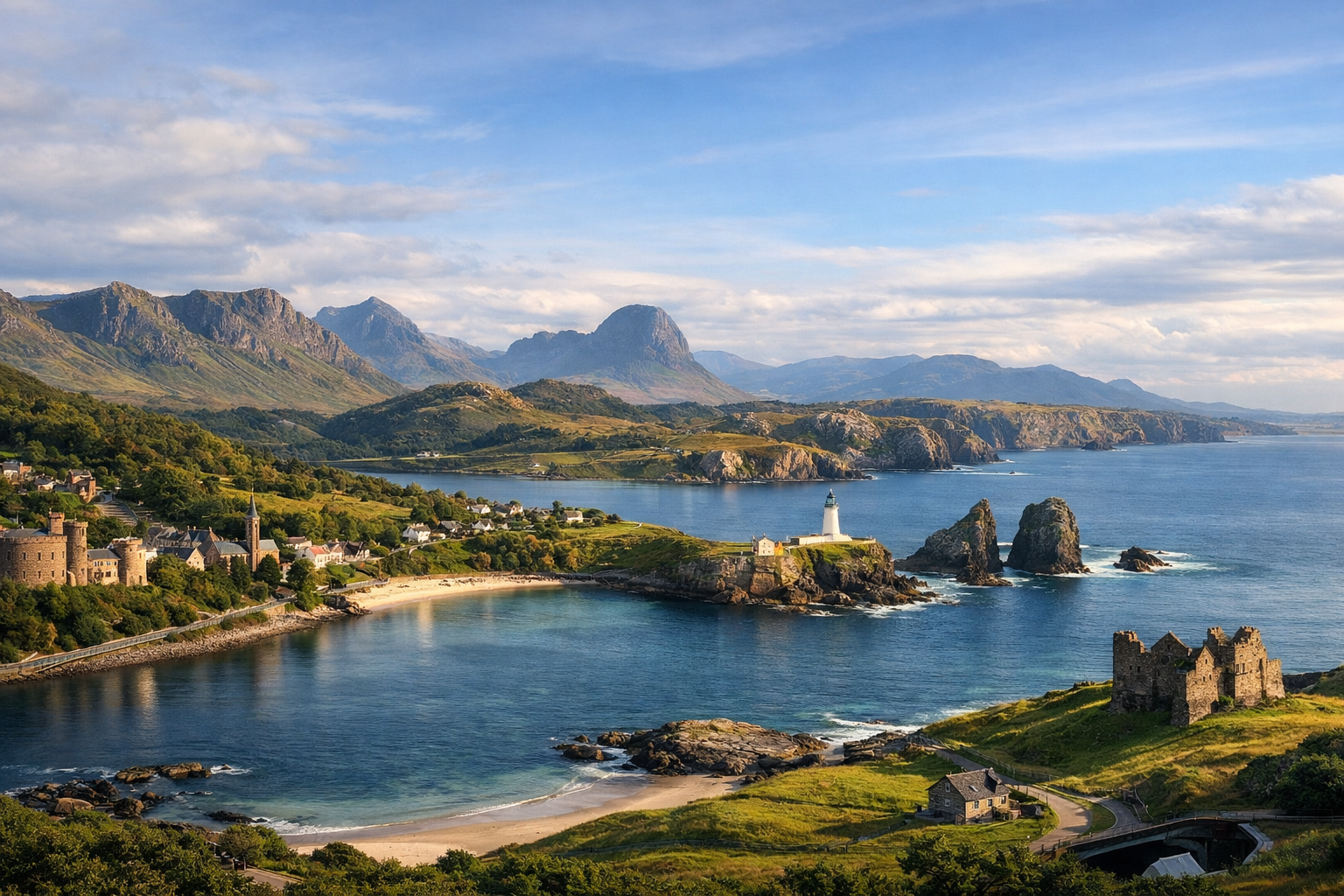
Trace the wild North Coast from Inverness through Torridon, Gairloch and Assynt to the far reaches of Durness and Caithness, where mountains, moorland and sea meet in dramatic style. Along the way, discover empty beaches, rugged cliffs, quiet fishing villages and some of Scotland’s most unforgettable views.

🧭 DAY-BY-DAY ROUTE

Ready-made country and city routes with daily plans, sights, transport and accommodation. Buy PDF guides for independent travel.

🧭 DAY-BY-DAY ROUTE


Day 1 — Inverness: getting to know the capital of the Highlands

  • 🚶 Inverness is the best starting point for a big northern Highlands route: not a giant metropolis, but a compact, lively city on the River Ness, where from the very first day you can already feel the character of the whole journey — soft gray light, wind from the firths, stone facades, old churches, cozy pubs, and the sense that the road ahead will only get more beautiful and wilder. It makes sense to begin with a walk along the River Ness and around Castle Hill: central Inverness is ideal for a day on foot, distances are short, and the main views keep opening up between bridges, towers, and green stretches along the water. The new Inverness Castle Experience has made the castle hill a key point of the city once again: it’s worth going up not only for the panorama, but also for its modern take on the spirit of the Highlands — not as dry history made of dates, but as a story of people, language, music, clans, coasts, and the inner roads of the north.

  • 🏛️ After a walk through the center, it’s convenient to stop by Inverness Museum and Art Gallery to gather context for the whole trip: this is an especially good place to “tune in” to the north — to understand that what lies ahead is not just a set of beautiful stops on a map, but an ancient cultural landscape where the Picts, Gaelic tradition, the Jacobite past, fishing villages, the Clearances, and modern Highland life are all intertwined. It’s best to keep the evening calm: an early dinner, a leisurely walk along Ness Walk, and an early night, because long but very beautiful driving days begin ahead.


Day 2 — Inverness → Torridon: the road into the dramatic mountains of Wester Ross

  • 🚗 Transfer: Inverness → Torridon, about 1 hr 45 min–2 hr 15 min without long stops. The road goes through the inland Highlands toward Wester Ross; it’s best to leave in the morning so you have the day for walks and short photo stops.

  • 🚶 Torridon is one of those places where the Scottish north suddenly becomes almost epic: gigantic ancient mountains rise straight above a sea loch, the light changes here every ten minutes, and the road feels as if it has been laid through a stony theater of nature. This area is famous for the massifs of Liathach, Beinn Alligin, and Beinn Eighe, and even if you are not planning serious trekking, simply being among these forms makes an incredibly strong impression. The best format for the day is not to rush: check in, have lunch, then take a short walk by the water or along one of the lower trails to see the reflections of the peaks in the loch and feel that rare northern silence people come here for. Torridon is especially beautiful in the evening, when clouds catch on the ribs of the mountains and warm gold from the low sun appears in the breaks.

  • 🌌 If the weather is kind, stay outside for at least half an hour after dinner: the Torridon area is known for very dark skies, and even without special preparation you can see exceptionally bright stars, while in the colder season conditions for stargazing are close to ideal. This is the day when it matters not to “fit in as much as possible,” but to let the route open up slowly.

Day 3 — Torridon → Gairloch: coast, lochs, and Atlantic light

  • 🚗 Transfer: Torridon → Gairloch, about 1 hr 10 min–1 hr 30 min depending on stops and the condition of single-track sections.

  • 🚶 The road to Gairloch is one of the most beautiful on the entire western section of the route: it curves around sea lochs, opens to broad coastal views, and lets you feel how the Highlands change from severe mountain mass to a lighter, more maritime landscape. Gairloch itself is not a “resort” in the classic sense, but a very pleasant place to pause by the shore, with space, light, bays, heather slopes, and a powerful sense of the edge of the world without excessive tourist bustle. This is a good place to spend the day not chasing a checklist of sights, but following the rhythm of coastal life: short walks, viewpoints, beaches, tea with a water view, and an unhurried drive around the Badachro or Poolewe area.

  • 🌊 Gairloch’s greatest value is the atmosphere of the western Highlands coast: the water here can be steel gray, turquoise, or silver depending on the sky, and along the shoreline stone, sand, peat tones, and grasses alternate in a way that makes the whole landscape feel as if it is moving in the wind. In good weather, the beaches and viewpoints over the Minch and the island silhouettes in the distance are especially beautiful. In the evening, this is an ideal stop for a calm dinner and a reset before the wilder, more sparsely populated part of the route ahead.

Day 4 — Gairloch → Assynt: into the land of isolated mountains and ancient rock

  • 🚗 Transfer: Gairloch → Assynt (Inchnadamph / Loch Assynt area), about 2 hr 30 min–3 hr 15 min without long stops. The road is beautiful, but narrow in places and best taken at a relaxed pace.

  • 🚶 Assynt is almost like another planet within Scotland. The landscape here does not just look beautiful, but geologically strange and mesmerizing: separate mountains rise from the land like independent stone islands, while lochs, boggy ground, bare rock, and wide open emptiness between them make the scale of the place especially tangible. This is where that famous feeling of northwestern Scotland is born — something impossible to confuse with the Alps, Norway, or ordinary rural Britain. Even if you are not doing a long hike, simply driving through the Loch Assynt, Inchnadamph, and Quinag area, with views toward Suilven or Ben More Assynt, becomes a distinct event in the journey.

  • 🪨 In Assynt it is better to allow time for rest and contemplation, not just movement. After checking in, it is worth taking a short drive or walk to the shore of Loch Assynt, seeing the ruins of Ardvreck Castle, and then simply spending some time in the silence. This area is famous for its extremely ancient geology, which makes it important not only as a tourist region but also as a place of global scientific significance: the relief here feels like an open book of the Earth. Toward evening, the mountains become especially graphic, and the water in the lochs starts working like a mirror for the low clouds.

Day 5 — Assynt: Ardvreck Castle, Bone Caves, lochs, and panoramas

  • 🚶 A full day in Assynt is essential: without it, this region flashes by as just a beautiful transfer, when in reality it deserves slow exploration. You can start in the Ardvreck Castle area on Loch Assynt — one of the most atmospheric castle silhouettes in Scotland, because the ruins do not stand “on their own,” but as part of a vast empty northern stage of water, wind, grass, and stone. Then, if you want light activity, you can choose a short route to the Bone Caves or take an easy walk around Inchnadamph. This is a good day for those who love dramatic scenery without city noise or museum overload.

  • 🥾 Assynt is especially impressive because even a small walk here feels like real immersion in wild land. There is no dense development, no feeling of a “tourist park,” but rather a living northern territory where you constantly feel the wind, moisture, open sky, and huge distances. If energy is lower, it is enough simply to drive from one point to another with short stops: in this area the road itself is one of the main attractions. In the evening, it makes sense to go to bed early — the next day takes you even farther north.

Day 6 — Assynt → Durness: the far northwestern shores

  • 🚗 Transfer: Assynt → Durness, about 2 hr–2 hr 30 min, but with photo stops and beach breaks it can easily stretch to almost the whole day.

  • 🚶 The road to Durness is one of the most cinematic on the entire north coast. Gradually the landscape becomes even more open: less forest, more grassy expanses, limestone stretches, rocky shores, and unexpectedly pale beaches where, in good weather, the water looks almost Caribbean, though the air remains northern and crystal clear. Durness is not just a remote point on the map, but a real sense of the end of the mainland: here you understand especially clearly how immense the ocean is and how sparse the settlement is in this part of Scotland.

  • 🌊 On arrival, it makes sense to devote time to Sango Bay or Balnakeil Beach — one of the best contrasts of the whole route: harsh winds and soft light combine with astonishingly pale sand, dunes, and turquoise bands of water. If you still have energy, you can add viewpoints toward Faraid Head or simply walk along the coast. There is no need to hurry here: the north coast works through the emotion of space, and the more slowly you move, the more strongly it reveals itself.

Day 7 — Durness → Caithness: north coast, moorland, and the road to Wick/Thurso

  • 🚗 Transfer: Durness → Caithness (base in Wick or Thurso), about 2 hr 45 min–3 hr 30 min. With stops at viewpoints and small villages, you should allow almost a full day.

  • 🚶 This section of the route is often underestimated, unfairly so: the north between Durness and Caithness is less “postcard-perfect” than the west, but it has a powerful character of its own. Here the road runs through immense moors, peatlands, low hills, bays, and scattered settlements, and in the air you already feel not the western romance of lochs, but a stricter, almost Scandinavian northernness. On the way, you can make a cultural stop around Bettyhill and the Strathnaver Museum to understand more deeply the history of the northern Clearances and the life of this region.

  • 🏛️ Caithness greets you with a more open horizon, stone towns, traces of maritime trade, and a different coastal texture. Depending on your base, you can spend the evening in Thurso or Wick. Wick is especially interesting as an old fishing and trading center with a very northern mood: here there is already a different type of urban fabric, a different light, and the route gradually turns from wild nature back toward human history.

Day 8 — Caithness: Wick, Thurso, the museum, and sea views

  • 🚶 A full day in Caithness is best devoted to a combination of small urban stops and open coastline. In the morning, you can drive to Thurso and visit Caithness Horizons in the old town hall building — a good way to see the region not only as a “place on the NC500 route,” but as an independent historic area with its own industrial, maritime, and social memory. After that, it is worth returning to the coastal views: in Caithness they are not as mountainous as in the west, but they are very powerful in terms of horizon line, wind, and oceanic scale.

  • 🌬️ After the museum part, the day continues well in Wick or at nearby viewpoints. This region is especially appealing to those who love a harsh northern aesthetic without decoration: long streets, stone houses, harbors, low sky, gulls, gray-blue shades of the sea, and the feeling that you are at the very edge of Britain. If you want a calmer rhythm, you can leave the second half of the day simply for a walk, coffee, and rest before the road back toward Easter Ross and the Black Isle.

Day 9 — Caithness → Black Isle: Easter Ross, Helmsdale, and Pictish heritage

  • 🚗 Transfer: Wick/Thurso → Black Isle, about 2 hr 45 min–3 hr 30 min. On the way, it is convenient to make 1–2 meaningful stops to break up the drive and turn it into a full excursion day.

  • 🚶 On the way back to Inverness, the route naturally unfolds along the east coast. This stretch is gentler, more populated, and historically richer than the northwest. A very good stop is Timespan in Helmsdale: a small but substantial place with an important local story about the region, the sea, fishing, gold prospectors, and the social changes of the northeastern Highlands. After the hard beauty of the western emptiness, the east is felt differently — as a space of villages, memory, churches, fields, and old roads.

  • ⛪ The Black Isle, despite the name, is not really an island in the strict sense, but a green peninsula north of Inverness. It gives the route a very beautiful conclusion: instead of extreme drama, you get fertile land, villages, the Moray Firth coast, old church monuments, and softer light. If time allows, it is worth including Portmahomack and the Tarbat Discovery Centre — one of the best places to connect with the region’s Pictish and early medieval heritage. This kind of day works well as a transition from expedition pace to the final, more contemplative chord of the trip.

Day 10 — Black Isle → Inverness: Rosemarkie, Fortrose, and the finale of the route

  • 🚗 Transfer: Black Isle → Inverness, about 30–45 minutes depending on your base and stops along the way.

  • 🚶 It’s best not to overload the final day. The Black Isle is wonderful precisely because of its soft finish: Rosemarkie and Fortrose offer a very different, almost intimate Scotland — maritime, green, refined, and historic. It is pleasant to walk along the Moray Firth shore here, drop into small cultural spots, and simply enjoy how, after mountains, moorland, and windswept bays, the route returns you to a cozier scale. If your schedule allows, you can add a short walk along the seafront in Rosemarkie or a stop at the historic cathedral grounds in Fortrose.

  • ✨ Returning to Inverness brings the route to a logical and gentle close. In ten days you cross one of the most expressive regions of the British Isles: from an urban starting point to the western stone amphitheaters, then onward to the almost Arctic north, the historic towns of Caithness, and the calmer landscapes of the east. This journey is especially good because it offers both spectacular scenery and real depth of place — history, geology, language, memory, and a sense of space that cannot be faked.

Flight tickets

eSIM for travel

Buy PDF guide

Buy PDF guide — 21.42 USD

PDF — 21.42 USD