
Buy PDF guide

Buy PDF guide — 10.71 USD

PDF — 10.71 USD

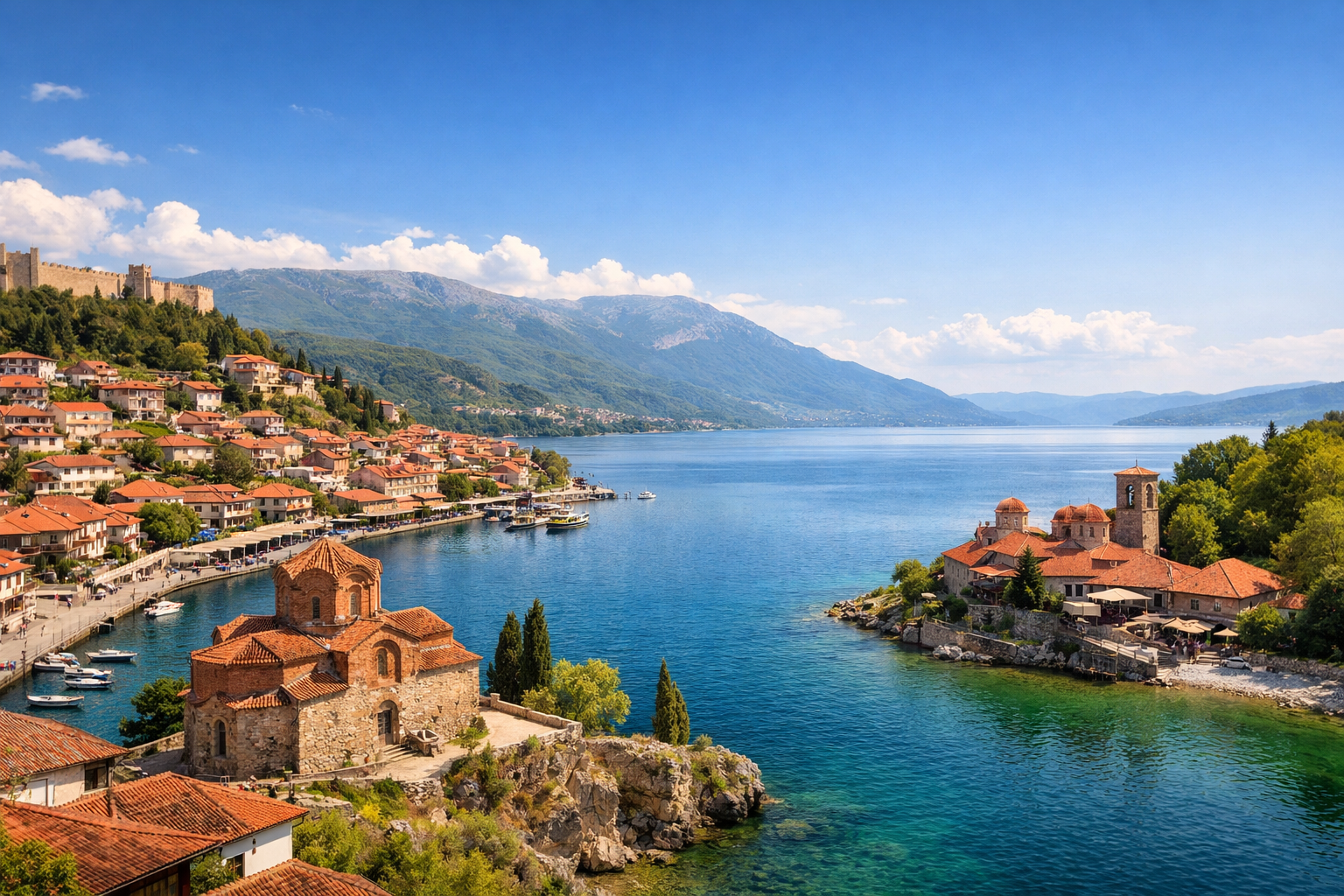
North Macedonia, Ohrid. A budget vacation by Lake Ohrid with visits to ancient churches, the fortress, beaches, and the neighboring Monastery of Saint Naum. Season: May - September.

North Macedonia, Ohrid. A budget vacation by Lake Ohrid with visits to ancient churches, the fortress, beaches, and the neighboring Monastery of Saint Naum. Season: May - September.

Ohrid is one of North Macedonia’s best-value summer escapes, where clear lake water, stone lanes, and centuries-old churches create an easy, sun-soaked rhythm from May to September. Spend your days between the fortress, lively beaches, and the serene Monastery of Saint Naum, with every stop framed by the calm beauty of Lake Ohrid.

🧭 DAY-BY-DAY ROUTE

Ready-made country and city routes with daily plans, sights, transport and accommodation. Buy PDF guides for independent travel.

🧭 DAY-BY-DAY ROUTE


Day 1 — Skopje: center, Stone Bridge, Old Bazaar

  • 🚶 Skopje is convenient to use as the starting point for a budget trip around North Macedonia: this is where most international flights arrive, and from here you can then head calmly toward Ohrid. It’s best to dedicate the first day to a compact introduction to the city without overloading yourself. Start at Macedonia Square and take an unhurried walk to the Stone Bridge — one of the main symbols of the capital, linking the more formal part of the center with the old urban fabric. Beyond the bridge begins the Old Bazaar — an atmospheric Ottoman quarter with artisan shops, mosques, courtyards, cafés, and lanes where Skopje feels not monumental, but lively and human. It’s pleasant here simply to wander without rushing, look at the façades, stop for Turkish coffee, and watch how the modern Balkan city gently layers itself over medieval and Ottoman history.

  • 🏛️ If you still have energy after the walk, you can add the Archaeological Museum of the Republic of North Macedonia or limit yourself to viewing the Vardar embankment and the central buildings from the outside. This format is especially good after a flight: the day feels full, but not tiring. Leave a light dinner for the evening in the bazaar area, where it’s usually easier to find inexpensive food than in the more touristy restaurants near the central square. Spending the night in Skopje lets you continue the route in the morning without fuss toward natural spots and then on to the lake.


Day 2 — Matka Canyon and transfer to Ohrid

  • 🚍 In the morning, head to Matka Canyon — one of the most popular natural attractions near Skopje, located about 17 km southwest of the city. It’s reasonable to allow at least half a day for the trip and walk. Matka is valued for its combination of limestone cliffs, water, boat rides, monastery complexes, and the gentle sense of “quick-access nature” without complicated logistics. It’s pleasant here to walk along the shore, sit by the water, take a short boat ride to the caves if you wish, or simply enjoy a calm pause before the long transfer to the southwest of the country.

  • ⚠️ For independent travelers, the country is generally considered convenient and suitable as long as you follow normal precautions, but if you want to explore any mountain or more remote trails beyond the urban area, it’s better to stick to official routes and check the weather, trail conditions, and seasonal restrictions in advance. Even in the warm season, conditions in the mountains and on higher ground can change quickly.

  • 🚆 After lunch, return to Skopje and travel to Ohrid by intercity bus. It’s reasonable to allow about 3.5–4.5 hours for the journey, depending on the service and stops. This timing is realistic for a budget route: you manage to see one strong natural highlight near the capital and arrive at the lake by evening without overnight travel. In Ohrid, it’s best to stay either near the entrance to the old town or within walking distance of the waterfront — that way you won’t have to spend money on constant taxis.

Day 3 — Ohrid: old town, churches, ancient theater, and Samuel’s Fortress

  • 🚶 Ohrid is one of the most beautiful and most cohesive historic destinations in the Balkans, where nature and architecture work together. The old town rises along the slope above the lake, and the whole day here is built around walking. Start in the lower part of the old town, climb the stone lanes to the House of Robevci, then to the ancient theater, and higher still to Samuel’s Fortress. The fortress is perceived not only as a separate monument, but as a viewing platform over the entire city: from here, it’s especially easy to see how the red-tiled roofs, cypresses, churches, and the smooth expanse of Lake Ohrid come together into an almost Mediterranean panorama.

  • ⛪ After the fortress, be sure to spend time at the Plaoshnik archaeological complex and the Church of Saints Clement and Panteleimon, then descend to one of the most photogenic points in the whole region — the Church of Saint John the Theologian at Kaneo. This is where Ohrid reveals itself in the most cinematic way: a small church on a rocky outcrop, bright water, boats below, and long views over the lake. This day is ideal for those who wanted a budget but very rich cultural route: almost all the main impressions are gathered on foot, without expensive excursions.

  • 🏖️ Toward evening, you can leave time to relax by the city beach areas and the waterfront. In the warm season from May to September, this is an important part of Ohrid’s rhythm: after climbing through the old town, it’s especially pleasant simply to slow down by the water, sit in the shade, stroll along the promenade, or swim if the weather allows. This contrast between ancient churches, fortress walls, and a light resort atmosphere is exactly what makes Ohrid so attractive.

Day 4 — Sveti-Naum, the southern lakeshore, and beaches

  • 🚌 On the fourth day, head to the Monastery of Saint Naum — one of the main shrines and most beautiful scenic points in the entire Ohrid region. It is located on the southern shore of the lake, not far from the border with Albania, and the trip from Ohrid usually takes about 45–60 minutes by car or longer by bus depending on the season and service. People come here not only for the monastery, but also for the special atmosphere: the water seems even clearer here, the shore more spacious, and the landscape combines monastic quiet, old trees, boats, and the springs of the Crn Drim River.

  • ⛪ The monastery complex itself is associated with Saint Naum of Ohrid and is felt as a place of calm rather than bustle. Even in high season, it’s better not to rush: see the church, the inner courtyard, and the walking areas, then set aside time for a short boat ride to the springs if it is available on the day of your visit. Around the monastery, it’s easy to combine the cultural part with time in nature — that is exactly why a day trip here fits so well into a budget route by the lake.

  • 🏖️ After the monastery, you can stay a while at one of the beach areas on the southern shore or return to Ohrid toward evening and spend the rest of the day at the city beaches. This day should not be overloaded with extra sights: its strength lies precisely in giving the trip a resort-style pause — with water, sun, the shade of plane trees, and the feeling of a slow Balkan summer.

Day 5 — Ohrid: a museum touch, the lake, and departure

  • 🏛️ It’s convenient to make the last day softer and more flexible. In the morning, you can visit the House of Robevci or the Museum on Water “Bay of Bones” if you prefer to end the trip not only with walks, but also with a meaningful museum accent. The House of Robevci is great for a final immersion into the urban history of 19th-century Ohrid and the region’s museum collections, while the “Bay of Bones” is for those interested in archaeology, the reconstruction of a prehistoric stilt settlement, and an unusual format of visiting right above the water.

  • 🚶 If your departure is planned for later, leave time for one more unhurried walk along the waterfront, coffee with a view of the lake, and final panoramas of the old town. For a budget trip, this is a successful ending: the route does not turn into a race across the whole country, but concentrates on a truly strong combination — the capital, a nature stop near Skopje, and then a full отдых in Ohrid with history, beaches, and a trip to Sveti-Naum.

  • ✈️ For the return journey, choose whichever airport is more convenient in terms of tickets: some travelers go back through Skopje by bus, while others adapt to seasonal flights from Ohrid Airport. In the high season from May to September, this option is especially convenient, but it’s worth checking flight schedules in advance. If the route goes through Skopje, it is wise to allow extra time for the intercity bus and possible summer delays.

Flight tickets

eSIM for travel

Buy PDF guide

Buy PDF guide — 10.71 USD

PDF — 10.71 USD