
Buy PDF guide

Buy PDF guide — 8.57 USD

PDF — 8.57 USD

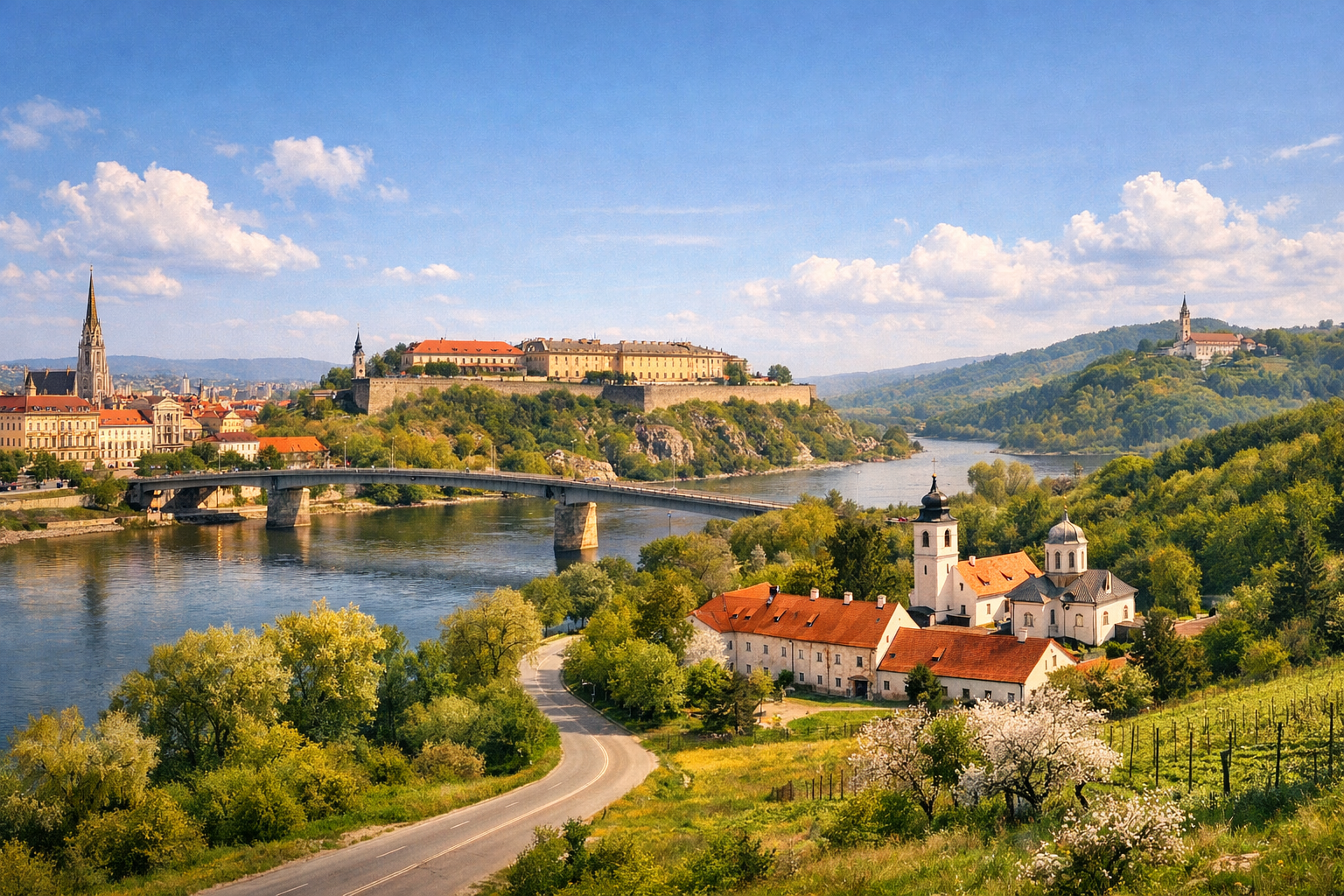
Serbia, Novi Sad and Fruška Gora. An inexpensive tour of cozy Novi Sad, the Petrovaradin Fortress, and the monasteries of the national park with bus trips. Season: April - October.

Serbia, Novi Sad and Fruška Gora. An inexpensive tour of cozy Novi Sad, the Petrovaradin Fortress, and the monasteries of the national park with bus trips. Season: April - October.

Discover Serbia from April to October with an affordable trip through the charm of Novi Sad, the grand Petrovaradin Fortress, and the baroque beauty of Sremski Karlovci. Continue by bus into the peaceful hills of Fruška Gora, where quiet monasteries and green landscapes offer a perfect escape.

🧭 DAY-BY-DAY ITINERARY

Ready-made country and city routes with daily plans, sights, transport and accommodation. Buy PDF guides for independent travel.

🧭 DAY-BY-DAY ITINERARY


Day 1 — Novi Sad: historic center, Danube Park, and the embankment

  • 🚆 If you are arriving at Belgrade Airport, the most sensible budget scenario for this short route is to head straight to Novi Sad by train or intercity bus. The trip Belgrade → Novi Sad by high-speed train usually takes about 36–40 minutes, while the bus takes around 1 h 20 min–1 h 40 min depending on the service and traffic conditions. From the airport to Belgrade’s rail or bus station, you need to allow time for the transfer, so on arrival day it is wise not to overload the schedule and to leave time for check-in and calm adjustment.

  • 🚶 Novi Sad is one of the most pleasant cities in Serbia for independent travel: it does not overwhelm with scale, does not force you to rush, and almost immediately wins you over with its gentle rhythm, broad boulevards, Austro-Hungarian façades, cafés, and the constant feeling of the Danube being close by. The historic center here is compact, so after check-in the best plan is simply to walk: go to Liberty Square, look at the City Hall and the Catholic Church of the Name of Mary, then take a slow stroll along Zmaj Jovina and Dunavska streets. In these quarters, the multilingual and layered history of Vojvodina is especially tangible: Baroque, Neo-Renaissance, cozy passages, old shop windows, and urban life without unnecessary theatricality.

  • 🌳 Danube Park is the perfect spot for a first quiet evening. It is not a grand theme-park attraction, but rather a green urban pause with ponds, paths, shade, and an atmosphere of unhurried provincial elegance. From here it is convenient to continue your walk to the Danube embankment: in Novi Sad the river is not just a backdrop, but a real part of the city’s character. Toward evening it is pleasant to sit on a bench, look at the bridges, and catch that rare style of travel when the program seems simple, yet the city starts to appeal to you almost immediately.

  • 💤 It is best to keep the evening free: have dinner in the center, go to bed early, and do not try to “tick off” everything in one day. This pace is especially good for the season from April to October: it may already be warm during the day, and the long daylight hours allow you to see a lot without rushing.


Day 2 — Petrovaradin Fortress and the museums of Novi Sad

  • 🚌 Petrovaradin Fortress is easy to reach by city bus across the bridge or by a short taxi ride, and on the way back you can walk down if the weather is good. You should allow at least half a day for the fortress itself: it is not only a panoramic viewpoint, but also a huge historic complex that gradually reveals itself through bastions, arches, stairways, inner courtyards, and unexpected views of the Danube.

  • 🚶 Petrovaradin Fortress is often called the “Gibraltar on the Danube,” and this is not just a pretty comparison. It truly gives the impression of a massive, strategically designed, and at the same time very picturesque stronghold rising above the river. Today it is loved for its panoramas and atmosphere, but in the past it was one of the most important defensive points in the region. The upper plateaus are pleasant for an unhurried walk: from here you get the best classic view of Novi Sad, the bridges, and the broad course of the Danube. It is especially beautiful here in the morning or closer to sunset, when the light makes the walls and roofs warmer and softer.

  • 🏛️ On the fortress grounds, it is definitely worth visiting the Museum of the City of Novi Sad. It is a good place not just to “look at walls,” but to understand how the fortress and the city itself developed from a border stronghold into the cultural center of Vojvodina. If you still have time and an interest in art, after returning to the center it makes sense to add the Gallery of Matica Srpska or the Museum of Vojvodina: both museums work perfectly as a pair with a city walk and provide deeper context — from Serbian art of the 18th–20th centuries to the history of a region where Balkan, Central European, and Danubian traditions intertwined.

  • ☕ After a busy first half of the day, it is better to take a long break for coffee and a late lunch, and spend the evening quietly in the center. This day looks very photogenic, but in practice it requires an ordinary human rhythm: climbs, stone stairs, museum halls, and sun on open terraces tire you out more than it seems.

Day 3 — Sremski Karlovci and the monasteries of Fruška Gora

  • 🚌 The main out-of-town day of the route is best built around buses and short transfers without renting a car. First, it is convenient to go from Novi Sad to Sremski Karlovci — the road usually takes about 20–30 minutes, after which you can walk around the historic center of this small but very expressive town. Then the route continues toward Fruška Gora: here it is important not to try to cover too many monasteries in one day, but to choose 2–3 points and leave enough time for travel, rest, and the return trip.

  • 🚶 Sremski Karlovci has a completely different mood from Novi Sad. If Novi Sad is a lively and relaxed city, then Karlovci is almost an open-air museum with the atmosphere of an old spiritual and cultural center of the Serbs in the Habsburg Monarchy. The small central area with cathedrals, the grammar school, patriarchal buildings, and quiet streets is especially good in the morning, when there are still few people around. It is pleasant not to hurry here, to look at the façades, step into courtyards, and simply catch the feeling of old Danubian Europe on a reduced, almost камерный scale.

  • 🌿 Fruška Gora is the green continuation of the whole trip and its most “breathing” day. The national park is known as the “Serbian Holy Mountain” thanks to its chain of Orthodox monasteries scattered among forests, slopes, and vineyards. For a budget-friendly and realistic route, it makes sense to choose, for example, Krušedol and Novo Hopovo, or Krušedol and Grgeteg — depending on the current bus schedule for your specific date. The roads themselves are already part of the experience here: the landscape gradually changes, the city dissolves away, and the trip begins to feel like a small pilgrimage into silence.

  • ⛪ The monasteries of Fruška Gora are valued not only for their religious importance, but also for a rare combination of calm, history, and natural surroundings. Even if you are traveling not as a pilgrim, these places are easily perceived as cultural and landscape gems of the region. White walls, quiet courtyards, old trees, bell towers, and soft light make the visit very peaceful. It is important to dress modestly, behave calmly, avoid making noise, and be prepared for the fact that infrastructure for tourists in small monasteries will be minimal — that is part of their authenticity.

  • 🚍 It is better not to plan your return to Novi Sad too late: suburban services to the national park run less frequently than city transport, so the second half of the day should be built with a time buffer. This is one of those cases where “less, but better” gives a more pleasant result than a race to maximize the number of stops.

Day 4 — a calm finale in Novi Sad and departure

  • 🚶 It is best to keep the last day light and flexible. If your train or bus is later, you can devote the morning to places you did not have time for during the first days: walk through the center once more, stop by the Museum of Vojvodina, stroll to the embankment, buy gastronomic souvenirs, or simply have a slow breakfast in the old town. This kind of finale is especially good for Novi Sad: it is a city that reveals itself not through mandatory “wow sights,” but through a second look, when you already begin to sense its intonation.

  • 🏛️ If you want to add a cultural stop before departure, a good option is the Gallery of Matica Srpska — one of the country’s most important art museums, where it is convenient to end the journey on a composed and beautiful note. If the history of the region is more interesting to you, then it is better to choose the Museum of Vojvodina: it helps you put together everything you saw during these four days — a Danubian city, a fortress, old church centers, and the monastic landscape of Fruška Gora.

  • 🚆 For the return trip to Belgrade, it is worth allowing extra time, especially if you are heading onward to the airport. Formally, the route from Novi Sad to Belgrade is quick, but transfers within the capital, the road to the airport, and possible queues at the entrance take up much more time than it seems when planning. It is practical to leave early and not turn the finale of a short cozy tour into a nervous race.

  • 🛡️ Serbia in general is suitable for independent tourism if you follow ordinary precautions. For this route, standard urban attentiveness is enough, but it is sensible to avoid demonstrations, conflict situations near sporting events, and trips to areas bordering Kosovo without checking the current situation in advance. For Novi Sad, Sremski Karlovci, and Fruška Gora, this format of trip is considered comfortable and realistic.

Flight tickets

eSIM for travel

Buy PDF guide

Buy PDF guide — 8.57 USD

PDF — 8.57 USD