Buy PDF guide

Buy PDF guide — 10.71 USD

PDF — 10.71 USD

San Francisco - streetcars, the Golden Gate Bridge, and IT culture

San Francisco - streetcars, the Golden Gate Bridge, and IT culture

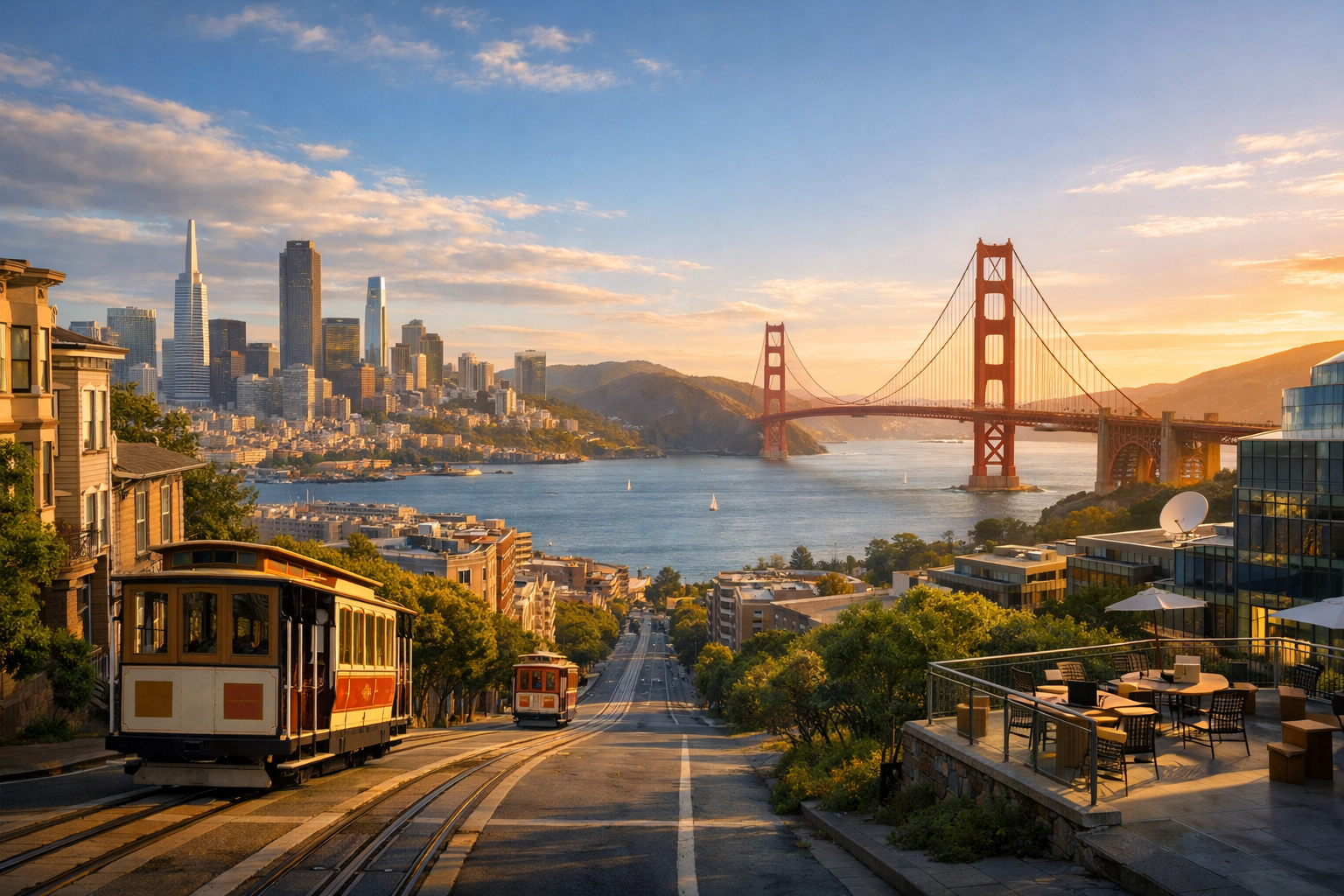
Ride San Francisco’s iconic streetcars from the buzz of Union Square and Nob Hill through Chinatown and North Beach to the waterfront at Fisherman’s Wharf. Between the Golden Gate Bridge, the green calm of Golden Gate Park and the Presidio, and the creative energy of SoMa’s IT culture, the city feels both timeless and forward-looking.

🧭 DAY-BY-DAY ITINERARY

Ready-made country and city routes with daily plans, sights, transport and accommodation. Buy PDF guides for independent travel.

🧭 DAY-BY-DAY ITINERARY


Day 1 — San Francisco: Union Square, Nob Hill, and a first introduction to cable cars

  • 🚶 It’s best to dedicate the first day to “vertical” San Francisco — a city of hills, cable car lines, and sudden shifts in perspective. Start in the Union Square area and head uphill toward Nob Hill: the climbs here immediately explain the city’s character better than any museum. Along the way, it’s easy to catch the atmosphere of the old business center, look at hotel facades, and see historic intersections where cable cars are not just decoration but part of the city’s identity. For your first ride, choose the Powell-Hyde or Powell-Mason line and allow time for waiting at the turnaround near Powell & Market: in the morning the line is usually lighter than in the afternoon. The ride itself takes relatively little time, but emotionally it works like a full excursion — the creak of cables, steep climbs, open platforms, wind from the bay, and sudden panoramas between the buildings. After the ride, it makes sense to walk to the Cable Car Museum in Nob Hill: this is not a “museum just to tick a box,” but a place where the engineering magic of San Francisco becomes clear. Allow about 1–1.5 hours for a relaxed lunch and a break, and plan the whole day without rushing: in this city, a short stretch on the map can easily turn into a long walk because of the terrain.


Day 2 — San Francisco: Chinatown, North Beach, Coit Tower, and the city’s Italian rhythm

  • 🚶 The second day is about San Francisco’s cultural layering. Start in Chinatown: it is one of the city’s most expressive neighborhoods, where the tourist layer quickly gives way to real everyday urban life — markets, pharmacy windows, tea shops, signs, and dense street activity. From here, it’s easy to walk to North Beach: the transition is short on the map, but it’s worth allowing about 20–30 minutes with stops and photos, because the area practically asks you to move more slowly. North Beach is already a different San Francisco: Italian cafés, bookstores, old restaurants, narrow streets, and the feeling that the city has suddenly begun speaking more softly and warmly. If you still have energy, go up to Coit Tower or at least Telegraph Hill: the climb will require time and a bit of extra energy, but from above the city opens up like a theatrical set — with downtown towers, water, islands, and bridge lines in the distance. It’s better to allow at least 1.5 hours for rest, coffee, and a late lunch, because this is a day you’ll want not to “rush through,” but to truly live. In the evening, you can return to Embarcadero or go back to North Beach for dinner — the area is especially good in the soft evening light, when the tourist bustle noticeably fades.

Day 3 — San Francisco: Fisherman’s Wharf, Aquatic Park, and the Golden Gate Bridge

  • 🚶 This is the day of the city’s main visual icon. In the morning, head to Fisherman’s Wharf and Aquatic Park to first feel maritime San Francisco: salty air, old piers, seagulls, historic ships, and that special light that comes off the bay. From here, it is convenient to get to the southern side of the Golden Gate Bridge by bus or taxi/rideshare; from the Wharf area, it is usually reasonable to allow about 20–35 minutes depending on traffic and your chosen starting point. At the bridge itself, it’s better not to rush: this is not just a photo stop, but a place where it’s important to experience the scale — the towers, the taut lines of the cables, the strong wind, the fog that can change the whole picture in minutes, and that rare case when infrastructure feels like a work of art. Around the Welcome Center and the viewpoints, calmly plan for 1.5–2 hours, and if you want to walk at least part of the bridge route on foot, add more time and a warm layer of clothing, even if it felt warm in the city center. After the bridge, a short rest in Presidio or a return to the water near Ghirardelli Square works well. You can end the evening on Hyde Street, where the cable car theme appears again: the day closes beautifully when the engineering romance of cable cars meets the engineering power of the Golden Gate Bridge.

Day 4 — San Francisco: Golden Gate Park, de Young, the Japanese garden, and Presidio

  • 🚶 The fourth day is for changing pace: after hills and waterfronts, it’s time for greenery, museum spaces, and a calmer urban scale. Golden Gate Park is huge, so don’t try to take it all in. It is more practical to choose the east-central part of the park: de Young Museum, Japanese Tea Garden, a walk along the paths, and a rest break at Music Concourse. Distances between points inside the park are greater than they seem, so even with a short list of locations, allow 15–25 minutes for walking between them and extra time for breaks. The Japanese tea garden gives the trip a completely different tone: after steep slopes and urban noise, here you get intimacy, water, bridges, plant compositions, and a feeling of slowing down. After lunch, you can move on to Presidio — this usually takes about 20–30 minutes by car, or longer by public transport with a transfer. Presidio is great because it combines nature, military history, and almost cinematic views of the bay. If you want to add a “culture and imagination” theme, include the Walt Disney Family Museum: it is not only about animation, but also about the American creative industry, storytelling, and the birth of a major cultural myth. End the day without rushing: the park and Presidio work better as breathing space than as a checklist.

Day 5 — San Francisco: SoMa, SFMOMA, Embarcadero, and the bay’s IT culture

  • 🚶 The final day brings together modern San Francisco — the one where art, the tech environment, and the business rhythm of the Bay Area live side by side. Start in SoMa: this former industrial district has long become a space of museums, offices, startup energy, and urban architecture on a new scale. SFMOMA is an excellent anchor point for this day: the museum provides cultural context, while the surrounding neighborhood shows how San Francisco knows how to combine creativity and technology. After the museum, walk toward Salesforce Park or farther to Embarcadero if you want more air and water. Here it makes sense to talk about the local IT culture not as a set of “big company offices,” but as an urban atmosphere: coworking spaces, coffee spots full of laptops, the habit of working on the go, conversations about products, design, and startups, and the city’s close connection with Silicon Valley and the entire innovation ecosystem of the bay. For getting between SoMa and Embarcadero, 15–25 minutes is usually enough, and for a leisurely final lunch and getting organized, leave at least 1–1.5 hours. The last evening is best spent by the water: at Embarcadero, San Francisco becomes more open, windier, and brighter, and this is a beautiful ending to the route, where its main themes come together — transport legend, bridge, cultural layers, and technological present.

Flight tickets

eSIM for travel

Buy PDF guide

Buy PDF guide — 10.71 USD

PDF — 10.71 USD