
Buy PDF guide

Buy PDF guide — 6.43 USD

PDF — 6.43 USD

Thessaloniki - Youth city tour: waterfront, Ladadika, bars, Byzantine monuments

Thessaloniki - Youth city tour: waterfront, Ladadika, bars, Byzantine monuments

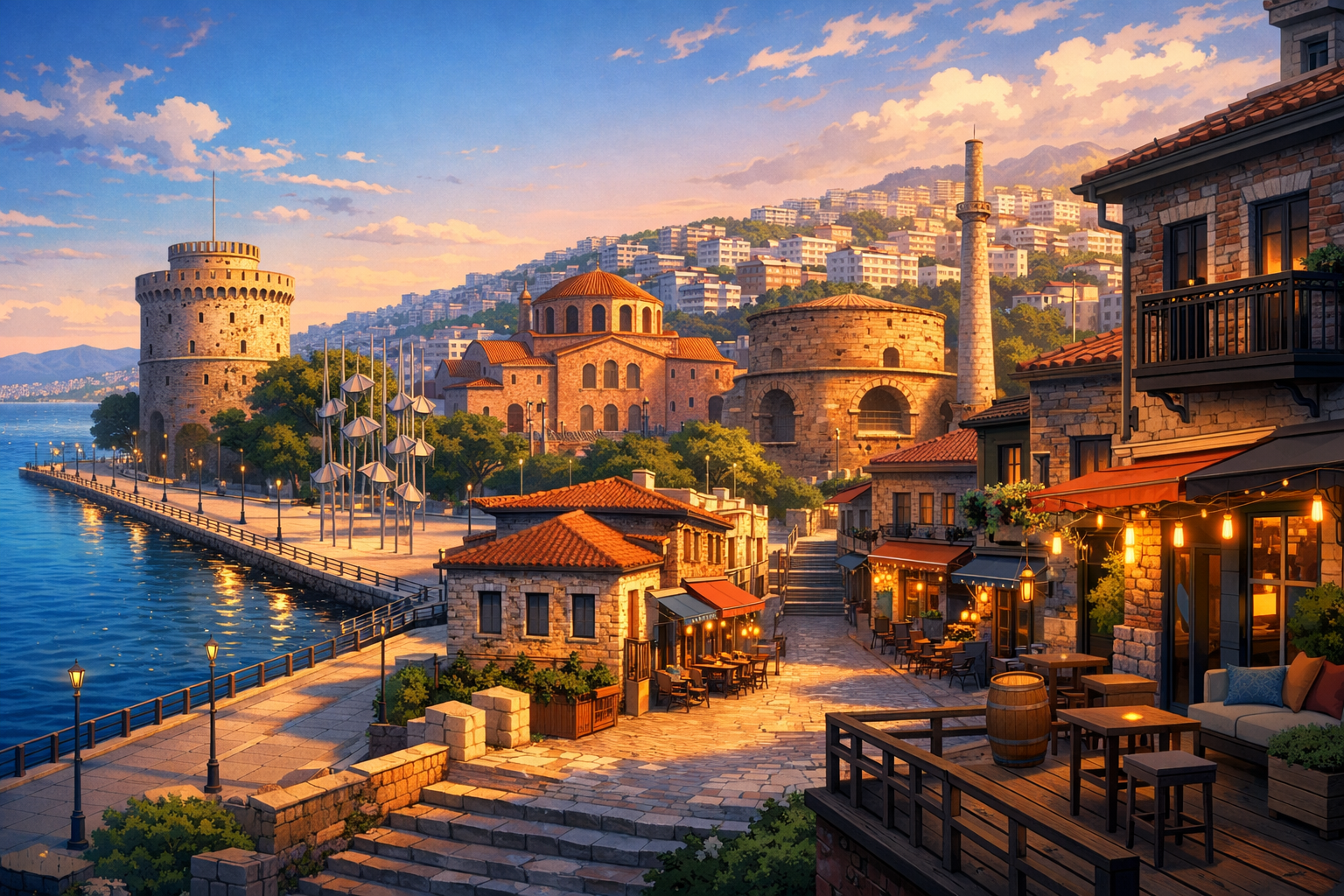
Thessaloniki blends sea views, late-night energy and layers of history into an easy city break. Stroll the waterfront, wander the lively lanes of Ladadika, linger in its bars, and discover Byzantine monuments woven through the city.

🧭 DAY-BY-DAY ROUTE

Ready-made country and city routes with daily plans, sights, transport and accommodation. Buy PDF guides for independent travel.

🧭 DAY-BY-DAY ROUTE


Day 1 — Thessaloniki Waterfront, the White Tower, and an evening in Ladadika

  • 🚶 Start getting to know the city from the New Waterfront and the classic promenade along the Thermaic Gulf. Thessaloniki’s shoreline stretches for about 5 km — from the Concert Hall to the port — and this is exactly where you feel the city’s youthful, open, and slightly Mediterranean-lazy energy best. In the morning or closer to sunset, the waterfront is especially beautiful: cyclists, runners, couples with takeaway coffee, students on benches, street musicians, and the soft salty air create that very urban escape atmosphere without haste. It’s worth walking slowly, with stops for photos, coffee, and a short rest by the water — allow 1.5–2.5 hours for a comfortable walk from the Megalou Alexandrou area to the White Tower.

  • 🏛️ The White Tower is the main symbol of Thessaloniki and an ideal first point for mentally “assembling” the city. It stands right by the sea and is historically linked to the old walls’ defensive system, while today it is perceived as a concise urban beacon of memory. Inside there is an exhibition dedicated to the city’s history, and at the top there is a panoramic view of the gulf, avenues, rooftops, and the waterfront line. This place is especially impressive on the first day: from above, you can clearly see how antiquity, Byzantium, Ottoman heritage, and the modern youth scene literally layer on top of one another. Allow about 45–60 minutes for visiting the tower and going up.

  • 🏛️ After the White Tower, it makes sense to walk 10–15 minutes to the Museum of Byzantine Culture, one of the city’s best museums for diving into Thessaloniki’s Byzantine heritage. The exhibition lets you do more than just “look at artifacts” — it helps you understand why this city was considered one of the most important centers of the Eastern Christian world for centuries. Themes of early Christianity, urban life, the cult of saints, mosaics, burial traditions, and the art of everyday life are especially well presented here. This is a particularly good stop for a youth-focused route: the museum presents the material in a modern way and then helps you see churches, the Rotunda, and the old walls very differently. Allow 1.5 hours for a visit without overload.

  • ☕ After the museum segment, take a break for rest and a late lunch around Nikis Avenue or closer to Aristotelous Square. From the museum to the central part of the waterfront it’s about a 20–30 minute walk at a relaxed pace or 10–15 minutes by bus/taxi. In the middle of the day, it’s best to deliberately leave 1–1.5 hours without a rigid plan: in Thessaloniki, the city’s rhythm reveals itself exactly when you’re not rushing between points, but allow yourself to sit by the sea and watch the light, boats, and people.

  • 🌆 In the evening, head to Ladadika — a historic quarter by the port that was once a trading district with warehouses and shops, and today has become one of the liveliest evening areas in the city. From Aristotelous Square, it’s about a 12–18 minute walk here; from the White Tower, around 25–30 minutes. During the day, Ladadika looks almost theatrical: cobbled streets, facades with balconies, warm ochre colors, old warehouses, and alleys. But the quarter truly comes alive in the evening, when bars open, music spills into the streets, warm lights come on, and tourists mix with local youth. This is exactly the place to catch your first night vibe of Thessaloniki.

  • 🍸 For a youth-style evening, it’s best not to overload the plan: start with one bar or wine spot, then move on to a livelier place with cocktails or music. Ladadika works not only for a “late dinner” but also for walkable bar-hopping: the streets are compact, and moving between places takes 3–7 minutes, so the area is ideal for a lively spontaneous evening. If you want to continue, after midnight you can move to nearby central districts, but most often Ladadika is more than enough for the first evening. Return to the hotel on foot or by taxi, depending on where you are staying.


Day 2 — Byzantine monuments: Rotunda, Kamara, Agios Dimitrios, and the Upper Town

  • 🚶 Dedicate the second day to Thessaloniki’s historic core — that very layer of the city where the ancient, early Christian, and Byzantine past can be felt literally within a short walk. Start in the Navarinou and Rotunda area. From central hotels near Aristotelous Square or the waterfront, it’s about a 20–25 minute walk here; from the station area, 25–35 minutes by bus with a short walking section or 10–15 minutes by taxi. It’s best to set out in the morning, while there are fewer people and the light is softer for photos.

  • 🏛️ The Rotunda is one of Thessaloniki’s most impressive monuments and one of the most important Roman-period monuments in Europe overall. It is a massive circular structure from the early 4th century that over its long life has served as a Roman monument, a Christian church, and a mosque. Inside, the sense of scale is especially striking: thick walls, a high dome, traces of ancient mosaics, and the almost physically tangible presence of centuries. The Rotunda is great because it does not look “museum-dead” — it is a living monument where history can be read in layers. Allow about 40–50 minutes for the visit together with the square and photos.

  • 🏛️ A few minutes’ walk away is the Arch of Galerius, known as Kamara, one of the city’s most recognizable meeting points. Here you can especially clearly feel how antiquity in Thessaloniki is stitched into everyday life: nearby are university students, cafés, street traffic, and right in the middle of it all stands a monument from the Roman era. This is not a place for a long visit, but rather an important city symbol and an excellent connecting point in the route. Allow 20–30 minutes for a short stop, photos, and a coffee break.

  • ⛪ Then continue to the Church of Saint Demetrius — the city’s main church and one of Thessaloniki’s key early Christian monuments. It’s about a 15–20 minute walk here from the Rotunda. The basilica is dedicated to the city’s heavenly patron, and its history is connected with the site of the saint’s martyrdom. Inside, the space feels very much like Thessaloniki: not like a ceremonial museum object, but like a living religious center where Byzantine memory is not preserved under glass, but continues to exist. The crypt and the overall sense of deep time make a special impression. Even if you are far from church themes, this place is read first and foremost as the city’s cultural and historical code. Allow 45–60 minutes for the church and a short pause.

  • 🍽️ After the насыщенного historical segment, take a lunch break in the center and then head up to Ano Poli — the Upper Town. This is the best change of pace after the monuments in the center. You can reach the lower part of Ano Poli by bus or taxi in about 10–20 minutes, and then continue on foot. Here Thessaloniki opens up in a completely different way: narrow streets, staircases, old houses, courtyards, cats, silence, and panoramic views of the gulf. If the city center feels noisy and youthfully energetic, then the Upper Town is its contemplative, almost cinematic side.

  • 🏰 The main goal of the second half of the day is the area of the fortress walls and Heptapyrgion. Heptapyrgion itself, also known as Yedi Kule, is located on the northeastern edge of the acropolis and is considered one of the Balkans’ most expressive fortification complexes. Even if you are not building the day around a long museum visit, it is worth coming up here for the atmosphere and the views. From above, the city breaks into layers: sea, modern districts, church domes, towers, port, and horizon. It’s good to leave 2–3 hours for an unhurried walk around the Upper Town and viewpoints, including a coffee stop.

  • 🌇 The evening of the second day can be calmer than the first: dinner in Ano Poli with a view of the city lights, or returning down to the center for a wine bar/cocktail spot. If you want to continue the youth-oriented line of the route, choose bars around the center and on the approaches to Ladadika, but without finishing too late — the third day will be active again. Returning from the Upper Town by taxi is usually more convenient and faster, especially after sunset.

Day 3 — Aristotelous Square, archaeology by the sea, a final walk, and bars

  • 🚶 Dedicate the third day to a lighter city rhythm so as not to overload the route and to leave time for enjoying the city itself. Start at Aristotelous Square — Thessaloniki’s most recognizable urban stage. It is not just a postcard view, but a place where the sea, broad perspective, cafés, strolling life, and everyday urban theater meet. It is a good place for a slow breakfast, watching the city, and planning the final day without fuss. From most central hotels, the square is a 5–15 minute walk away.

  • 🏛️ Then head to the Archaeological Museum of Thessaloniki, located not far from the waterfront and perfectly paired with the Byzantine layer you saw the day before. If the Museum of Byzantine Culture helps you understand the Christian and medieval layer of the city, then the archaeological museum adds ancient Macedonia, urban archaeology, and a broader historical context. Thanks to this combination, Thessaloniki stops being just a beautiful port city and starts to read as a multilayered regional capital. Allow 1–1.5 hours for the museum, especially if you want to go through the exhibition without rushing.

  • 🌊 After the museum, return to the sea: the stretch between the White Tower, Nikis Avenue, and Aristotelous Square is ideal for a final walk, buying a few souvenirs, a coffee break, and last photos. The walk from the museum to the water takes about 10–15 minutes. It’s convenient to leave a free window of 2–3 hours here: you can simply stroll, get ice cream, stop by a café, take a tourist boat ride around the gulf if you’re in the mood, or have a long late lunch.

  • ⛪ If you want to add one more strong Byzantine accent, on the final day you can include a short ride or walk to one of the additional monuments in the center — for example, Acheiropoietos or the Roman Forum area. But it’s important not to turn the third day into “finishing off the list.” Thessaloniki is remembered best not by the number of checkmarks, but by the feeling of the city: the combination of salty wind, broad light, church domes, student energy, and the evening noise of bars.

  • 🍹 Give the final evening back to the youthful urban atmosphere. The most convenient option is to return to Ladadika or choose the bar scene in the central districts closer to the waterfront. By the third evening, it’s already easy to navigate the city, so you can create the perfect finale: an aperitif by the sea, then dinner in the center, followed by 2–3 bars within walking distance. Thessaloniki itself seems made for this scenario: you don’t need to travel long between points, the evening is built step by step, and the city gradually reveals itself through streets, light, music, and conversations.

  • 🚕 If your flight is early, it’s worth confirming an airport transfer in advance in the evening or ordering a taxi through an app. From the center to the airport, the trip usually takes about 30–45 minutes by car depending on traffic; by bus, allow more time. It’s better to finish the program not too late so you still have energy for departure and can pack calmly.

Flight tickets

eSIM for travel

Buy PDF guide

Buy PDF guide — 6.43 USD

PDF — 6.43 USD