
Buy PDF guide

Buy PDF guide — 8.57 USD

PDF — 8.57 USD

SAXONY - Ore Mountains: crafts, mines

SAXONY - Ore Mountains: crafts, mines

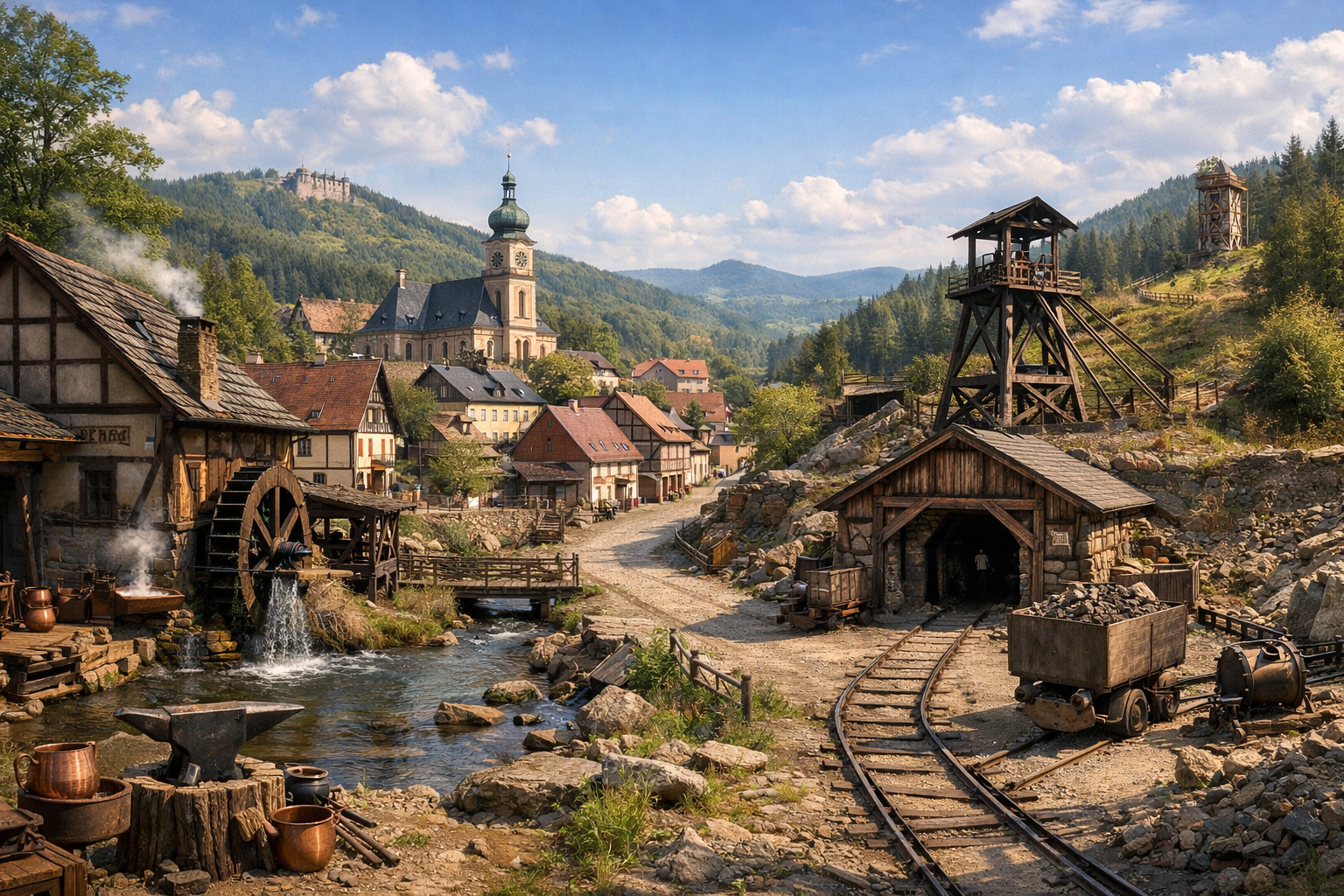
Discover the Ore Mountains of Saxony, where Dresden’s elegance gives way to Freiberg’s silver-mining heritage and the handcrafted charm of Annaberg-Buchholz. End in Oberwiesenthal, where forested slopes and mountain air frame a region shaped by mines, workshops, and enduring tradition.

🧭 DAY-BY-DAY ITINERARY

Ready-made country and city routes with daily plans, sights, transport and accommodation. Buy PDF guides for independent travel.

🧭 DAY-BY-DAY ITINERARY


Day 1 — Dresden → Freiberg: the silver heart of Saxony

  • 🚆 Arrival in Dresden and transfer to Freiberg — the most logical start for a short Ore Mountains route. From Dresden Airport, it’s convenient to take the S-Bahn to Dresden Hauptbahnhof / Dresden-Neustadt, then change to a regional train toward Freiberg (Sachs). In real conditions, including the transfer, waiting time, and getting out of the airport, it’s worth allowing about 1 hr 35 min to 1 hr 50 min. It’s a comfortable journey without an exhausting transfer, so on the first day you can immediately include a walk and a museum visit without overloading yourself.

  • 🚶 Freiberg is one of those towns where mining history feels not like museum scenery, but like the living fabric of the place. Here, silver shaped Saxony’s wealth, street architecture, scientific tradition, and a special miners’ pride for centuries. The old town, with its squares, stone facades, town hall, and church silhouettes, looks composed, noble, and very German, yet not cold: you can feel the prosperity accumulated over centuries, literally grown from the ground. After checking into the hotel, it’s best to stroll through the center at an unhurried pace, pause for coffee, and give yourself time to settle into the rhythm of the region.

  • 🏛️ The day’s main highlight is terra mineralia in Schloss Freudenstein. This is not just a beautiful mineral exhibition, but a spectacular introduction to the whole journey: after visiting it, you look differently at the mines, the crafts, and the Ore Mountains landscape. Thousands of minerals, gemstones, and meteorites are displayed in the castle’s historic interiors, all presented in a highly visual way — with carefully designed lighting, deep color, and an almost theatrical sense of display. It’s easy to spend 1.5–2 hours here without rushing: first simply admiring the sparkle, shape, and texture, and then gradually realizing how closely nature, extraction, science, and beauty are intertwined in this region.

  • 🌆 The evening is best reserved for a gentle walk through Freiberg’s historic center. It’s the right rhythm for the first day: no long transfers, just a beautiful introduction to silver and mining heritage. If you still have energy, you can head to viewpoints and old streets around Schlossplatz, then return calmly to the hotel a bit early — the next day the route will go deeper into the region’s underground history.


Day 2 — Freiberg → Annaberg-Buchholz: mine, old town, and the memory of craft

  • 🚆 In the morning — transfer from Freiberg to Annaberg-Buchholz. In practice, if you travel by public transport via Chemnitz with a change and a small buffer for connections, it is sensible to allow about 2 hours. Along the way, the landscape becomes increasingly hilly and distinctly Ore Mountains-like: less university-town severity, more forests, valleys, and the feeling that civilization here was sustained for centuries by the work of craftsmen and miners.

  • ⛏️ After checking in, it makes sense to start with Markus-Röhling-Stolln — one of the most expressive mining sites around Annaberg. It is here that you especially understand that the region’s ore history is not some abstract “they mined metals,” but a world of hard physical labor, damp stone, engineering ingenuity, and constant risk. Descending into the mine space has an almost physical effect: the air becomes cooler, the sounds more muffled, and the story of ore veins, tools, and miners’ daily life stops being just information. For the visit, including the trip from the center, waiting time, and the tour itself, it is convenient to set aside 2–3 hours.

  • 🏘️ Back in town, devote the second half of the day to Annaberg-Buchholz. This is one of the main historic centers of Saxony’s Ore Mountain belt, where the wealth of the late medieval mining era is especially visible in the urban fabric. Narrow streets, Renaissance and Baroque facades, stairways, squares, and dominant church buildings create the impression of a town that grew not around a court or a river, but around ore, trade, and craftsmanship. It is pleasant here not just to “tick off sights,” but to walk, peek into courtyards, stop by the windows of craft shops, and feel how mining history gradually turns into cultural history.

  • 🪵 If the day allows, finish it at Frohnauer Hammer — a historic forge-and-hammer complex linked to metalworking and water power. It is a wonderful contrasting stop after the mine: in the morning you see how wealth was extracted from the earth, and in the evening — how it was turned into a material result. What impresses here most is not grandeur, but engineering concreteness: water, mechanics, wood, metal, and the repetitive rhythm of work. The day’s route becomes very coherent and full, but not overwhelming, if you keep a calm pace and plan for a long lunch or an early dinner.

Day 3 — Annaberg-Buchholz: museums, Christmas imagination, and Ore Mountains crafts

  • 🚶 It’s best to make the third day almost entirely pedestrian and museum-focused, so that after the mines and transfers you can let your body rest and your mind gather everything you’ve seen into one cultural picture. Start with Erzgebirgsmuseum mit Silberbergwerk „Im Gößner“. This is a very successful stop because the museum ties together urban life, mining history, and local identity into one narrative. Here it becomes clear that the Ore Mountains are not only about extraction, but about an entire way of life, with its own symbols, costumes, everyday objects, religiosity, and ideas of dignified work.

  • ✨ Then move on to Manufaktur der Träume — a museum that creates an entirely different, almost fairy-tale impression. If the mines show the harsh side of the region, this place reveals its poetic soul: wood carving, toys, Christmas figures, decorative scenes, fine handwork, and the distinctive visual culture of the Ore Mountains. For many people, this museum becomes the emotional center of the route, because it explains how an amazingly warm and bright artistic tradition grew out of a hard mining life. This is the world of smokers, nutcrackers, angels, candle arches, and cozy winter home comfort, which is now associated with the Erzgebirge far beyond Germany.

  • 🕯️ In the second half of the day, leave time for a calm walk through the center and for craft shops. In Annaberg-Buchholz, it’s worth buying not “random souvenirs,” but things with the character of the region: wooden figures, Christmas decor, locally made workshop pieces, and books about mining heritage. It’s better not to pack the day with new distant excursions: after two full days, this is exactly where it helps to build in some rest, a long coffee break, and at least an hour or an hour and a half of free time. This kind of balance turns a 4-day route from a rushed sprint between sites into real immersion.

  • 🌙 In the evening, you can walk through the town once more at dusk. Ore Mountain towns are especially beautiful at this hour: lights in the windows, strict lines of houses, quiet streets, and the feeling of deep, old Europe. Even outside the Christmas season, it is easy to imagine that very winter Erzgebirge, which became famous around the world for its workshops, candlelight, and home festive aesthetics.

Day 4 — Annaberg-Buchholz → Oberwiesenthal → Dresden: summits, narrow-gauge railway, and a gentle finale

  • 🚆 In the morning — transfer to Kurort Oberwiesenthal, the highest town in Germany and a beautiful final accent to the route. If you travel via Cranzahl and then connect the program with the historic Fichtelbergbahn or local transport, it is sensible to allow about 1 hr 20 min to 1 hr 40 min from Annaberg-Buchholz depending on the connection. This day is less about mine workings and more about landscape, air, and the sense of the mountain region as a place of life, not only of labor.

  • 🚂 Fichtelbergbahn is one of the most atmospheric railway lines in the region. Even if you don’t take a long retro ride for the whole day, the very idea of the narrow-gauge railway as part of the route wonderfully completes the Ore Mountains theme: here technology is not opposed to the landscape, but fits into it with rare humanity. Steam, carriages, station buildings, and the smooth movement among the slopes create an almost nostalgic feeling of traveling in the Europe of the past, when the journey itself was still an event.

  • 🏔️ In Oberwiesenthal, it is worth devoting a few hours to a walk through the spa part of town and, if the weather allows, an ascent or a short outing to the views of Fichtelberg. After museum interiors and underground adits, this is an almost cleansing finale: space, wind, panoramas, and silence. Even in summer, you can feel the harshness of the climate and the closeness of the border here, while in winter the place takes on an almost postcard beauty — bright snow, dark forest, and the clean lines of a mountain resort.

  • 🚆 It is better to plan the return to Dresden without rushing, leaving a buffer for transfers and a little rest before your flight or an overnight stay in the city. In real conditions, the journey from Oberwiesenthal to Dresden by regional transport usually takes about 3–3.5 hours. So it is best to finish the active part of the day not too late. This route is especially good because of its compactness: in 4 days you manage to see the silver capital Freiberg, the mining and craft town of Annaberg-Buchholz, and mountain Oberwiesenthal — without unrealistic dashes and with a clear logic from the depths of the earth to craftsmanship, and then to the mountain horizon.

Flight tickets

eSIM for travel

Buy PDF guide

Buy PDF guide — 8.57 USD

PDF — 8.57 USD