
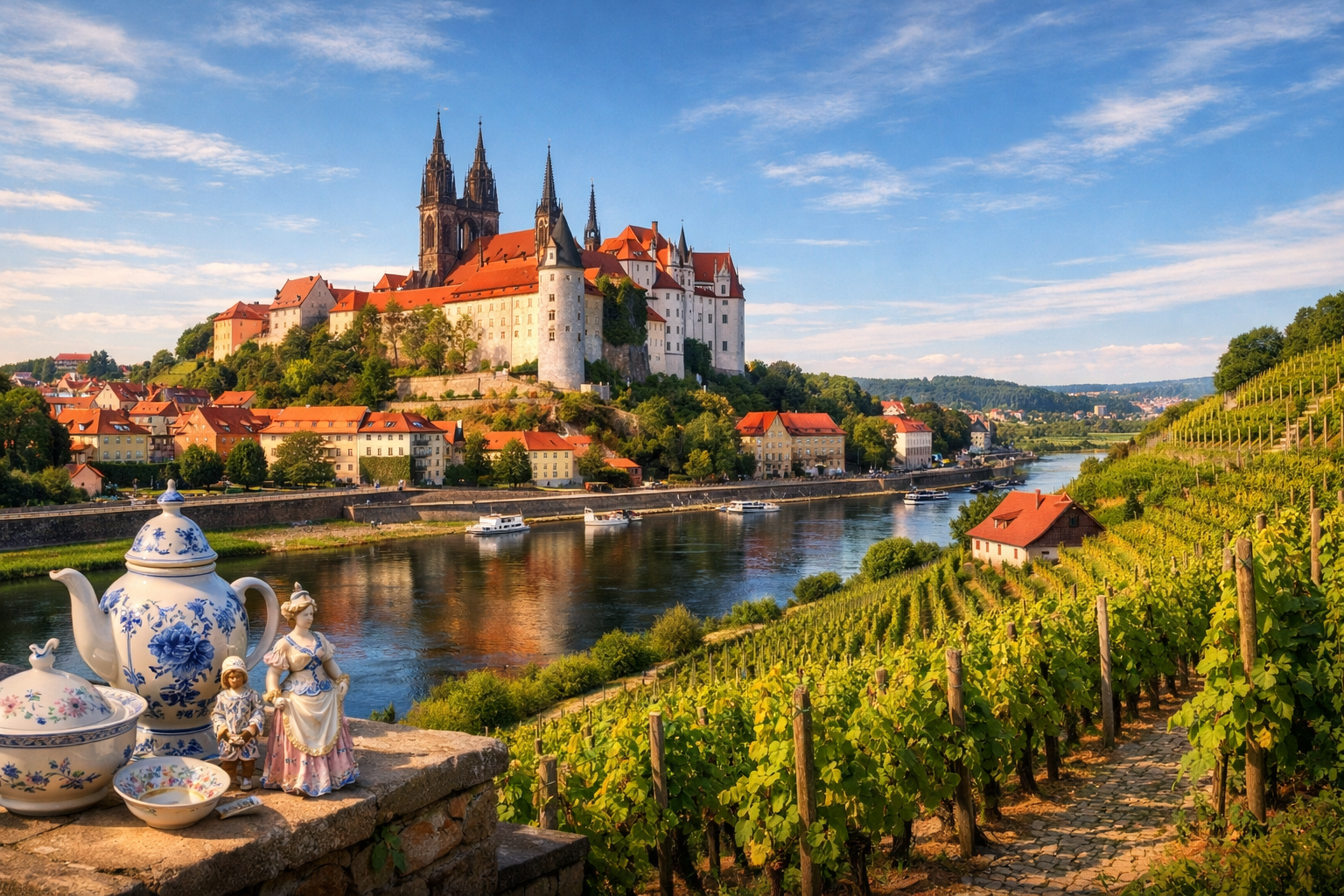
Day 1 — Meissen: Old Town, Albrechtsburg and the Cathedral
🚆 It is most convenient to plan your base arrival via Dresden: from Dresden Hauptbahnhof to Meißen, regional S-Bahn/Regionalbahn trains take about 35–45 minutes, and from the station in Meissen to the historic center and Castle Hill, it is worth allowing another 10–20 minutes for an easy walk or a city bus. If arriving via Dresden Airport, allow around 1–1.5 hours to reach Meissen with a transfer to the city S-Bahn and then a train, or less by private transfer/taxi.
🚶 Begin your introduction to Meissen with its old center and Market Square: this is one of those Saxon towns where the medieval logic of the streets has survived not as decoration, but as the living fabric of the city. Narrow cobbled lanes, burgher house facades, inner courtyards, small shops, and wine venues create a rare feeling of “quiet Germany,” where the rhythm does not rush you, but invites you to look more closely. It is here that Meissen’s scale is felt especially well: it is not huge, but very concentrated, and almost every turn opens a new perspective of towers, terraces, and red roofs descending toward the Elbe.
🚶 Then head up Castle Hill to Albrechtsburg — one of the most important architectural symbols of Saxony. This castle is often called the cradle of Saxony and Germany’s first residential palace castle: the late Gothic halls, staircases, vaults, and carefully staged light inside create not “museum chill,” but the impression of a grand theater of power, ambition, and early Renaissance taste. What is especially valuable is that Albrechtsburg is tied not only to dynastic history, but also to the history of European porcelain: it was here at the beginning of the 18th century that Europe’s first porcelain manufactory was housed, and from here the triumph of Meissen’s “white gold” began. It is worth allowing about 1.5–2 hours to explore the castle without rushing, with pauses by the panoramic windows and viewpoints above the Elbe valley.
🚶 Next to the castle stands Meissen Cathedral — the majestic Dom zu Meißen, which together with Albrechtsburg forms one of the most recognizable silhouettes in all of Saxony. Inside, the cathedral impresses not only by its scale, but also by its special atmosphere of light and verticality: the Gothic space seems to draw the eye upward, while the sculptures, choir area, and museum rooms add layers to the experience. If you catch a daytime organ interval or a guided tour, the experience becomes even deeper: it is no longer simply seeing a monument, but sensing how the religious, artistic, and political history of the region converged here over centuries. It makes sense to allow 60–90 minutes for the cathedral and museum.
☕ After the intense Castle Hill segment, be sure to take a break for a late lunch or coffee down in the old town. This is not “lost time,” but an important part of the route: climbs, stairs, and museum spaces are more tiring than they seem, and Meissen is best perceived at the pace of slow travel. In the second half of the day, you can add an unhurried walk to the Frauenkirche on the market square — the city church known for its porcelain carillon — and then simply wander the streets without a rigid goal.
🌆 The evening is best devoted to a walk along the Elbe and viewpoints of the illuminated Castle Hill. At dusk, Meissen is especially beautiful: the strict forms of the cathedral and castle become more graphic, the river reflects the lights, and the vineyard terraces on the slopes remind you that you are not just in a historic town, but in one of Germany’s oldest wine-growing regions. If you want a soft, intimate end to the day, choose a glass of Saxon white wine and an early rest — porcelain and vineyards still await.