
Buy PDF guide

Buy PDF guide — 6.43 USD

PDF — 6.43 USD

SAXONY - Leipzig: music, bars, art, and history

SAXONY - Leipzig: music, bars, art, and history

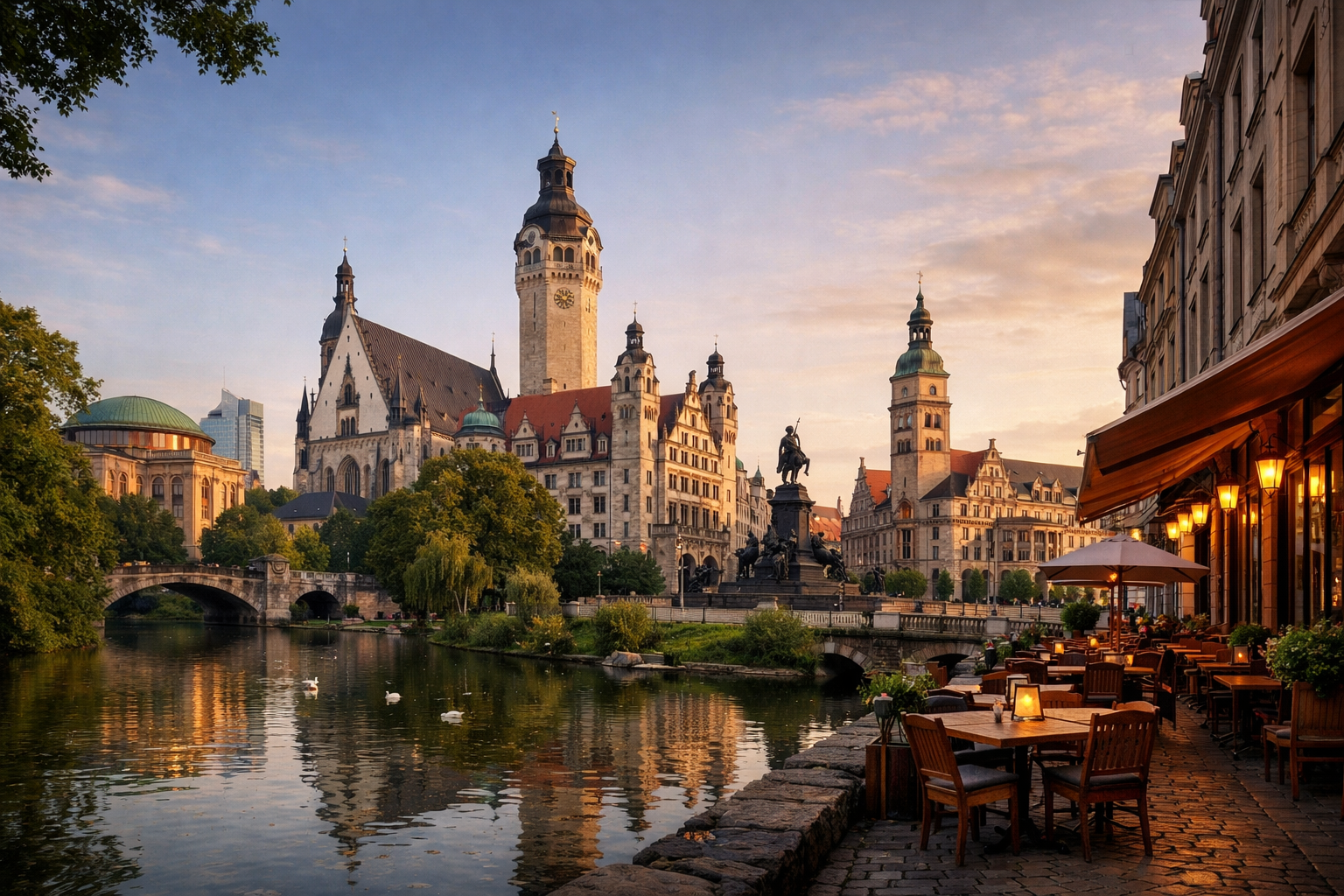
Leipzig blends grand musical heritage with a young, creative energy that spills from its galleries into its lively bars and cafés. Wander through a city where Bach’s legacy, bold street art, and layers of history meet on every corner.

🧭 DAY-BY-DAY ROUTE

Ready-made country and city routes with daily plans, sights, transport and accommodation. Buy PDF guides for independent travel.

🧭 DAY-BY-DAY ROUTE


Day 1 — Leipzig: old center, Bach, and an evening above the rooftops

  • 🚆 If you arrive at Leipzig/Halle Airport, allow about 15–20 minutes to get to Leipzig Hauptbahnhof on the S-Bahn, and then another 10–15 minutes for a walk or a short tram/taxi ride to your hotel in the center. This is one of those rare European cities where the transfer does not "eat up" half the day: within an hour of leaving the terminal, you can already be having your first coffee in the old town without feeling travel fatigue. After check-in, it is best to leave at least 45–60 minutes for rest, a shower, and a calm start — Leipzig opens up not in haste, but in the rhythm of an attentive walk.

  • 🚶 Begin your introduction with the historical heart of the city: Markt, the Old Town Hall, the narrow passages and alleys around Thomaskirchhof and Nikolaikirche. The center of Leipzig is remarkable because it does not try to be "picture-postcard pretty" in just one style: here, Renaissance facades stand next to shopping arcades, strict merchant houses, the musical memory of the 18th century, and a very lively contemporary rhythm. Walking through the center has a special pleasure — the city does not overwhelm with scale like a metropolis, but it does not feel sleepy either. It feels composed, educated, and slightly theatrical: you sense this in the squares, in the silhouette of the towers, and in the way music and history are literally woven into the urban fabric.

  • 🚶 Thomaskirche is one of Leipzig’s main emotional landmarks. It is here that you feel especially clearly that Leipzig is not just a beautiful city in Saxony, but one of Europe’s musical centers. St. Thomas Church is almost inseparably linked to the name of Johann Sebastian Bach: here he served as cantor, worked with the choir, created and performed sacred music, and today the space itself continues to resonate as a living memory of the German musical tradition. Even if you do not make it to a concert or motet, the place makes a strong impression — the строгая готическая vertical, the bright interior, and the sense of calm create that rare effect when architecture is not just beautiful, but seems to discipline your inner rhythm.

  • 🏛️ Right next door, it makes sense to visit the Bach-Museum, not simply to see another museum exhibition, but to gather context: what musical Leipzig was like, how Bach lived and worked in the city, and what the environment looked like in which works that became part of world culture were created. This museum is good because it does not overload you with dry academicism, but helps you feel Bach not as a bronze monument, but as a person of his era. It is worth allowing 1–1.5 hours for the visit, after which it is useful to pause for coffee or a late lunch in the center.

  • 🚶 In the second half of the day, walk to Nikolaikirche and through the city arcades — Mädler Passage, Specks Hof, and neighboring passageways. In Leipzig, the passages are not just shopping corridors, but an important part of the city’s identity: mercantile splendor, glass, stone, arches, light, and the feeling of an old European commercial city that has learned to age elegantly. Here it is pleasant not so much to "race through the sights," but to wander, peek into courtyards, catch the details of signs, and listen to how the day gradually turns into evening.

  • 🍸 It is best to end the evening without rushing: first head up to Rooftop One Bar or another bar with a view in the center, and then, if you still have energy, move on to a more intimate place in the old town. This order works perfectly: from above, Leipzig looks composed, graphic, and very photogenic, while below it already feels warm, human, and conversational. For an evening without overload, plan for 2–3 spots at most, otherwise instead of pleasure you will end up with a "checklist." It is better to finish the day relatively early: tomorrow will be a full encounter with Leipzig’s artistic and industrial side.


Day 2 — Leipzig: museums, art, and the nightlife of Plagwitz

  • 🚶 Start the morning calmly, without an early rush: after breakfast, head to Museum der bildenden Künste Leipzig. From most central hotels, the walk takes about 10–20 minutes, and this is a good option because the city gradually comes alive right before your eyes. MdbK is not a museum "just to tick off," but a strong space where contemporary architecture contains the layered artistic history of Leipzig and Saxony. It is worth seeing without rushing: ideally allow 1.5–2 hours so you have time for the permanent collection, the building itself, and the internal sense of scale.

  • 🏛️ After MdbK, it makes sense to move on to GRASSI Museum für Angewandte Kunst. From the center, allow about 10 minutes by tram or around 15–20 minutes on foot if you want to continue walking. GRASSI is one of those places where design, craftsmanship, decorative arts, and architecture come together into a very coherent impression. This is not a museum "about pretty objects behind glass," but a conversation about taste, form, everyday life, and cultural memory. The building itself, with its art deco features, adds special depth to the experience: the space feels almost cinematic.

  • 🍽️ After the museum, be sure to take a long lunch and rest break — at least 1–1.5 hours. This matters for such a route: the first half of the day is intellectually dense, and if you do not insert a pause, your perception will become much duller by evening. Ideally, have lunch around Augustusplatz or return closer to the center so you can continue later without haste.

  • 🚋 In the second half of the day, head to the western part of the city, to Plagwitz, with its former factories, canals, courtyards, and very distinctive mix of industrial past and creative present. It is most convenient to get to Baumwollspinnerei by tram/bus with a transfer or by taxi; from the center, it is reasonable to allow about 25–35 minutes one way. Spinnerei is one of the strongest arguments that Leipzig has long outgrown the image of being "only Bach’s city." The former cotton mill has turned into a huge area of studios, galleries, and artistic life, where the industrial shell is not hidden but instead works as part of the experience. Red brick, large buildings, courtyards, traces of labor, and at the same time contemporary art create an atmosphere of rare density.

  • 🚶 It is best to set aside at least 2–3 hours for Spinnerei. People come here not for one specific "tick-box," but for the environment itself: to walk between galleries, go into exhibition spaces, look at the studios, and feel how Leipzig transforms its industrial past not into museum props, but into a living cultural ecosystem. This place is especially rewarding when experienced without haste and with a willingness to wander a little.

  • 🍻 Dedicate the evening to Karl-Heine-Straße and the surrounding streets of Plagwitz. It is here that Leipzig becomes relaxed, conversational, young, and a little cheeky. What makes this district great is that music, bars, small venues, theater spaces, and street life are mixed together naturally, without the feeling of an artificially created "entertainment quarter." You can start with an aperitif, then move on to a bar with a livelier atmosphere, and finish the evening in a place with concerts, DJs, or simply good city buzz. For moving around within the district, a 5–15 minute walk between spots is usually enough.

Day 3 — Leipzig: industrial memory, panoramas, and a farewell evening

  • 🚶 It is best to make the third day a little freer in pace. Do not rush in the morning: have a late breakfast, leave your hotel area unhurriedly, and only then head south through the city. If you are staying in the center, allow about 20–30 minutes by tram/public transport or 15–20 minutes by taxi to Panometer Leipzig. This makes a good final note precisely because the Panometer is unlike an ordinary museum experience.

  • 🏛️ Panometer Leipzig is housed in a former gas holder, and that alone makes the visit special: the industrial shell has been transformed into a space of total visual immersion. What matters here is not only the theme of the current panorama, but the scale of the experience itself — the enormous circular work, the light, the height, the chance not just to look at an image but to literally find yourself inside an atmosphere. It is one of those places where Leipzig again shows its rare quality: it knows how not to erase its industrial past, but to make it a carrier of contemporary cultural experience. It is comfortable to allow 1–1.5 hours for the visit.

  • 🌿 After the Panometer, it is good to take a pause and not overload the day with new "must-see" stops. If you want air and greenery, you can return to the center and walk through the Promenadenring or choose a calm walk along city streets without a strict plan. Leipzig is especially good in moments like these: when you are no longer trying to fit everything in, but begin to notice its intonation — serious, cultural, but without capital-city snobbery.

  • 🎨 Leave the second half of the day for whatever you did not manage to do: another visit to your favorite central district, some short shopping in the passages, an extra museum if the collections especially drew you in, or simply a slow coffee break with a view of the city flow. For a short 3-day route, this is an important moment: it is better to leave room for your personal rhythm than to try to force in five more locations.

  • 🍷 It makes sense to spend the farewell evening back in the center again, but in a more mature mood: a good dinner, then a bar or wine spot, and, if you wish, a music program if the schedules of venues and churches line up. Leipzig does not demand constant rushing from the tourist; it opens up more generously to those who leave space for an aftertaste. That is why it is better to make the route’s finale soft: not like a "last push," but like a beautiful fading of the journey.

  • 🚆 If you are leaving in the evening or the next day via Leipzig Hauptbahnhof, allow 10–15 minutes from the center for the trip. If you are flying out from Leipzig/Halle Airport, it is sensible to leave around 35–50 minutes for the transfer from the center to the airport: about 15 minutes to the main station or nearest S-Bahn, plus around 15–20 minutes by train to the airport, and a little extra time for finding your way around the terminal.

Flight tickets

eSIM for travel

Buy PDF guide

Buy PDF guide — 6.43 USD

PDF — 6.43 USD